Abstract
A nursing dissertation is either literature-based, with the review as its method, or empirical, with data from patients, staff, or records. Readers check that question, design, and claims match; that ethics approval, consent, and data protection are reported for every group in the results; and that nursing implications stay within what one ward or a few small studies can show.
A nursing dissertation at bachelor's or master's level is either literature-based or collects its own data from patients, staff, or records, and readers check it against that choice. This page sets out what nursing readers look for chapter by chapter, where ethics approval and patient data come in, what assessors check, and where to get feedback on your own draft before you submit. Guidance from universities in Sweden, Norway, India, Malaysia, and the US is quoted.
In short
Nursing is a practice discipline, so a nursing dissertation is read with one question in the background: what would this mean for patients and for the people who care for them? The research question usually starts from a care problem (pressure injuries on a geriatric ward, pain assessment in people with dementia, discharge information after day surgery) and the reader follows it through to the implications for practice at the end.
Two shapes are common. In a literature-based dissertation, published studies are your data, and the search, selection, appraisal, and synthesis are your method. In an empirical project, you collect or analyze data of your own: interviews with nurses, a questionnaire to patients, an audit of records. At Karlstad University in Sweden, the bachelor's degree project in nursing is described this way: “The degree project is normally carried out in the form of a literature study by two students working together, but other formats may be used.” At Lund University, the learning outcomes of the bachelor's thesis in nursing ask students to “formulate and justify a clearly delimited research issue for a theoretical or empirical study”.
For how to search, appraise, and synthesize studies inside the review, see the nursing literature review page. For an evidence-based practice proposal in a US program, see nursing capstone project and DNP project. This page covers the dissertation as a whole.
Program templates differ, but the chapters carry the same work in both shapes. The table shows what a nursing reader looks for in each part, for a literature-based dissertation and for an empirical project.
| Chapter | Literature-based: what nursing readers look for | Empirical: what nursing readers look for |
|---|---|---|
| Introduction and background | A care problem with its size and consequences, and a reason why a review of existing studies is the right step now | A care problem in a named setting, and a reason why new data from that setting is needed |
| Theoretical or conceptual framework | A nursing theory or model that shapes the question and the synthesis, used again in the discussion | A framework that shapes what is asked or measured, visible in the interview guide or instrument |
| Aim and research question | A focused question (often built with PICO or PEO) that the included studies can answer | A question that the chosen design and sample can answer |
| Method | Databases, search terms, limits, inclusion criteria, a flow of records, an appraisal tool for each design | Design, setting, sampling, recruitment, instruments with validity and reliability, analysis plan, ethics approval |
| Results | Findings organized by theme or outcome, with each claim traceable to included studies | Findings that answer each objective, with tables that match the text and the numbers in the method |
| Discussion | What the evidence means, how strong it is, and how far it carries to your setting | Findings set against earlier studies, with strengths, limitations, and alternative explanations |
| Nursing implications and conclusion | Implications that follow from the strength of the evidence, and an answer to the question asked | Implications for practice, education, or management that stay within a single-site or small-sample study |
Some programs prescribe the chapter order. The dissertation guidelines for the M.Sc. Nursing at Swami Vivekanand Subharti University in Meerut, India, list chapters from the introduction through methodology, analysis and interpretation, and results, ending with a chapter that includes nursing implications, limitations, and recommendations. On tables, the same guidelines state: “Tables must be self explanatory.” The College of Nursing at Ohio State University recommends a five-chapter guide for the BSN honors thesis, from the statement of the problem through the review of the literature, methodology, results, and conclusions and recommendations.
Ethics runs through the guidance. Lund's learning outcomes include the ability to “argue for considerations of research ethics in relation to a planned data collection”. At Universiti Malaya, the nursing research project's first learning outcome is to “Conform to the research ethics and guidelines set in carrying out the project.” The Subharti guidelines place the approval at the start: “The institutional research and ethical committee (College level) will approve the topic.”
Before you compare your draft with any of these, find your own program's handbook. It decides the chapters, the length, and which shape of dissertation you may submit.
An empirical nursing project almost always touches people in a vulnerable position or information about them. At Western Norway University of Applied Sciences, the guidelines for master's theses in the Faculty of Health and Social Sciences state: “All research that uses personal data or health information is subject to notification and requires approval, either from Sikt, the local data protection officer, or from the regional committee for medical and health research ethics.” In Ohio State's BSN honors milestones, the possible needs listed for the research project include “CITI Certification, COI Disclosure, IRB approval of study”.
In the dissertation, readers look for the approval and for how it was applied. Name the committee or office, the reference number if your program asks for it, and what was approved: which participants, which data, which setting. Describe how consent was obtained and from whom, with particular care for patients who lack capacity, children, and staff who report to a manager involved in the project. For records, say what was extracted, who had access, and how it was stored and pseudonymized.
Two details draw questions. On a small ward, a quote with a job title, a shift, and an age can identify a colleague even without a name. And a literature-based dissertation still has ethics: how you handled the ethics reporting of the included studies, and whether some of them lacked approval. Whether your literature-based project needs a formal approval of its own is a question for your program.
Readers in nursing expect the dissertation to end in practice. They also notice when the implications run ahead of the findings. Eight interviews with nurses on one oncology ward can show how those nurses experience a new handover routine; they cannot show that the routine should be adopted across a hospital. A review of six small before-and-after studies can say an intervention looks promising; it cannot settle that it works.
Clinical guidelines raise the same issue from the other side. A guideline recommends; the studies behind it are the evidence. If your discussion cites a guideline as proof that your finding is right, a reader will ask what the guideline itself rests on. The nursing literature review page covers how to keep guidelines and primary studies apart. For the limitations paragraph that keeps implications in proportion, see the limitations section, and for the last chapter, what goes in a thesis conclusion.
These fragments are made up. None of them comes from a real dissertation.
Your supervisor is the first reader and knows the program's expectations; send a full chapter with specific questions rather than asking for a general opinion. The health sciences librarian can check your search strategy and database choice, which matters most in a literature-based dissertation. University writing support can read for structure and clarity. Seminars where students act as opponents for each other's projects, as in the Swedish programs quoted above, give you a reader who sees the work for the first time.
Feedback on your own draft is one thing; having someone else produce the work is another. The HVL guidelines say plainly: “The supervisor must not be a co-author of the master's thesis. The thesis is the student's own work.” Before you ask anyone outside your program to read a draft, check what your institution allows for outside feedback and for AI tools. The pages can I get AI feedback on my thesis and is AI feedback on a thesis cheating set out the questions to ask.
For a general list that applies across fields, see the thesis checklist before you submit. The citation checker compares your reference list with your in-text citations.
An introduction with the care problem, a framework, the aim and question, a method chapter, results, a discussion, and nursing implications with a conclusion. In a literature-based dissertation, the method is the search and appraisal and the results are the synthesis; in an empirical project, the method describes your own sample, instruments, and ethics approval. Your program's handbook decides the exact chapters.
In some programs, yes. Karlstad University describes its bachelor's degree project in nursing as normally a literature study by two students, with other formats possible, and Lund's learning outcomes refer to a theoretical or empirical study. Other programs require data of your own. Check your program's rules before you choose.
Your own school's library or institutional repository is the best place, because those dissertations met your program's rules. When you read one, look at how the question is narrowed, how the method is reported, where ethics approval appears, and whether the implications stay within the findings. Use them to see the standard, never as text to copy.
Programs and countries differ on when approval is needed. Even without a formal approval, readers expect you to report how the included studies handled ethics. At HVL in Norway, research that uses personal data or health information requires approval from one of the bodies the guidelines name. Ask your supervisor what applies to your project.
Start with your supervisor, then the library and writing support at your university, and peers in seminars. Outside feedback is possible where your institution allows it, as long as the work stays your own. Esmond reads a draft you upload and comments on content, method, and sources.
Esmond evaluates every assignment before you submit. It never writes it.
Esmond is an AI tool that doesn't write for you. If your course doesn't allow any AI tools, don't use Esmond for that work. If you're unsure, ask your instructor or advisor.
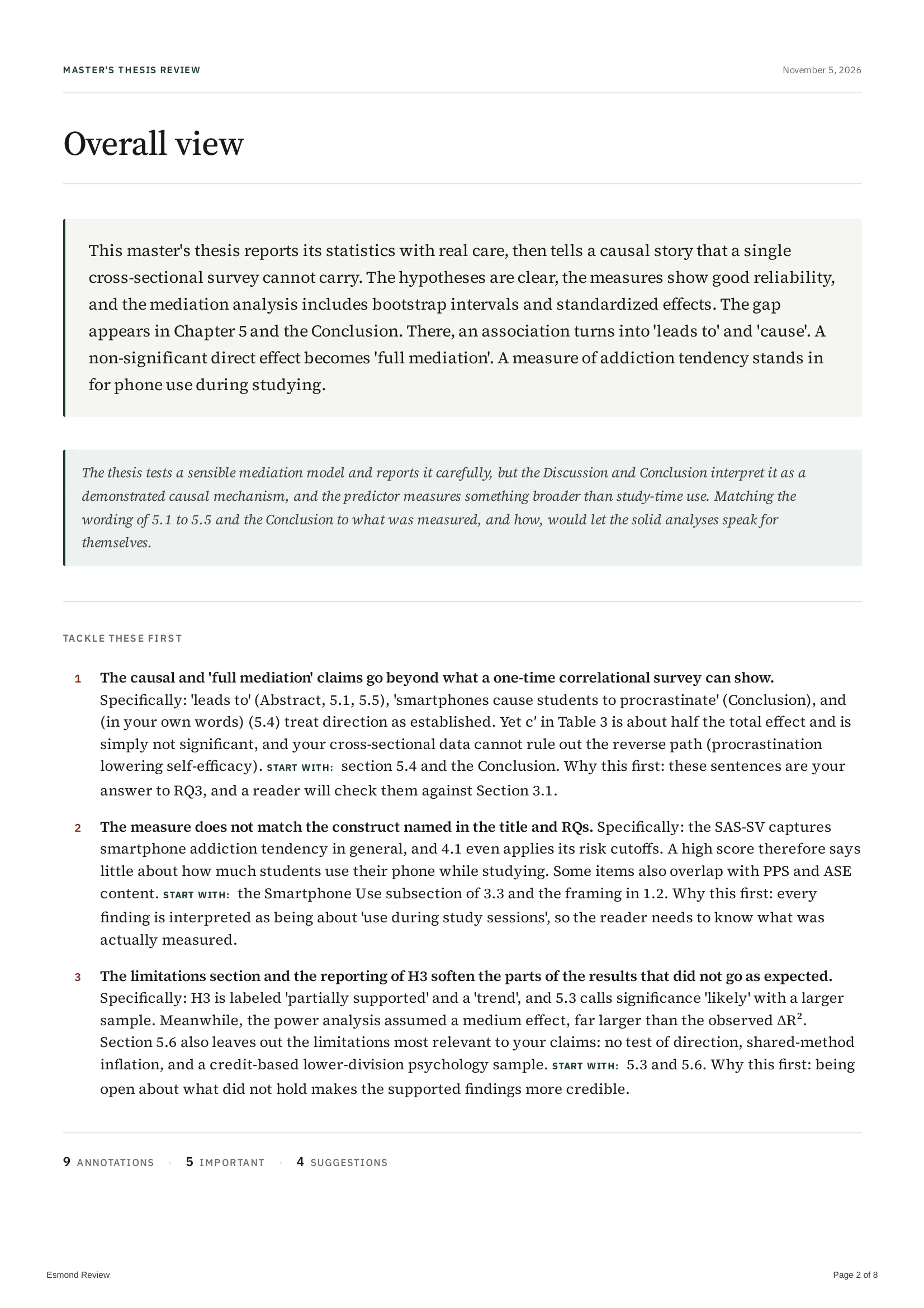
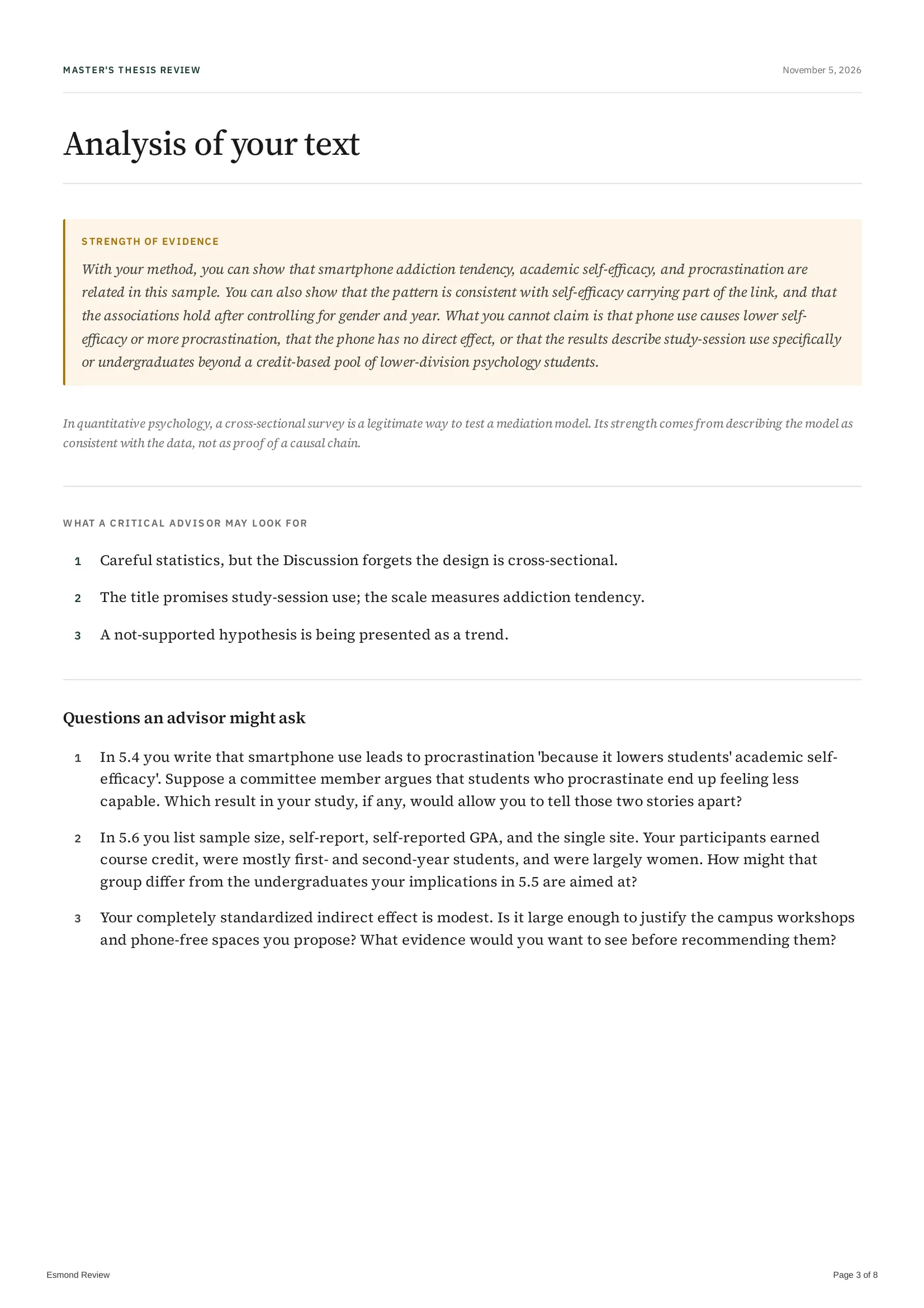
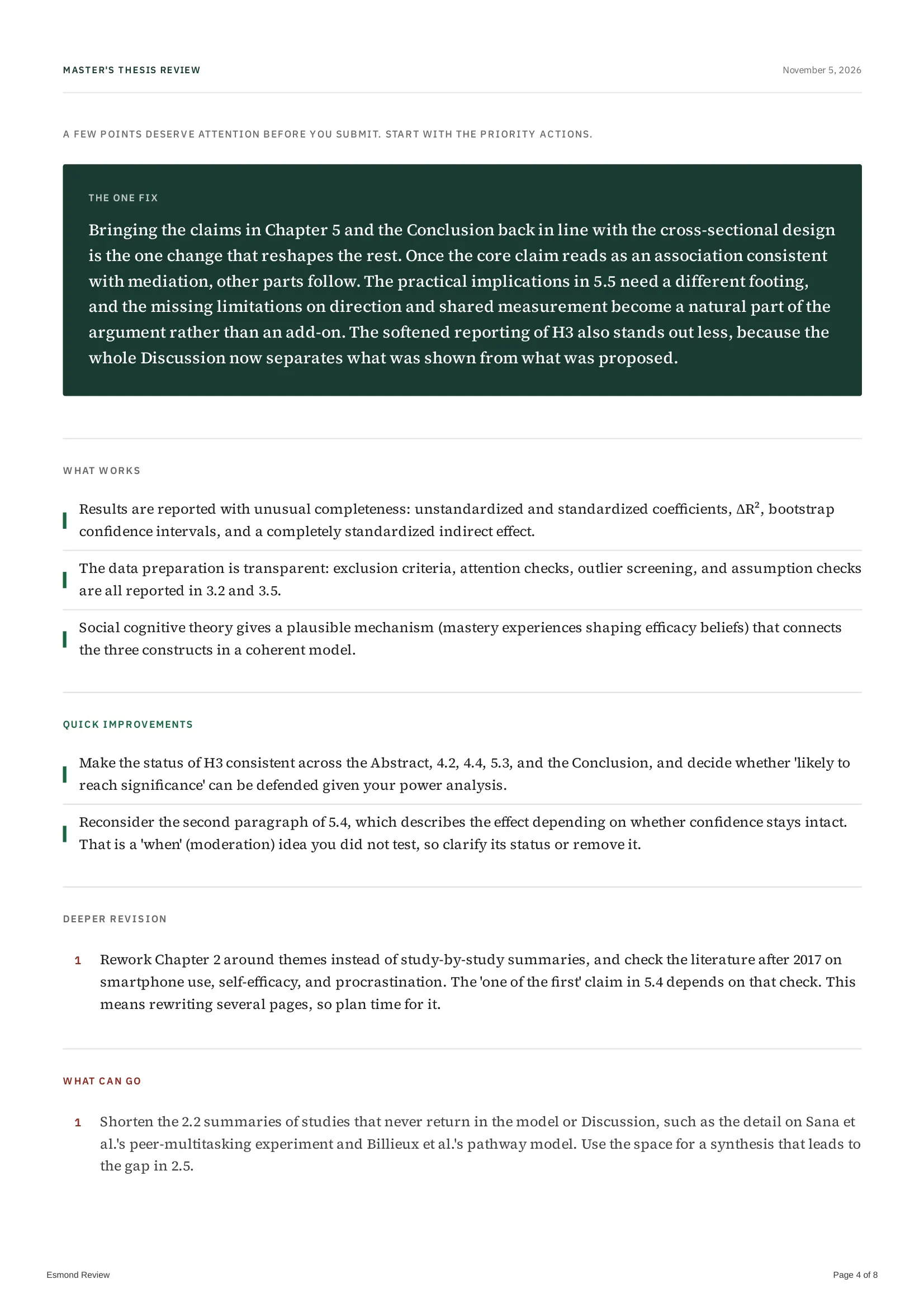
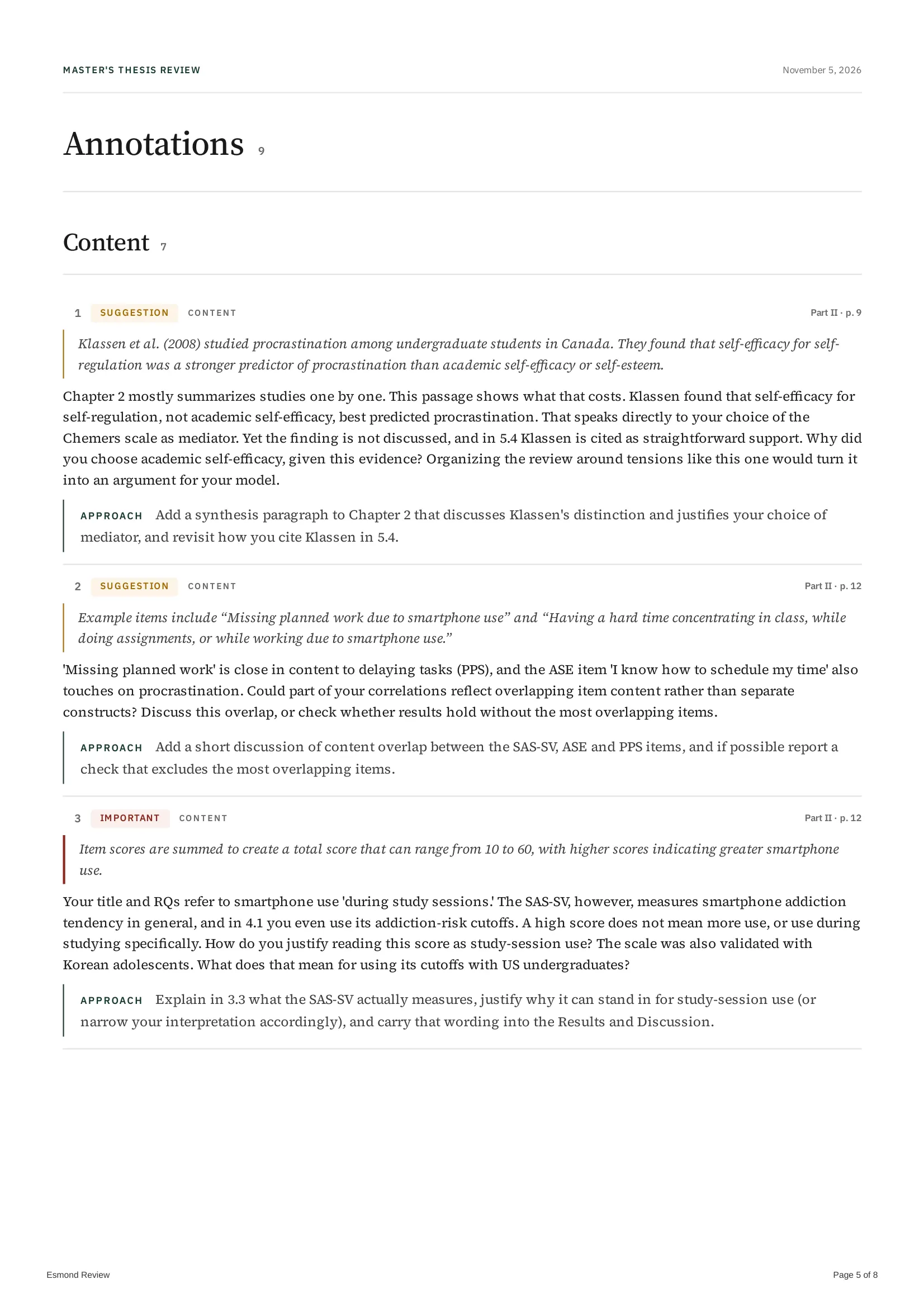
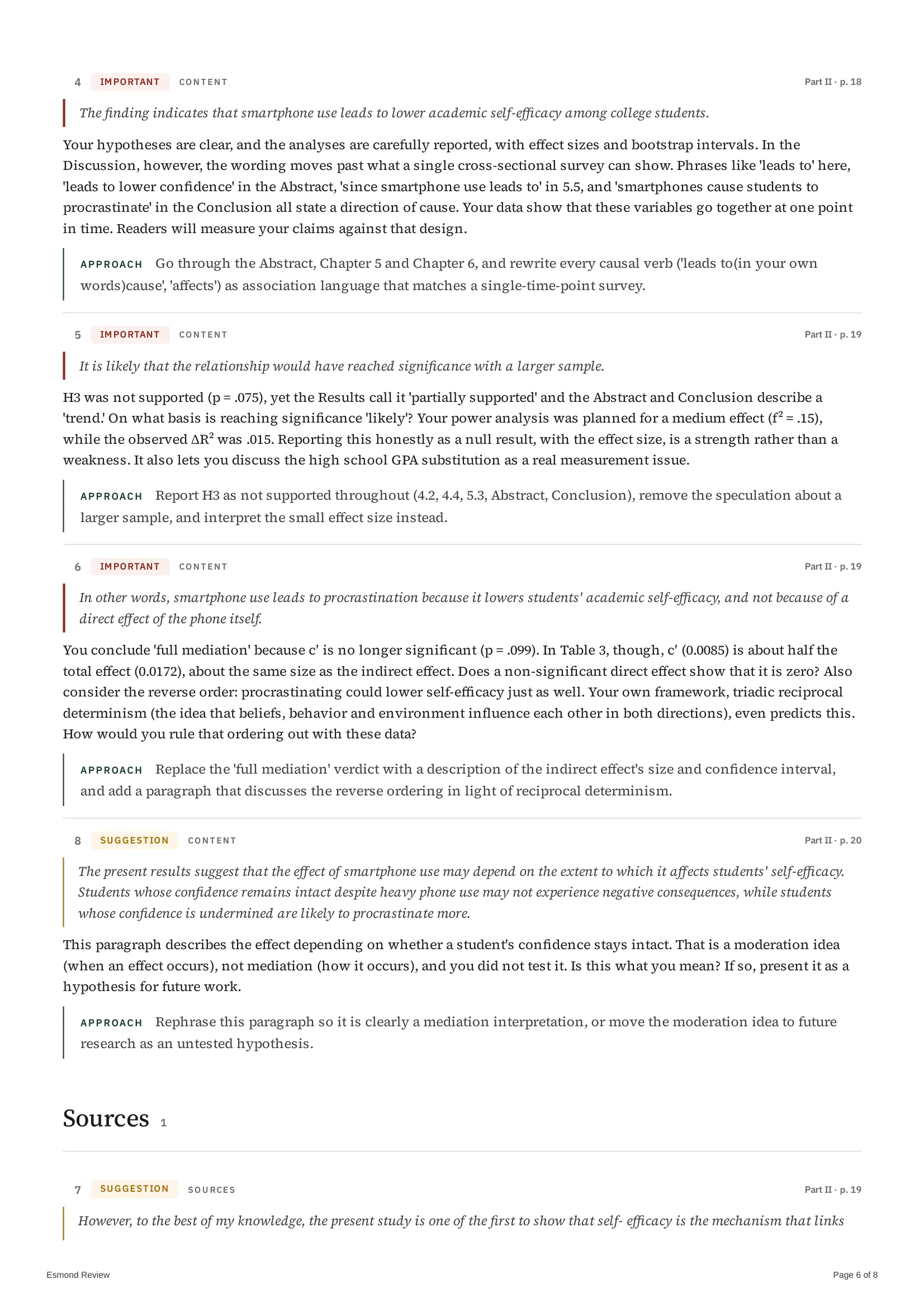
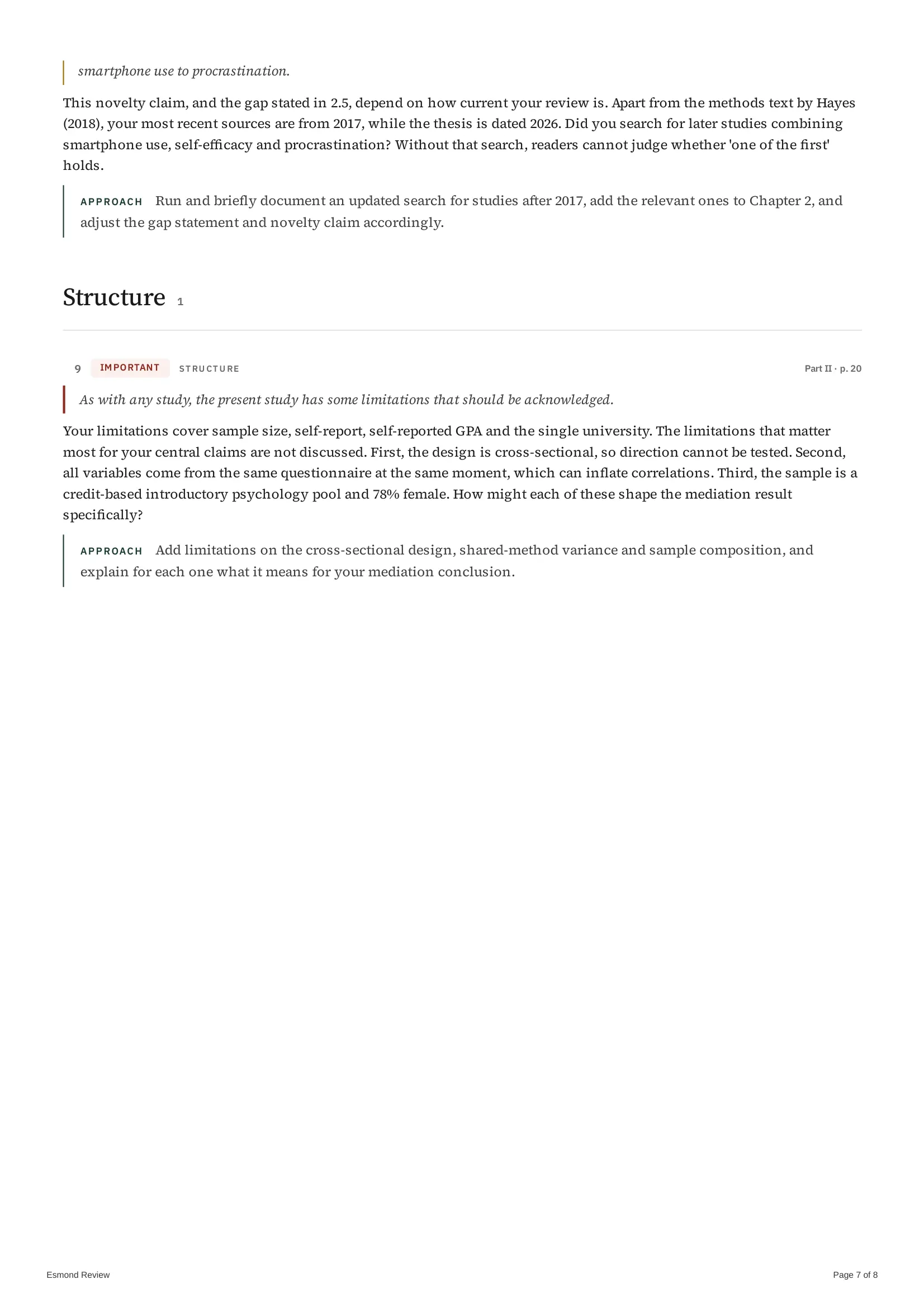
Esmond reads the draft you upload. It can flag, in the text, what a nursing reader may question: a sample size that differs between the method and the tables, a literature-based dissertation that calls itself systematic without the method to match, ethics approval that doesn't cover a group that appears in the results, nursing implications that go further than one ward or a handful of small studies can carry. The sample report shows the format, and how Esmond works describes the steps.
Upload the whole draft if you can: Esmond then reads the chapters against each other, for example whether the conclusion answers the question the introduction asked. A single chapter gets a review of that chapter only.
Before you upload a draft anywhere, anonymize patient and staff details as your ethics approval requires. Esmond doesn't check your ethics approval, rerun your statistics, look up the studies you cite, or compare the draft with your program's template. What to change remains your decision.
Read on November 21, 2026.
Last revised
Get your paper evaluated before you submit