Abstract
A public health dissertation is judged on whether its design supports its verbs: cross-sectional surveys give prevalence and associations, cohorts give incidence and temporal order. With DHS or national survey data, readers check access, sampling weights, and indicator definitions. Assessors also look at the reasons for each adjustment variable, results stratified by equity group, and recommendations proportional to the evidence.
A public health dissertation, at master's level (MPH or MSc) or bachelor's level, rests on survey or registry data or on data the student collects, and its claims have to match the study design. This page explains what each epidemiological design can and cannot claim, what readers expect when you use secondary data such as a DHS round, how confounding and health equity are handled, and how far policy recommendations can go. Guidance from schools of public health in the US, South Africa, and Denmark is quoted.
In short
Public health works at population level. A dissertation in the field asks how often a health problem occurs, in whom, why, and what could reduce it, and it is read for whether the data and design can carry the answer. The University of Southern Denmark's regulations for the master's thesis in public health put the core skill this way: “Regardless of the format chosen, the student must apply critical thinking and demonstrate their ability to formulate, analyze and make a clear presentation of a public health problem.”
The research dissertation is a different product from a practice capstone. The MPH thesis guidelines of the University of Washington School of Public Health separate the two: “A thesis is a research effort conducted explicitly for the purpose of creating new knowledge and contributing to the public health literature.” A capstone, by contrast, is aimed at a practice audience. If your program calls the final project a capstone, see the MPH capstone project page; for a dissertation that is a review of studies, see the public health literature review page.
Programs vary, but the analytic dissertation follows the order of a journal article. In the MPH thesis guidelines of California State University, Long Beach, the last chapter is described as follows: “Chapter 5 is a discussion of findings, strengths, limitations, implications for the field of public health, and directions for future research”.
| Chapter | What public health readers look for in it |
|---|---|
| Introduction | The size of the problem in a named population, with recent figures and their source, and a question that follows from a gap |
| Literature review | What is known about the exposure and outcome, which designs produced that knowledge, and where the evidence is thin |
| Conceptual framework | A model of determinants (for example a social-ecological model or a causal diagram) that decides which variables enter the analysis |
| Methods | Data source, sampling, inclusion criteria, definitions of exposure and outcome, covariates with a reason for each, analysis plan, survey weights, ethics |
| Results | Sample description first, then the main analysis, with tables that move from description to adjusted models |
| Discussion | Findings compared with other studies, alternative explanations, bias, and what the design does and does not allow you to conclude |
| Implications and recommendations | Recommendations that follow from specific findings, addressed to someone who could act on them, at a strength the design supports |
The questions readers ask about a public health dissertation keep coming back to the design. The verb in your conclusion (is associated with, increases, causes, prevents) has to fit it.
| Design | What it can support | Where readers push back |
|---|---|---|
| Cross-sectional survey | Prevalence at one point in time, and associations between variables measured at the same moment | Claims that one variable caused another, since the survey doesn't show which came first |
| Repeated cross-sections (survey rounds) | Trends in prevalence in the population across years | Statements about change within individuals, since different people were sampled each round |
| Cohort | Incidence, risk ratios, and the order of exposure and outcome | Confounding that remains after adjustment, and loss to follow-up that differs between groups |
| Case-control | Odds ratios for exposures, efficient for rare outcomes | Prevalence or incidence figures, which the design can't give; recall and selection bias |
| Ecological (areas or countries as units) | Associations between group-level rates | Conclusions about individuals, which is the ecological fallacy |
| Trial or quasi-experiment | Effects of an intervention, under the assumptions of the design | Small samples, contamination between groups, and outcomes measured too soon |
An MPH dissertation can analyze data someone else collected. That saves months, and it moves the work to choosing the right dataset and understanding how it was built. The CSULB guidelines state: “Regardless of the type of secondary data chosen, the student must be able to answer the research question using the data available.” They also ask every student doing a secondary analysis to check with the IRB office whether formal approval is needed before the analysis starts.
With Demographic and Health Surveys and similar national surveys, readers check four things. First, access: the DHS Program releases datasets after users register and describe their project, so say which datasets you were granted. Second, the survey design: these surveys use sampling weights, clusters, and strata, and an analysis that ignores them gives the wrong prevalence and standard errors that are too small. Third, definitions: an indicator such as stunting or skilled birth attendance must be built the way the survey's own reports build it, or you should explain the difference. Fourth, comparability: questions and sampling frames change between rounds and between countries.
When you collect primary data instead, ethics and permissions come earlier and take longer. The handbook of the School of Public Health at the University of the Western Cape tells MPH students: “You will also need to submit your proposal to various Ethics Committee’s including UWC and country or provincial ethics committees as well as having to seek permission to different authorities where necessary.”
Confounding is where a quantitative public health dissertation is tested hardest. A reader wants to know which variables you adjusted for and why. A causal diagram drawn before the analysis makes the choice visible: it shows common causes of exposure and outcome, which belong in the model, and variables on the path between them, which don't, because adjusting for a mediator removes part of the effect you set out to estimate. After adjustment, say which confounders you could not measure and in which direction they would likely move your estimate.
Health equity is a question about distribution. Reporting a national average hides the groups that public health cares most about, so readers look for results stratified by wealth quintile, education, sex, place of residence, or region, with absolute and relative gaps where it matters. The UW guidelines describe the results section this way: “Provides a clear, systematic presentation of results, linked back to the research questions and conceptual model.” For equity, that means the groups named in the research question appear in the results tables, from description to adjusted models.
Recommendations are read last and remembered longest. Each one should point back to a specific finding, name who could act (a ministry, a district health team, a hospital), and match the design: an association in a cross-sectional survey supports a call to test an intervention, and a trial result supports a call to scale one up. Assessors check, in particular:
These fragments are made up. None of them comes from a real dissertation.
Your supervisor or thesis chair is the first reader on design and analysis questions, and a committee member with statistical expertise is the person to ask about survey weights or model choice. Some schools of public health offer statistical consulting or data clinics for students. The library can help with the search for the literature review, and writing support at your university reads for structure. Classmates who use the same survey can compare variable definitions with you, which catches errors early.
Asking for comments on your own draft keeps the dissertation yours; work that someone else produces for you is not your own work, and universities treat it as such. Check what your program allows for outside feedback and AI tools before you share a draft. The pages who can review my thesis and is AI feedback on a thesis cheating go into those questions.
For the methods chapter in general, see what goes in a methodology chapter; for keeping results and interpretation apart, see results vs discussion.
For an analytic dissertation: introduction, literature review, conceptual framework, methods, results, discussion, and implications with recommendations. A review-based dissertation replaces the methods and results with a search, appraisal, and synthesis. Your program's guidelines set the exact order and length.
Often, yes, if your program accepts secondary analysis and the data can answer your question. You will need access to the dataset, an analysis that uses the survey's weights and design, and a check with your ethics office on whether approval is required. CSULB's MPH guidelines ask students doing a secondary analysis to check this with the IRB office.
Your school's repository and library hold dissertations that met your program's rules. Read them for how the design is described, which covariates are chosen and why, how results are stratified, and how cautious the recommendations are. They show the standard; they are not text to reuse.
In the University of Washington's MPH guidelines, a thesis is research meant to create new knowledge for the public health literature, while a capstone shows professional-quality work for a practice audience. Programs define the two differently, so check yours.
Yes: from your supervisor or chair first, then from statistical consulting, the library, and peers where your school offers them. Outside feedback depends on what your institution allows. Esmond reads a draft you upload and comments on its argument, method, and sources.
Esmond evaluates every assignment before you submit. It never writes it.
Esmond is an AI tool that doesn't write for you. If your course doesn't allow any AI tools, don't use Esmond for that work. If you're unsure, ask your instructor or advisor.
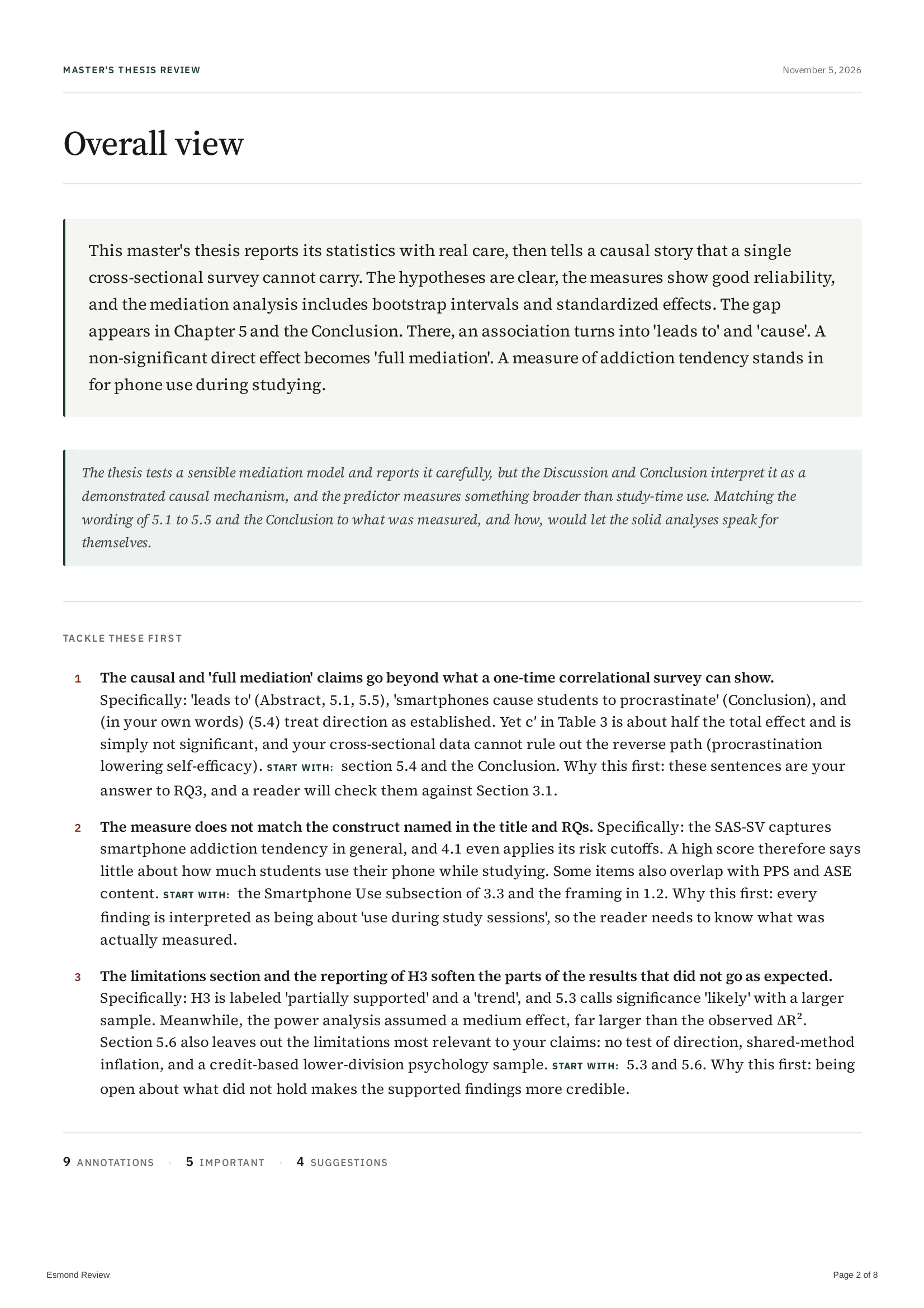
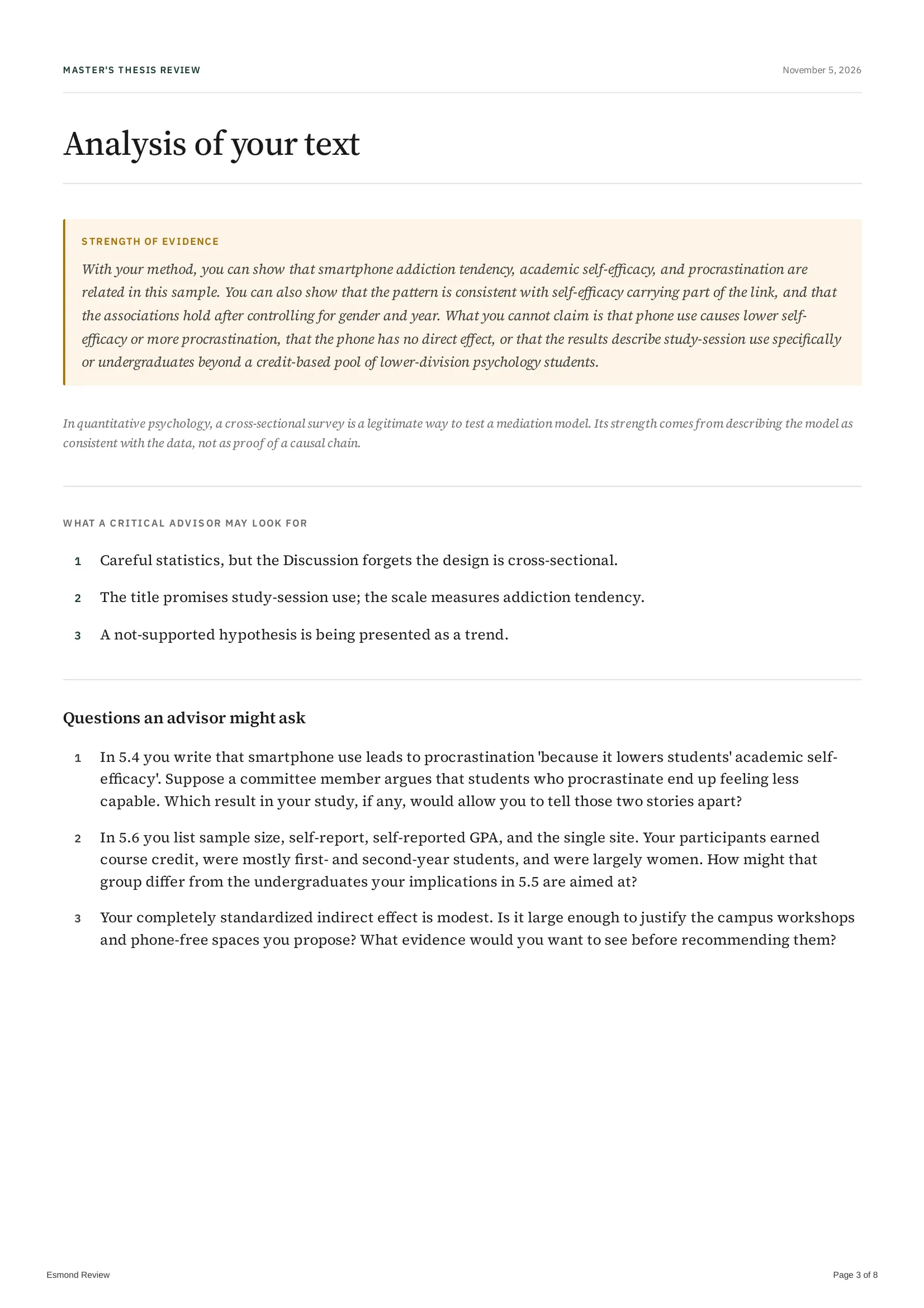
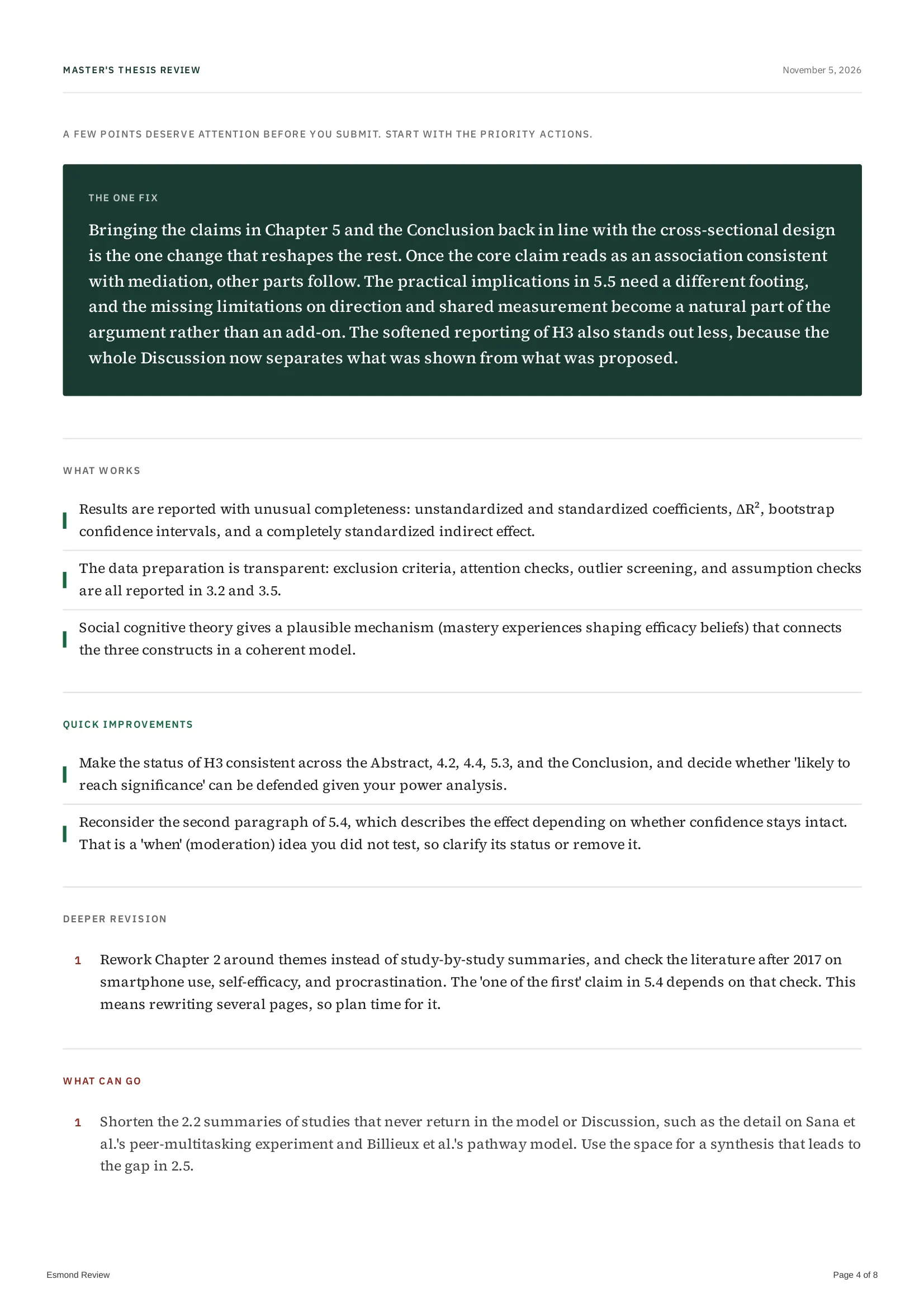
Esmond reads the draft you upload. It can flag, in the text, what a public health reader may question: causal language that a cross-sectional or ecological design can't support, sample sizes that change between chapters without explanation, a covariate list with no stated reasons, equity questions in the introduction that the results never answer, and recommendations that reach further than the findings. The sample report shows what a review looks like, and how Esmond works explains the process.
Upload the whole draft if you can: Esmond then reads the chapters against each other, for example whether the conclusion answers the question the introduction asked. A single chapter gets a review of that chapter only.
Before you upload a draft anywhere, anonymize participant details as your ethics approval requires. Esmond doesn't rerun your models, open your dataset, check your survey weights in the code, or verify your ethics clearance. You decide what to change.
Read on November 21, 2026.
Last revised

Get your paper evaluated before you submit