Abstract
A history dissertation is read for an argument built on primary sources and placed in an existing historiographical debate. This page sets out the usual chapters, chronological and thematic order, source criticism and archives, Chicago footnotes, anachronism, and an assessor checklist, with guidance quoted from history departments at Brown, Pittsburgh, Oslo, Agder, Victoria, and Lethbridge.
A history dissertation at bachelor's or master's level is read for its argument from primary sources and for the debate among historians it enters. This page sets out the usual chapters, how primary sources and archives are handled, where the historiography belongs, and why a history dissertation is judged on its argument. Guidance from history departments in the United States, Canada, and Norway is quoted throughout.
In short
A history dissertation asks a question about the past that the sources can answer, and answers it with an argument. The reader wants three things: a question narrow enough to be settled with the material you had access to, a body of primary sources read with care, and a clear statement of how your answer relates to what historians have already said.
Brown University's history department in the United States puts the core demand in one line: “The thesis must analyze rather than merely narrate or summarize.” The same rubric expects close work with primary sources and names avoiding anachronism as part of historical thinking: the past is to be read on its own terms.
Master's theses in Norway show that the source base can take two forms. At the University of Oslo, the course description for the master's thesis in European history says: “The master’s thesis is an independent research project, based on your own source studies or a historiographical analysis.” The University of Agder describes its history master's thesis in similar terms: “The work can be based on their own studies of sources, be a historiographical analysis or a historical-didactic work.” A historiographical dissertation studies how historians have treated a subject; the works of those historians then become its sources.
Departments differ in the number and names of chapters, and you may use descriptive chapter titles instead of generic ones. The functions below recur across the department guides quoted here. For the general forms a master's thesis can take, see master's thesis structure.
| Part | What it does | What readers in history look for in it |
|---|---|---|
| Introduction | States the question, the period and place, and the argument | An answer that could be contested, stated in the first pages, and a reason why the question matters |
| Historiography | Sets out what historians have argued, in the introduction or a separate chapter | Positions grouped by argument, an evaluation of each, and the gap or disagreement your dissertation addresses |
| Sources and approach | Names the archives, collections, and printed sources, and how they were selected and read | What survives and what does not, language and translation, and the limits of the record |
| Body chapters | Build the argument step by step, in chronological or thematic order | A claim at the start of each chapter, evidence from primary sources, and counterevidence dealt with openly |
| Conclusion | Answers the question and returns to the debate | What your findings change in the historiography, and what the sources could not settle |
| Bibliography | Lists everything cited | Primary and secondary sources listed separately, archival references complete |
A chronological structure suits a question about change over time: how a policy shifted, how an institution grew or declined. Its risk is that chapters turn into periods, and periods into retelling. A thematic structure suits a question with several dimensions, such as the economic, religious, and political reasons for a conflict. Its risk is that the reader loses track of when things happened and of what came first.
Many history dissertations combine the two: a broadly chronological spine with chapters organized around a problem. Whatever you choose, readers check that the order follows from the question. A useful test is to read only the first paragraph of each chapter. If those paragraphs, in sequence, state the steps of your argument, the structure works. If they announce dates and events, the chapters are narrating.
Whether a document counts as primary depends on your question. The University of Victoria's history style guide in Canada notes: “Keep in mind that the nature of a primary source depends on the project.” A study of how historians treated a strike in the 1970s uses their books as primary sources; a study of the strike itself uses them as secondary literature.
Source criticism asks who produced a document, when, for which audience, and with what interest or knowledge. The same guide compares sources to witnesses: “Like witnesses at a trial, primary sources can be truthful or duplicitous, accurate or mistaken on various points.” A police report on a demonstration tells you what the police recorded and wanted their superiors to read. It is weaker evidence for what the demonstrators intended. Readers look for that distinction in your text, especially where a single source carries a claim about motive.
Archival work is common but not required everywhere. The University of Pittsburgh's history department in the United States says of its honors theses: “Honors theses do not require travel to archives, but if students study abroad or if they have access to domestic archives, they may want to include sources from these locations.” Digitized collections and printed source editions are legitimate sources. What a reader needs is a clear account of which collection you used, how you searched it, and what it leaves out.
History footnotes carry more than a reference. The University of Lethbridge's history department in Canada explains the choice of style: “Historians use Chicago-style citations because they provide more information than other referencing styles” A reader follows a note to see which document supports the sentence. Two habits draw questions: citing a document you only saw quoted in a book without saying so (Chicago asks for a "quoted in" note), and long block quotations left without comment. Brown's rubric is direct about the second: “Paragraphs should not end with a block quote since the block quote must be analyzed.”
The historiography shows the reader which conversation your dissertation joins. Brown's rubric asks that it stay visible: “A discussion of secondary literature should be prominent in the introduction and references to the historiographic framework should continue throughout the thesis.” Pittsburgh's guidelines say the same about the thesis itself: “It should posit a clear and original thesis that is firmly situated in, and extends, the existing historiography.”
A historiography section that lists books one by one, each with a summary, tells the reader what you read. A section grouped by position (who argues what, on which evidence, and where they disagree) shows where your contribution fits. The same applies to the body chapters: when your evidence confirms, qualifies, or contradicts a named historian, say so at that point. For how to state the gap your work addresses, see research gap in a thesis.
Anachronism is the other check readers make here. Terms such as nation, class, or race had different meanings in earlier periods, and some categories did not exist yet. Using a modern concept is fine if you say so and explain why it helps; applying it silently to people who would not have recognized it is a weak spot readers notice.
The conclusion is where a history draft can lose force: it summarizes the chapters but doesn't say what changes in the debate. See what goes in a thesis conclusion.
These fragments are made up. None of them comes from a real dissertation.
Your supervisor is the first reader. At Oslo, supervisor and student sign a supervision agreement and meet regularly while the thesis is in progress. Bring specific questions: whether a source can carry a claim, whether the chapter order follows the question, whether the historiography is complete for your topic.
Peers are a second source of feedback in some history departments. Agder's master's course, for example, requires students to present drafts of their own thesis in seminars and to give prepared comments on fellow students' drafts. Archivists and subject librarians can tell you which collections exist and how they were put together, which matters for source criticism. Your university may also run a writing center where staff read drafts for structure and clarity.
Feedback on your own draft is one thing; having someone else produce chapters or analysis for you is another, and that work is not your own. Rules on outside feedback and AI tools differ between universities and departments, so check your own department's rules and ask your supervisor if they are unclear. For the arguments on both sides, see is AI feedback on a thesis cheating, and for citing an AI tool in Chicago style, see how to cite ChatGPT in Chicago.
For a broader list that applies to any thesis, see the thesis checklist before you submit. The citation checker compares your bibliography with the sources cited in your text.
A common outline has an introduction with the question and the argument, a historiography (in the introduction or a chapter of its own), an account of sources and approach, body chapters in chronological or thematic order, a conclusion that returns to the debate, and a bibliography that lists primary and secondary sources separately. Your department's guidelines decide the details.
Your own department or university library is the best place: ask whether they keep a repository of past bachelor's and master's theses. When you read one, look at how the introduction states its argument, how the historiography is grouped, how sources are criticized in the text, and how the notes are built. Use examples to see how an argument is built; the outline, the argument and the reading of the sources have to be yours.
Not always. Pittsburgh's history department says its honors theses do not require travel to archives, and both Oslo and Agder accept a master's thesis based on a historiographical analysis. Digitized collections and printed editions of sources count as primary sources. What a reader expects is a clear account of where your sources come from and what they can show.
Some history departments ask for Chicago-style footnotes or endnotes with a bibliography. Lethbridge's history department asks for them in all essays unless the instructor says otherwise, and Oslo's master's thesis in European history uses the Chicago footnote style. Check your own department's guide.
Start with your supervisor, and use seminars, the library, and the writing center where your university offers them. Outside feedback, including AI tools, depends on your department's rules, so check them first. Esmond reads a draft you upload and comments on argument, sources, and structure, without changing your text.
Esmond evaluates every assignment before you submit. It never writes it.
Esmond is an AI tool that doesn't write for you. If your course doesn't allow any AI tools, don't use Esmond for that work. If you're unsure, ask your instructor or advisor.
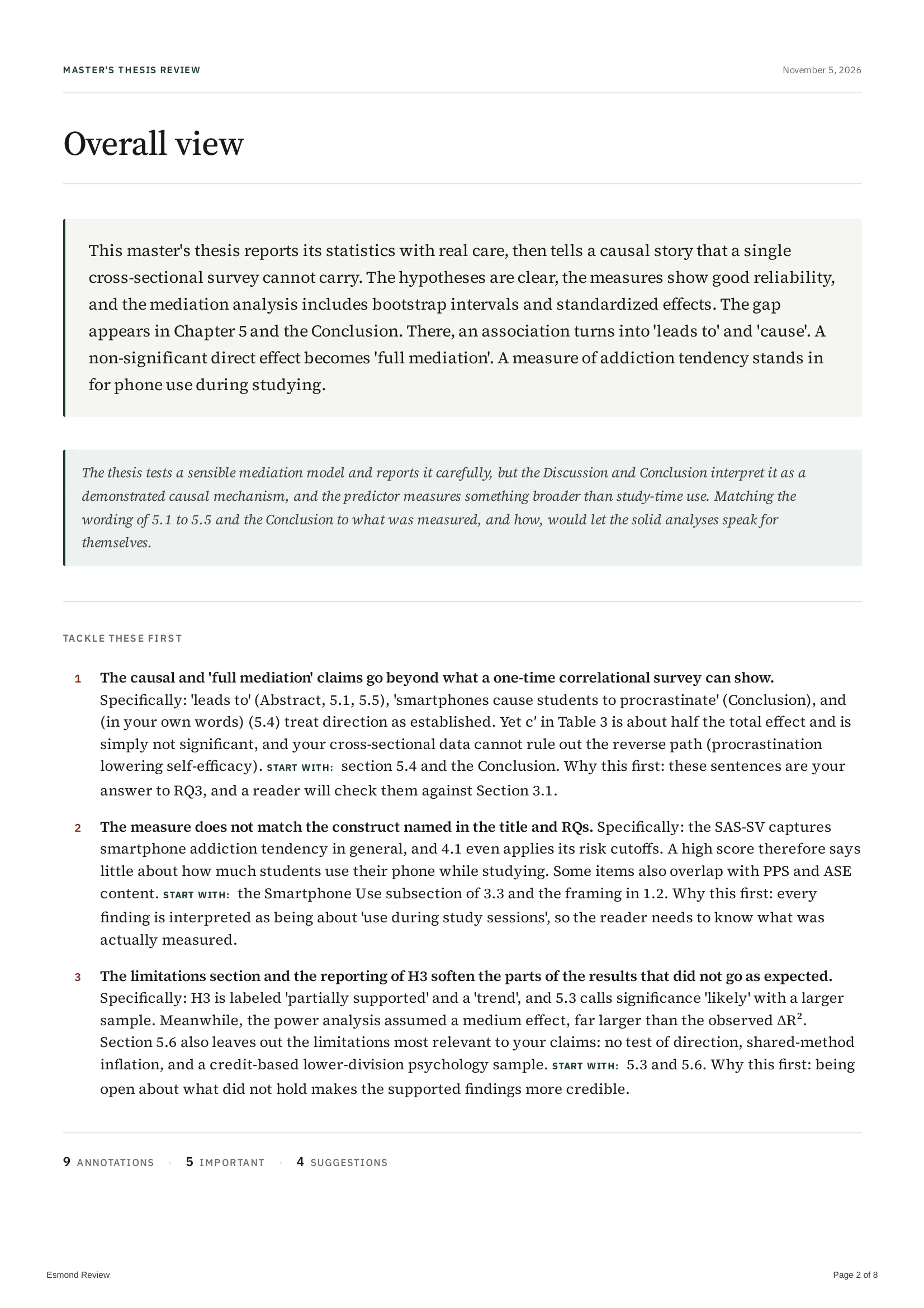
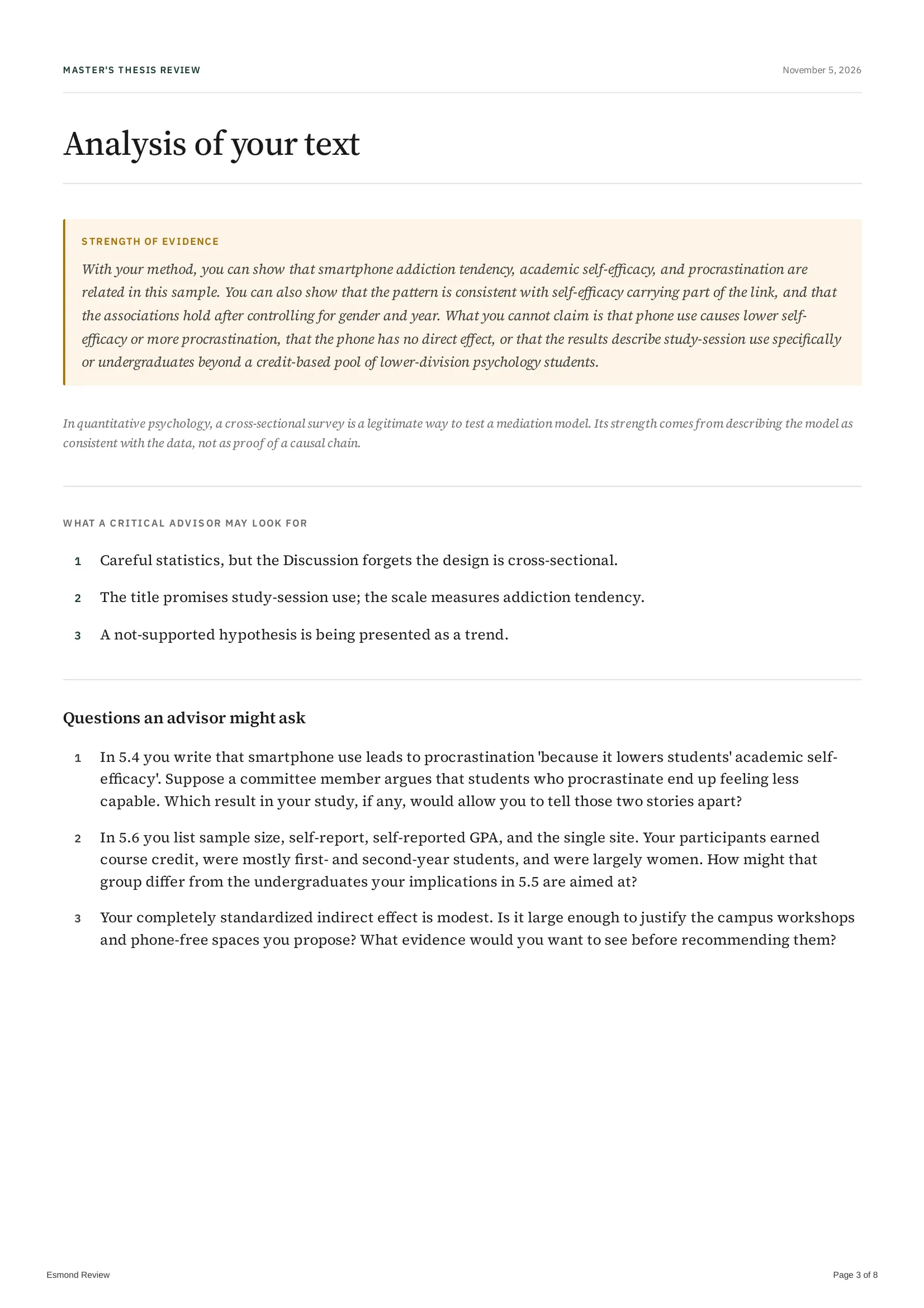
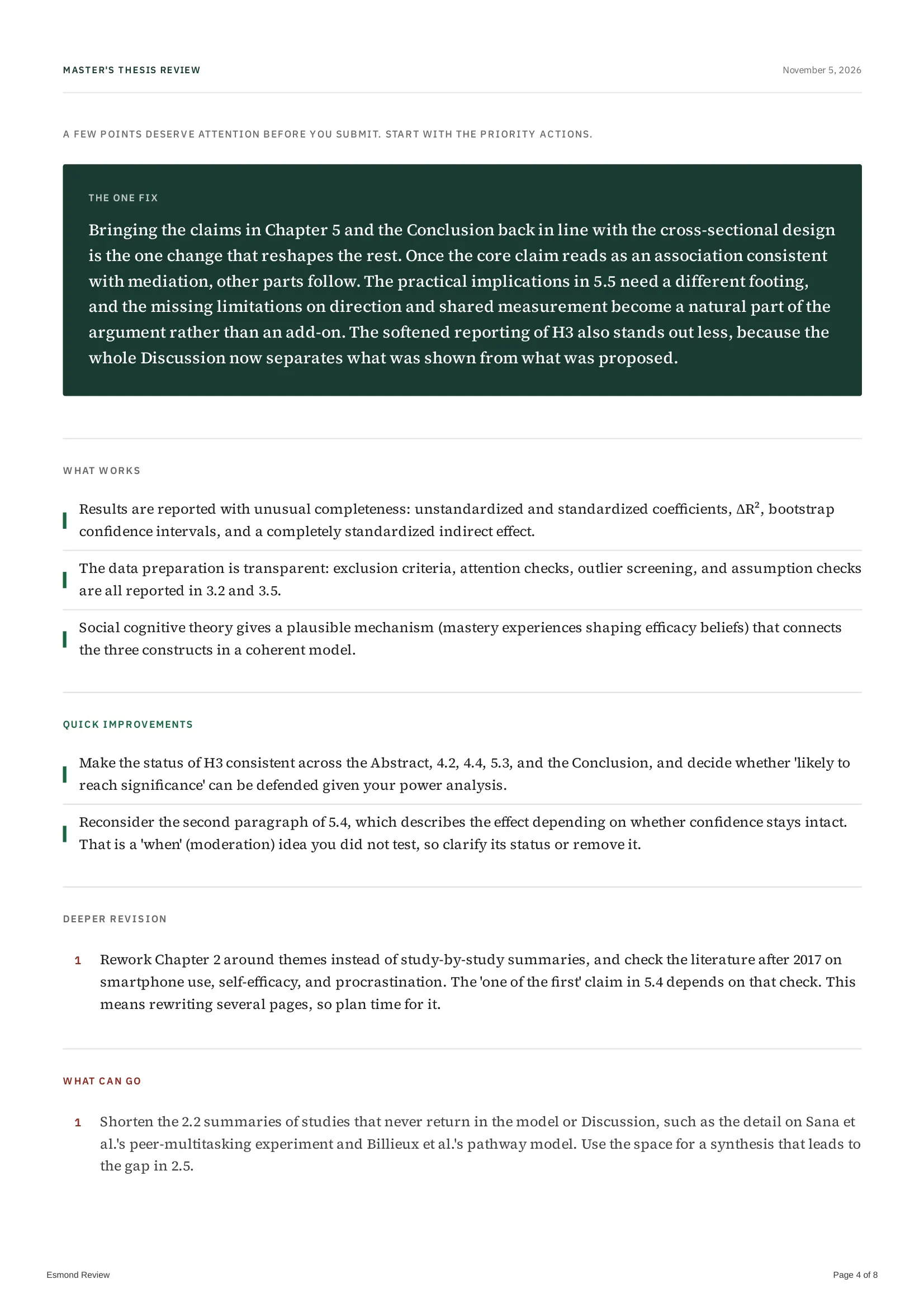
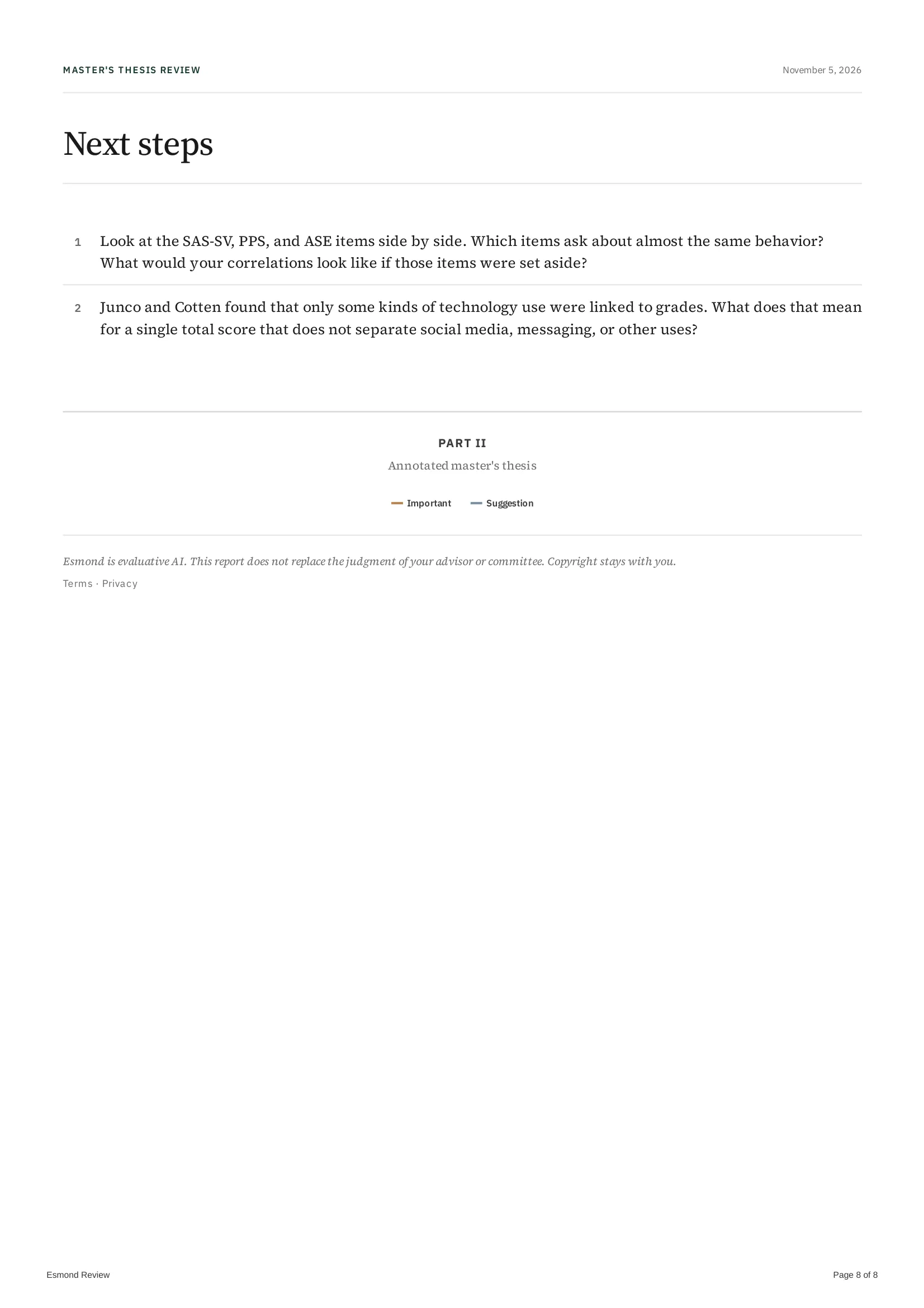
Esmond can flag, in the text you upload, the points a reader in history may question: chapters that retell events without a claim, a motive or cause resting on one document, a historiography named in the introduction and absent afterward, a modern category applied to the past without comment, and a conclusion that answers a different question from the one the introduction asked. The sample report shows the format, and how Esmond works describes the process.
Upload the whole draft if you can: Esmond then reads the chapters against each other, for example whether the conclusion answers the question the introduction asked. A single chapter gets a review of that chapter only.
Esmond doesn't visit archives, open the documents in your notes, or check your footnotes against Chicago rules. What you change in your draft stays your decision.
Read on November 21, 2026.
Last revised
Get your paper evaluated before you submit