Abstract
An English literature dissertation is read for one arguable claim supported by close reading of specific passages, with criticism engaged and theory used in the readings. This page covers structure (chapter per text or per theme), quotation and citation practice, primary text versus criticism, an assessor checklist, and guidance quoted from Warsaw, Göttingen, Trinity College, Victoria, and Millersville.
An English literature dissertation at bachelor's or master's level is read for an argument built through close reading of primary texts, with criticism and theory in support. This page covers the usual structure, how an argument is built from close reading, how primary texts, criticism, and theory relate, and the quotation habits readers notice. Guidance from English departments in Poland, Germany, Canada, and the United States is quoted.
In short
A literature dissertation makes a claim about texts that a careful reader could dispute, and then shows, passage by passage, why the claim holds. The evidence is the language of the texts themselves: diction, imagery, syntax, narrative voice, form, and structure. Criticism and theory frame that evidence; they don't replace it.
The University of Warsaw's Institute of English Studies in Poland sets the bar for its master's theses in literature and culture: “A master’s thesis should demonstrate a critical application of specialist knowledge and make an independent contribution to existing scholarship in the area of literary/cultural studies.” One of the two goals its guidelines recommend is a set of close readings of specific texts, grounded in a theoretical perspective or a focus on form, that answers a research question set in the introduction. Trinity College's English department in the United States names the qualities it reads for: “we expect successful theses to excel in four categories”, namely argument, close reading, engagement with existing scholarship, and the quality of the prose.
Literature dissertations vary more in shape than empirical ones. The parts below are the functions the guides quoted here ask for; some of them can share a chapter. Warsaw's guidelines for bachelor's theses ask the abstract to name the texts; in the section on the abstract they state: “For theses analyzing specific literary/cultural texts, the primary texts to be examined in subsequent chapters must be listed.”
| Part | What it contains | What readers in literary studies look for in it |
|---|---|---|
| Introduction | The texts, the question, the thesis statement, the approach, and an outline | A claim specific enough to be wrong, and a reason the texts are read together |
| Critical context | What critics have argued about the texts or the topic, in a chapter or within the introduction | Positions set against each other, and a clear place for your own reading |
| Theoretical framework (if used) | The concepts the readings will apply, with their sources | Only the theory the analysis will use, defined precisely enough to test against the texts |
| Analysis chapters | Close readings organized per text or per theme | Each chapter advancing the thesis, with quoted passages interpreted, not retold |
| Conclusion | What the readings add up to | An answer to the question, what it changes in the critical debate, and its limits |
| Works cited | Primary texts and secondary sources in one recognized style | The editions used, cited consistently |
A chapter per text is easy to plan and suits a dissertation on a sequence of works, for example how a single author's novels change. Its risk is that the chapters stand side by side as separate essays, and the comparison only arrives in the conclusion. A chapter per theme (silence, inheritance, the city) brings the texts into contact on every page, but it asks more control: readers check that each text gets enough sustained reading to support the claims made about it.
Whichever order you choose, the introduction has to say why. The Warsaw guidelines also make the critical review movable: “A thesis in literary/cultural studies does not need to contain a separate chapter devoted to the review of existing literature on the topic.” They add a condition: “A thesis must, however, engage existing academic research on the topic in a critical manner.” The master's thesis introduction page covers how to set up the question and the outline.
The University of Victoria's English department in Canada asks honours students to propose, among other things, “a thesis statement; a description of the critical and/or theoretical approach to the topic; and an indication of where the proposed project sits in relation to previous studies of the topic”. That sequence is a fair test of any literature dissertation draft: can you state the claim, the approach, and its place in the debate in three sentences?
Close reading moves from a quoted passage to what its language does and back to the claim. A paragraph that retells events gives context. A paragraph that asks why the narrator switches tense at this point, or why a stanza breaks off mid-sentence, produces evidence. Trinity's description of weaker work includes textual evidence used to summarize plot points in place of interpretation; that is the pattern readers look for when they say a chapter is descriptive.
Quotation habits are part of the method. Short quotations sit inside your sentence; longer ones are set off as a block and then read, line by line if needed. Cite one edition of each primary text throughout and say which edition it is, because page and line numbers differ between editions. Departments use different styles: MLA and MHRA are two common ones in literary studies, and Chicago is also used. Warsaw, for example, lets the student choose MLA or Chicago together with the supervisor. Follow the style your department names, consistently. To cite an AI tool in MLA style, see how to cite ChatGPT in MLA.
The UVic guidelines add: “The 499 essay should also demonstrate the student’s awareness of scholarship, criticism, and theoretical approaches relevant to the chosen topic.” Awareness is the floor. Readers look for what you do with a critic: agree and extend, qualify with a passage the critic didn't consider, or disagree with evidence. A critic's reading that you repeat and then treat as a finding still belongs to the critic.
Göttingen's English department in Germany adds a practical warning for its medieval studies theses: “Look out for the pitfall of continually citing just one or two secondary sources over extended parts of the thesis (particularly hard to avoid in theory sections).” The same problem shows in theory chapters that summarize one thinker at length and are not used again. Theory works as a lens when the readings test it: where does the text fit the concept, and where does it resist? If the analysis would read the same without the framework chapter, readers will ask what the framework adds.
A gap between what the introduction promises and what the chapters deliver is common in literature drafts. See logical gaps and inconsistencies in a thesis.
These fragments are made up. None of them comes from a real dissertation.
Your supervisor is the main reader of drafts, and some English departments add a second reader. At UVic, the second reader of an English honours essay receives and comments on a draft before the final version. Use those readings to test the thesis statement and the chapter order, not only the prose.
Revision is where feedback pays off. Millersville University's English department in the United States warns: “When revising their theses, students should avoid the common error of substituting the rearrangement of existing material for the rethinking of the positions expressed in the paper.” Peers in a thesis seminar, a subject librarian for critical sources, and the university's writing center can each help with a different part of that rethinking.
Departments set their own rules for AI tools and outside feedback. Göttingen's medieval English section, for instance, allows AI for brainstorming or finding sources but not as submitted text, and states: “We require that you append our twin declarations of responsible scholarly practice and the use of AI to all written work, whether it be a midterm commentary, a term paper, or a thesis.” Where your department restricts AI or asks for a declaration, ask your supervisor before you use any AI tool on the dissertation, and declare it as required. Feedback on your own draft is different from having someone produce the readings for you; that work is not your own. See can I get AI feedback on my thesis.
Millersville also points students to theses by past honors graduates in the department, which helps with the self-check: you see how a finished argument is laid out. The thesis checklist before you submit covers the general points, and the citation checker compares your works cited list with the citations in your text.
Usually an introduction with the texts, question, and thesis statement; critical context, either as a chapter or within the introduction; a theoretical framework if you use one; analysis chapters organized per text or per theme; a conclusion; and a works cited list. Warsaw's guidelines, for example, say a separate literature review chapter is not required as long as the thesis engages critically with existing research.
The texts and why they belong together, the question, a thesis statement specific enough to be disputed, the critical or theoretical approach, where your reading sits among existing criticism, and a short outline of the chapters.
Ask your department or library: some keep past theses, and Millersville's English department, for instance, points students to theses by earlier honors graduates. When reading one, look at how the thesis statement is phrased, how a close reading paragraph is built, and how critics are answered. Use them to see how an argument is built; your readings have to be your own.
As much as the readings use. Readers check that each concept from the framework returns in the analysis and that the texts are allowed to complicate it. A long summary of a theorist that the chapters never draw on adds length, not argument.
Your supervisor, a second reader where your department has one, and seminar peers are the first places. Check your department's rules on AI tools and outside feedback, and ask your supervisor if a declaration is needed. Esmond reads a draft you upload and comments on argument, structure, and use of sources, without adding text.
Esmond evaluates every assignment before you submit. It never writes it.
Esmond is an AI tool that doesn't write for you. If your course doesn't allow any AI tools, don't use Esmond for that work. If you're unsure, ask your instructor or advisor.
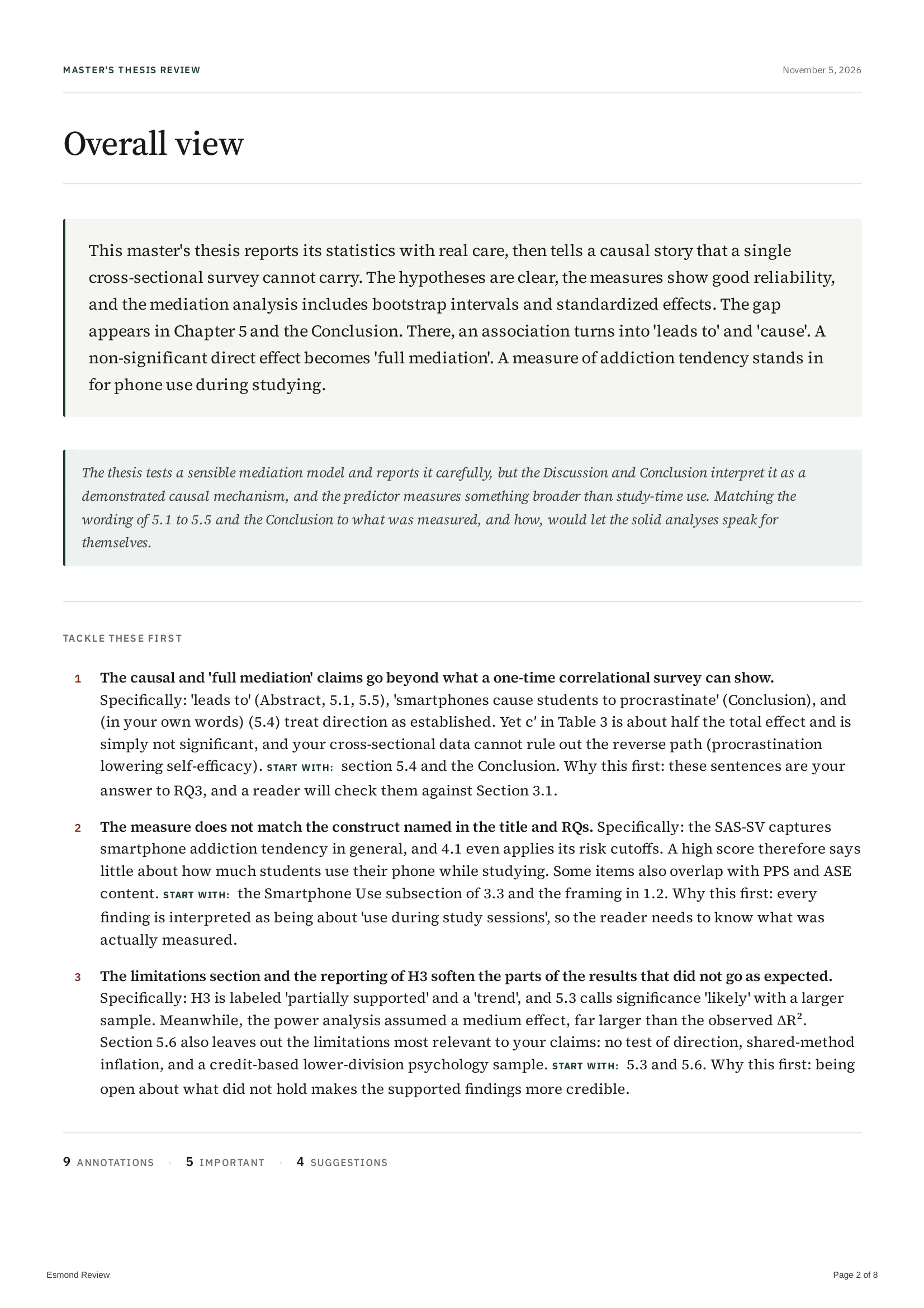
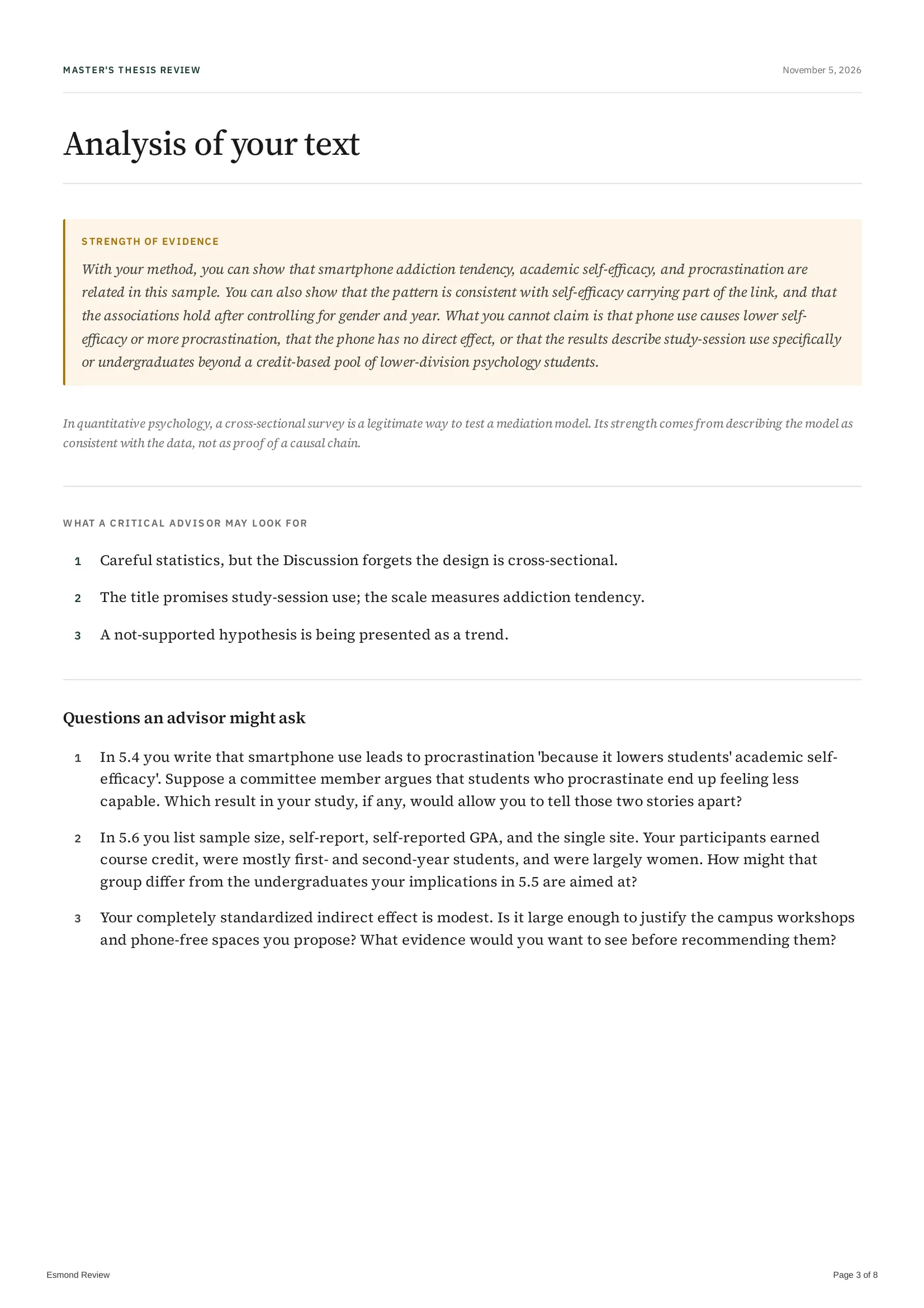
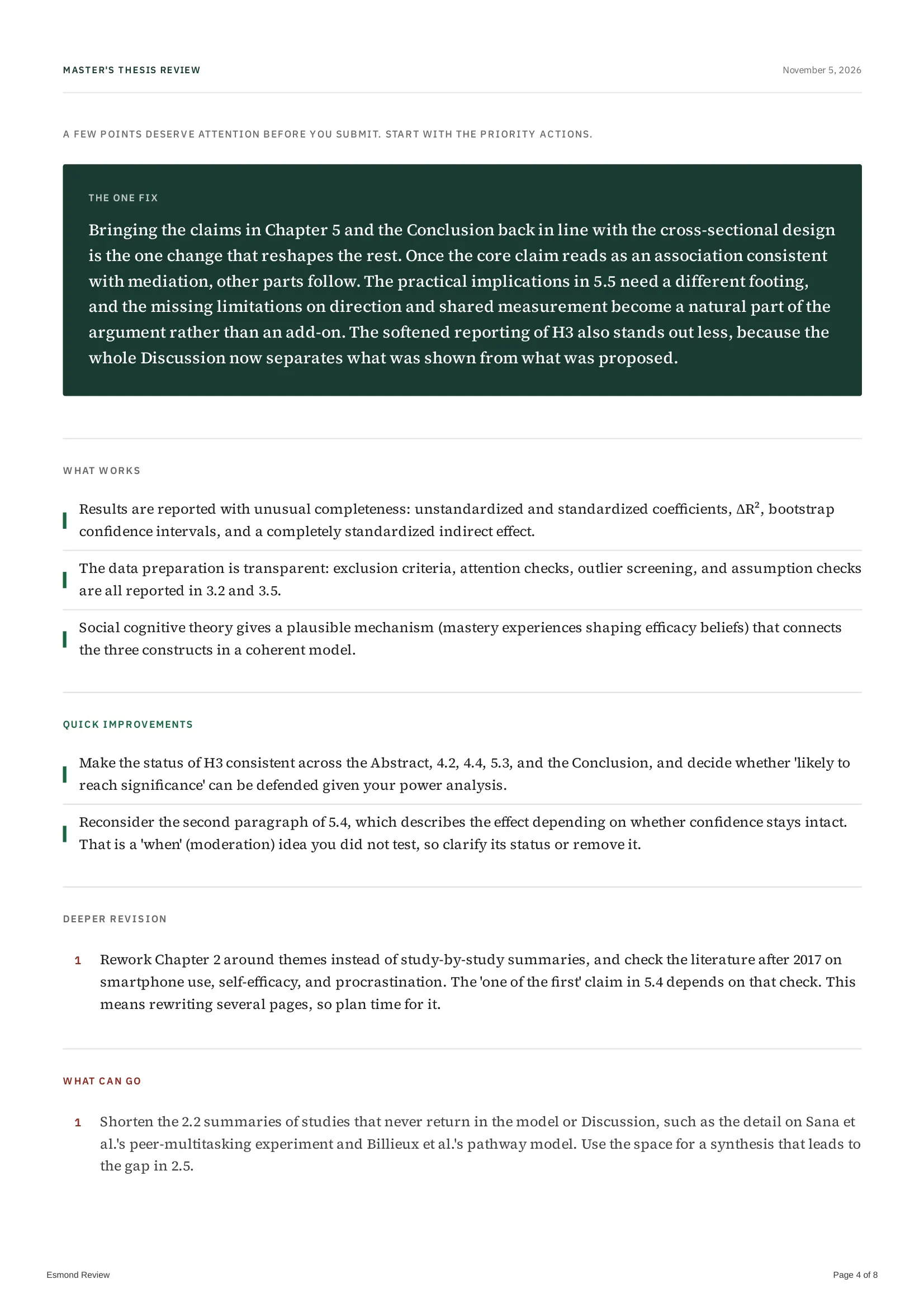
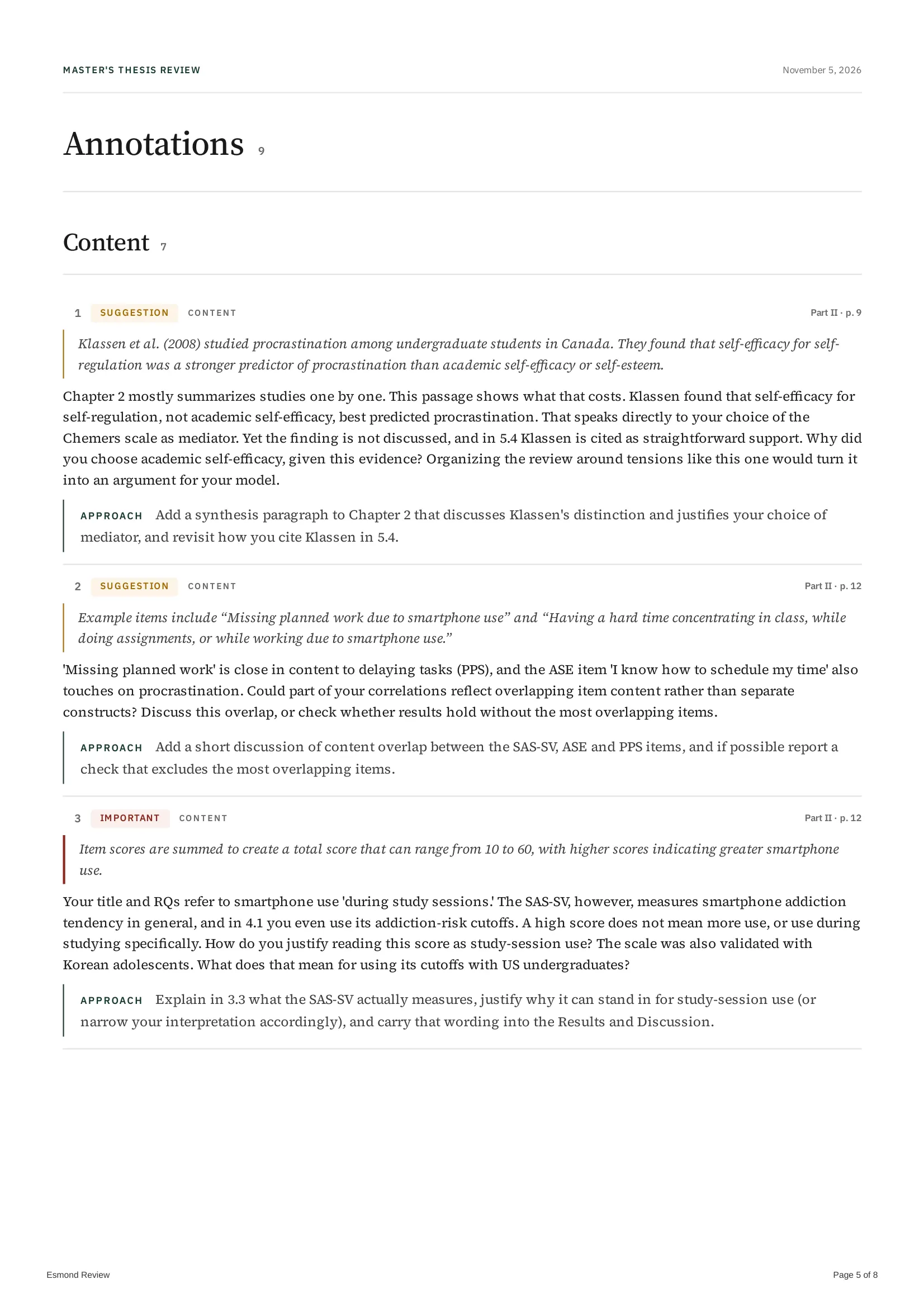
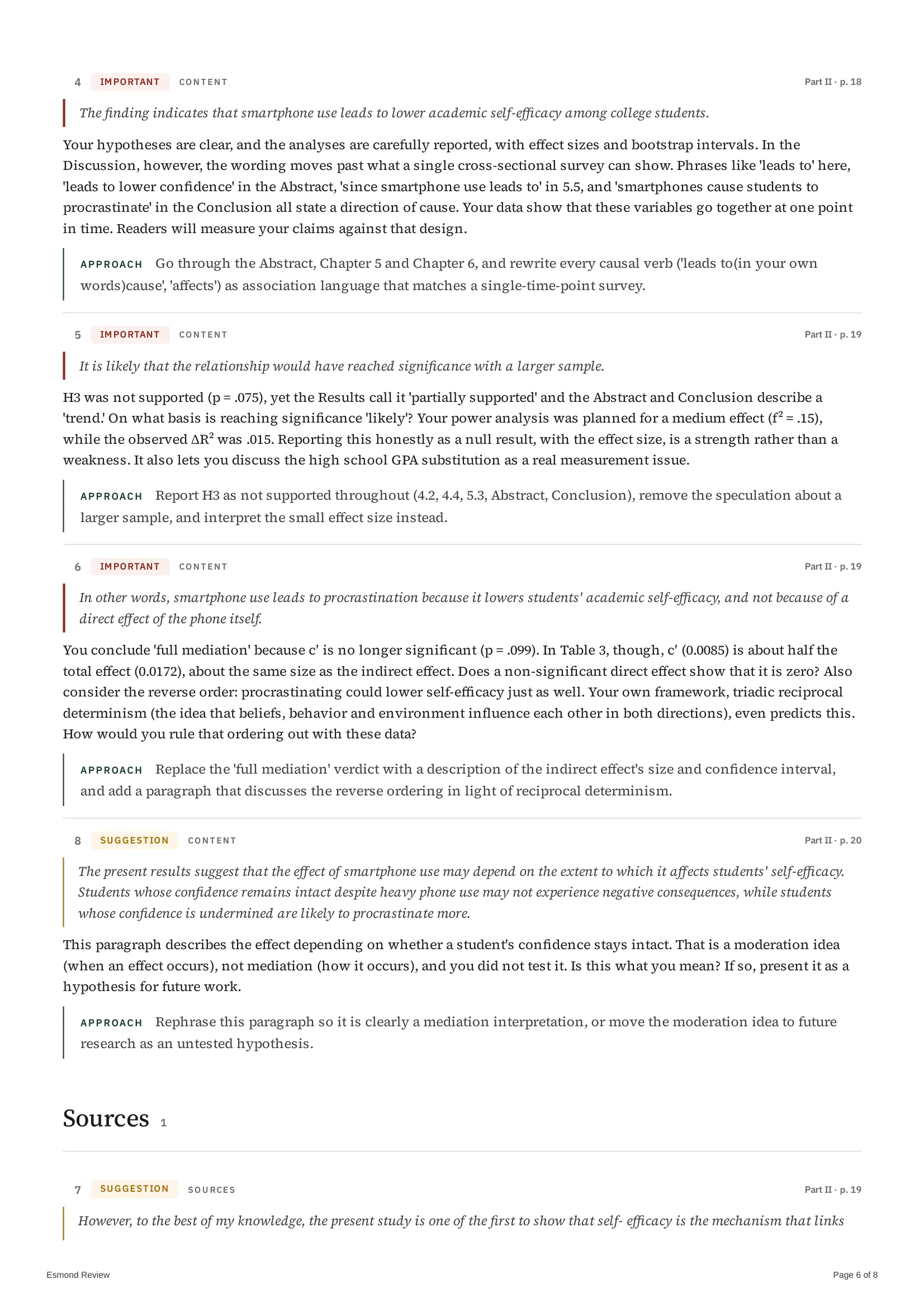
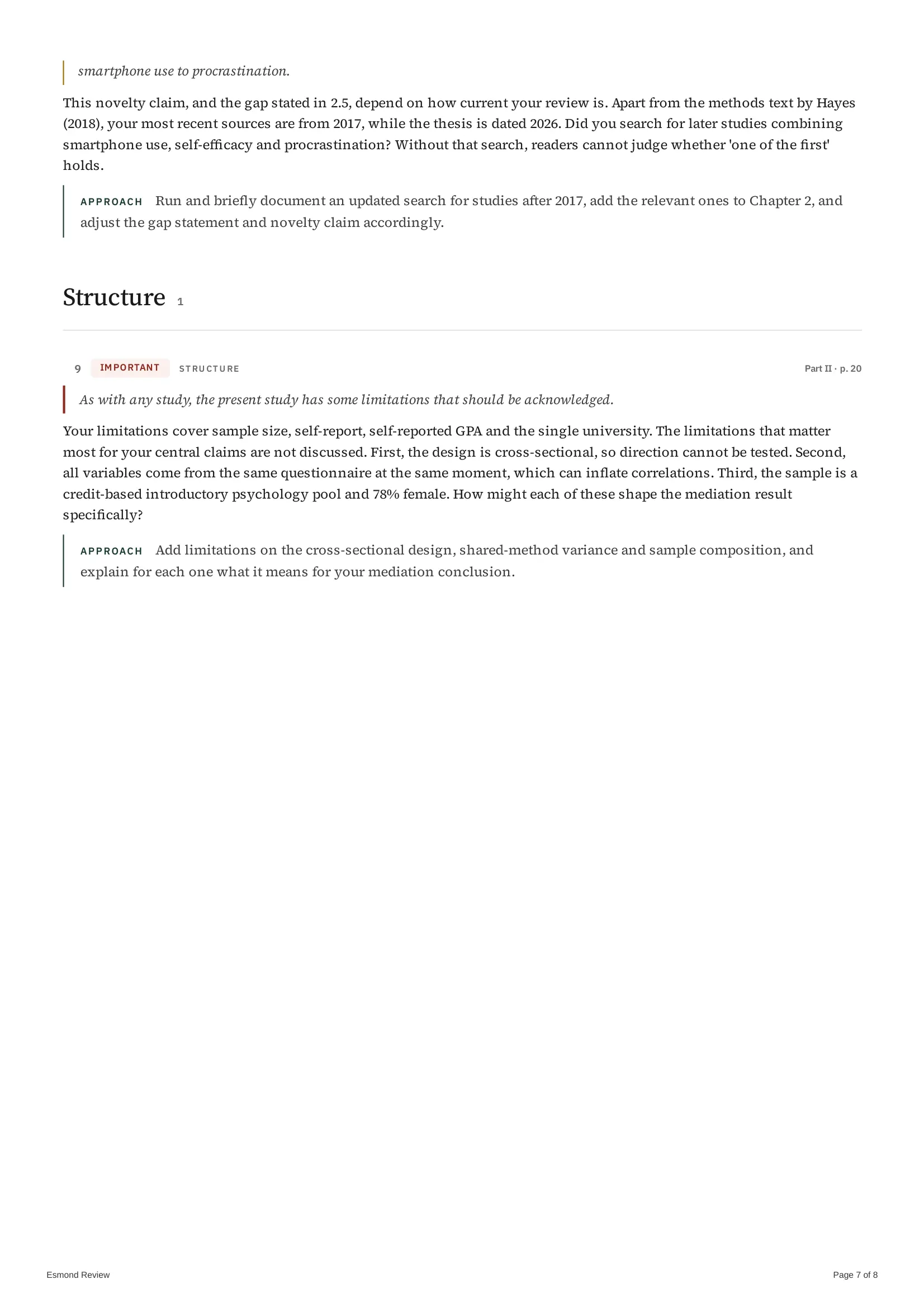
Esmond can flag, in the text you upload, what a reader in literary studies may question: analysis paragraphs that summarize plot, a theory introduced and then left unused, a critic's reading adopted as your own finding, a text named in the introduction that the chapters barely read, and an argument in chapter 3 that contradicts the thesis statement. The sample report shows the format, and how Esmond works describes the process.
Upload the whole draft if you can: Esmond then reads the chapters against each other, for example whether the conclusion answers the question the introduction asked. A single chapter gets a review of that chapter only.
Esmond doesn't compare your quotations with an edition, check your works cited list against MLA or MHRA rules, or suggest readings of the texts. What you change stays your decision.
Read on November 21, 2026.
Last revised
Get your paper evaluated before you submit