Abstract
A marketing dissertation is read for the chain from consumer theory to named constructs and from each construct to its measurement. Borrowed survey scales need their source, every adaptation and reliability for the student's own sample. A convenience sample of students limits how far claims reach, brand cases depend on company access, and managerial implications must follow from the study's own results.
For students with a marketing dissertation or master's thesis in progress: a survey or experiment on consumer behavior, a case built with a brand or company, or a study of social media data. This page sets out how the chapters of an empirical marketing dissertation hang together and what a marketing reader looks for in each one. Guidance from marketing departments in Austria and Germany is quoted throughout.
In short
Marketing research asks why customers, users, or business buyers act the way they do, and what a firm can change as a result. A typical dissertation question links a marketing stimulus (an ad format, a sustainability label, an influencer, a loyalty program) to a response such as attitude, trust, word of mouth, or purchase intention, often through a mediator and under some condition that moderates the effect. Other dissertations study a brand or company in depth, or work with data the firm or a platform already holds.
Each design carries its own burden of proof. A survey has to show that its constructs were measured well. An experiment has to show that the manipulation worked and that the groups differed only in it. A case has to show why this company tells the reader something beyond itself. At WU Vienna's Institute for Digital Marketing & Behavioral Insights, the guideline states: “Your master's thesis must be empirical in character, although conceptual projects are accepted in rare cases.” WU's Department of Marketing adds a rule for mixed designs: “If a student chooses more than one method (e.g. a survey plus interviews), the mentioned criteria apply to the central method of the theses.” If your draft combines interviews with a questionnaire, say which of the two carries the answer to your question.
How theory becomes a conceptual model and hypotheses is covered on the page about the business thesis literature review. This page follows the whole dissertation from there.
The table follows a quantitative study with primary data, the shape the marketing guides quoted here describe for empirical work. Your department's template decides the headings.
| Chapter | What a marketing reader looks for in it |
|---|---|
| Introduction | A managerial problem and a research question that are the same problem; a contribution stated against named prior studies |
| Literature review and hypotheses | Constructs defined once and used consistently; each hypothesis argued from a mechanism, with a conceptual model that matches the hypotheses one to one |
| Method | Design (survey, experiment, interviews), population and sampling, each scale with its source and adaptations, the stimulus material, ethics and consent |
| Results | Measurement quality before hypothesis tests; descriptives; the tests in the order of the hypotheses; supported and unsupported hypotheses reported in the same detail |
| Discussion | Findings compared with the studies from chapter 2; theoretical implications; managerial implications that stay inside the results; limitations of sample and measures |
| Conclusion | A direct answer to the research question |
| Appendix | Full questionnaire in the language respondents saw, stimuli or screenshots, coding scheme for qualitative material, additional output |
Marketing constructs such as brand trust, perceived value, or customer engagement are latent: no single question captures them, so dissertations measure them with multi-item scales taken from earlier studies. Readers check four things. The source of each scale is cited. Every change is reported: dropped items, new wording, a different response format, or a translation (with back-translation if you used one). Reliability is computed on your own data; Cronbach's alpha of 0.70 is a common rule of thumb, and a lower value needs a comment. If you run a structural equation or PLS model, composite reliability and average variance extracted show convergent validity, and the Fornell-Larcker criterion or the HTMT ratio shows that two constructs are not the same thing measured twice.
The sample decides how far a claim reaches. A questionnaire shared in your study program's group chat produces a convenience sample of young, highly educated respondents. That sample can test whether a mechanism exists. It cannot show how common a reaction is among a country's consumers, and a draft that calls it representative will be questioned. Report how respondents were reached, how many started and finished, which attention checks you used, and how many responses you removed and why.
A brand or company case brings its own conditions. WU's Department of Marketing notes that “for theses, which are conducted in cooperation with a corporate partner, the criteria naturally should meet customer needs and therefore should be altered accordingly.” The academic reader still checks the method: what the company gave you (sales data, CRM extracts, interviews with its managers), what it did not give you, and whether the company's interest shaped the question. Agreements and confidentiality are covered on the page about a master thesis in a company.
Social media data raise separate questions: which posts were collected, through which tool, over what period, and whether the platform's terms allowed it. Posts are not a sample of consumers. A small group of active accounts can produce a large share of the content, and a sentiment classifier that was never checked against a hand-coded subset leaves the reader unsure what its labels mean.
The Chair of Marketing at Universität Hamburg draws a line that marketing drafts often blur: “Hypotheses, experiences of practitioners, theoretical considerations or plausible knowledge are to be distinguished from empirical results.” A quote from a marketing manager in an interview is data about that manager's view, and it does not confirm a hypothesis about consumers.
Hamburg also addresses the statistics portals that marketing students use for market sizes and usage figures: “If you find information in fact databases (e.g. Statista), be sure to refer to the primary source.” For the final chapter, the same guidelines say: “The last chapter of each thesis should return to the problem formulated at the beginning and point out the implications for science and practice.”
WU's Institute for Digital Marketing & Behavioral Insights asks for synthesis in the review: “When presenting different empirical studies, you need to analyze to what extent their results match or contradict each other.” It also asks for the material behind the numbers: “In case of empirical work, please provide your supervisor with the raw data and scripts of your thesis.” Your own department's guide may differ on any of these points, and it is the one that applies.
Managerial implications deserve their own pass. A study that found a positive effect of influencer credibility on intention can suggest choosing credible influencers. It cannot tell a firm how much to spend, which platform to choose, or what return to expect, unless those were measured. For the general shape of a final chapter, see what goes in a thesis conclusion.
| Where in the draft | The question an assessor asks |
|---|---|
| Research question | Is this a question about consumers or markets that the chosen data can answer? |
| Constructs | Is purchase intention, or trust, or engagement, defined the same way in chapter 2 and measured that way in chapter 3? |
| Scales | Where does each scale come from, what was changed, and how reliable is it in this sample? |
| Sample | Who answered, how were they reached, and do the claims stay within that group? |
| Experiment | Did the manipulation check work before the effect was interpreted? |
| Results | Are unsupported hypotheses reported as clearly as supported ones? |
| Managerial implications | Does each recommendation follow from a result, or from the literature or common sense? |
These fragments are made up. None of them comes from a real dissertation.
Your supervisor is the first reader, and the one whose view counts for the assessment. Bring specific questions: whether a scale adaptation is acceptable, whether the sample supports a claim, whether a hypothesis can be dropped. The university library can help you trace market figures to their primary source and find the original publication of a scale. Academic skills or methods support at your university, where it is offered, reads drafts too.
Outside feedback and AI tools depend on your institution's rules. At the University of Mannheim, the Area Marketing & Sales permits AI tools under conditions, among them: “AI-based applications must not be used as a stand-alone source.” and “If AI tools are used, the academic paper must contain a reflection section stating which AI tool was used for which purpose and in which section of the paper.” If your department has rules like these, ask your supervisor first before using any AI review on your draft, and declare it as required. Feedback on a draft you produced is one thing. Having someone else produce chapters or analysis for you is something else: it is not your own work. The pages can I get AI feedback on my thesis and is AI feedback on a thesis cheating set out what universities say.
The general thesis checklist before you submit covers formal points, and the citation checker compares your reference list with your in-text citations.
An empirical marketing dissertation has an introduction, a literature review that ends in hypotheses and a conceptual model, a method chapter with design, sample, and measures, results that start with measurement quality, a discussion with theoretical and managerial implications, and a conclusion. Case-based and review-based dissertations follow other structures, and your department's template decides the headings.
Your own department's archive or the university library's repository are the best places, because they show what your program accepts. When you read one, look at how scales are sourced and adapted, how the sample is described, and whether the managerial implications follow from the results. Esmond doesn't supply example dissertations.
It can be enough for testing whether an effect exists, especially in an experiment. What a reader checks is that the claims stay within that group, and that the draft does not call the sample representative of consumers in general. Ask your supervisor what your program expects.
Start with your supervisor, and use any thesis seminar or university support your program offers. Outside feedback and AI tools are possible where your institution allows them, sometimes only with a declaration. Esmond reads a draft you upload and comments on it.
Esmond evaluates every assignment before you submit. It never writes it.
Esmond is an AI tool that doesn't write for you. If your course doesn't allow any AI tools, don't use Esmond for that work. If you're unsure, ask your instructor or advisor.
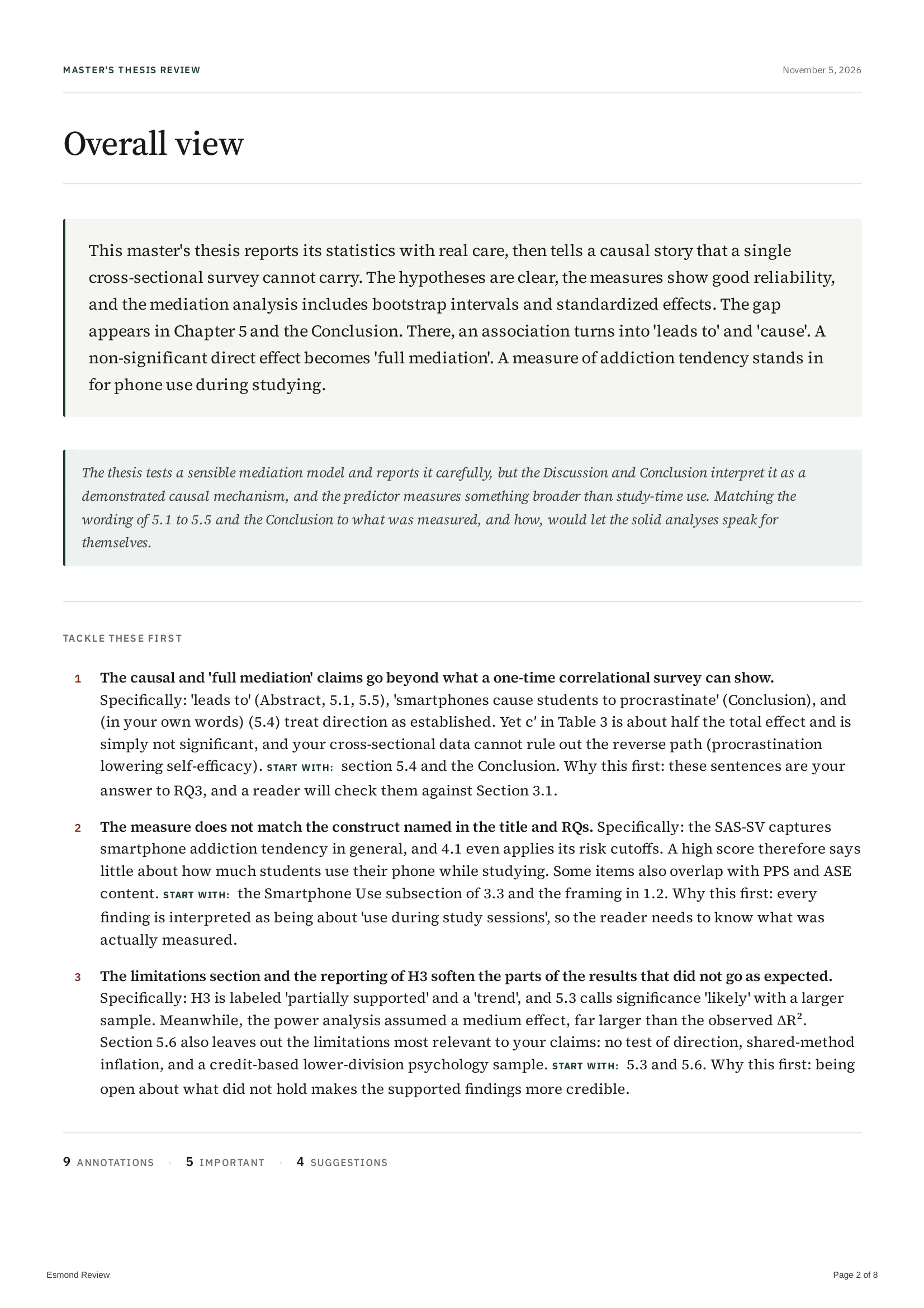
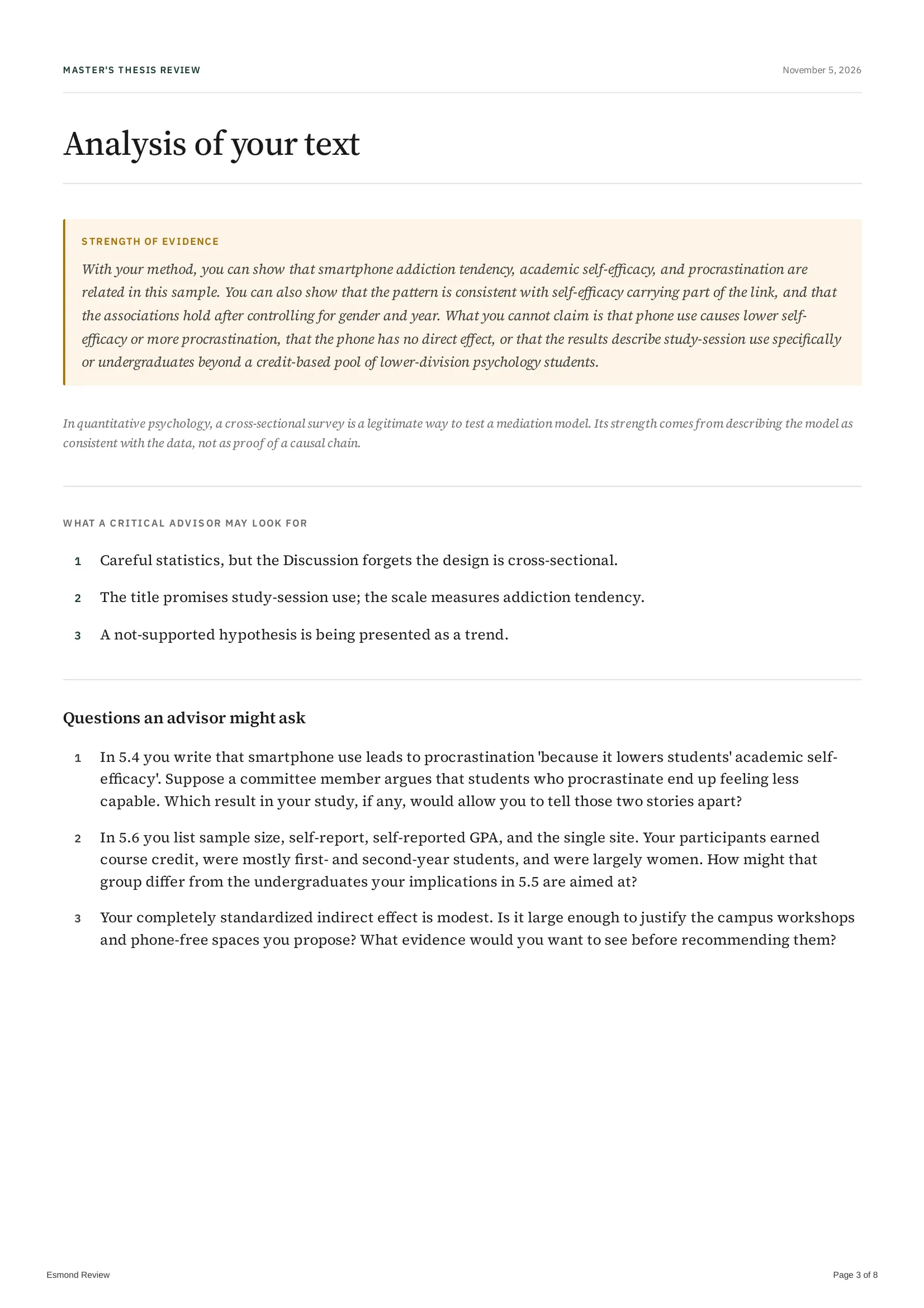
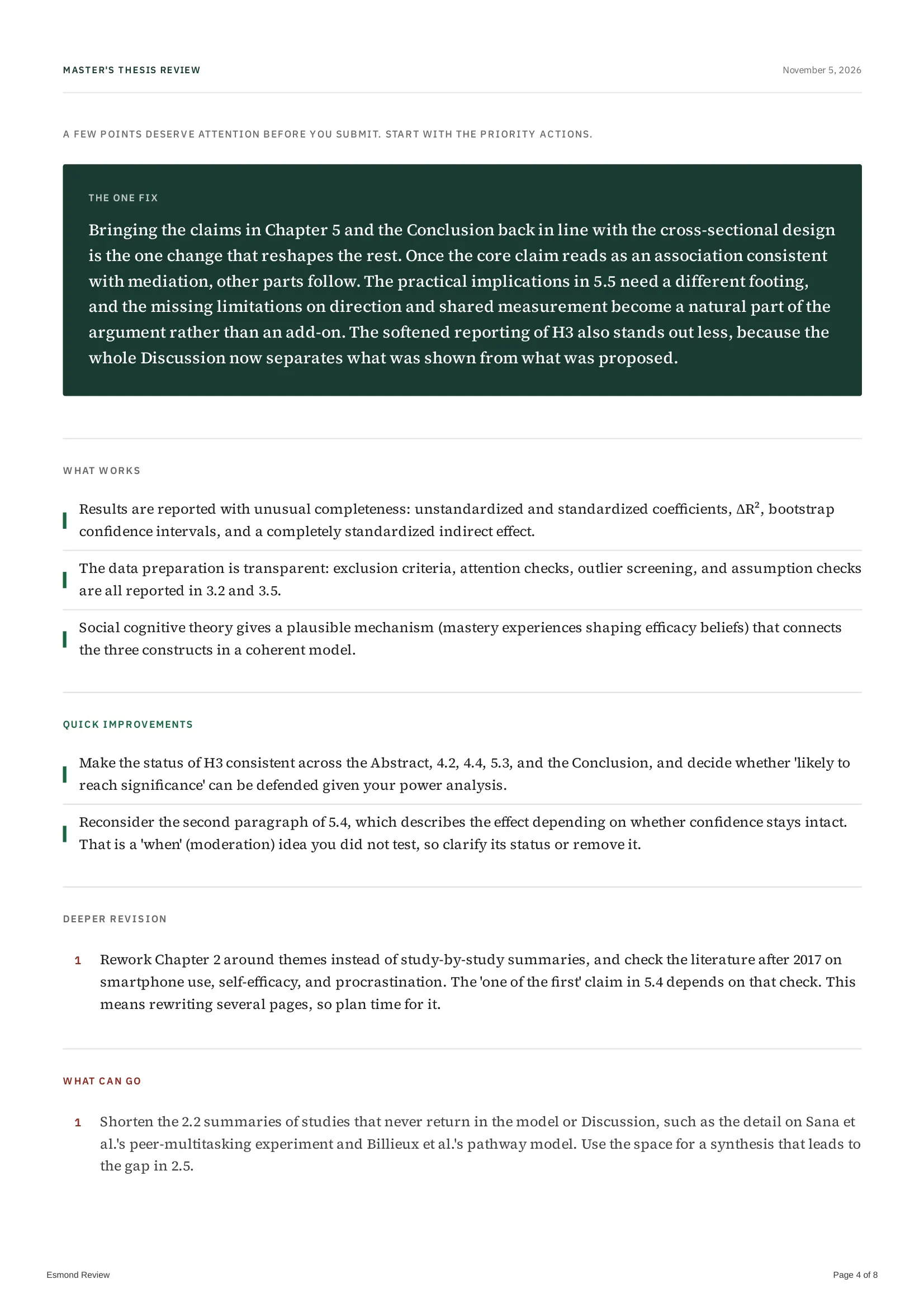
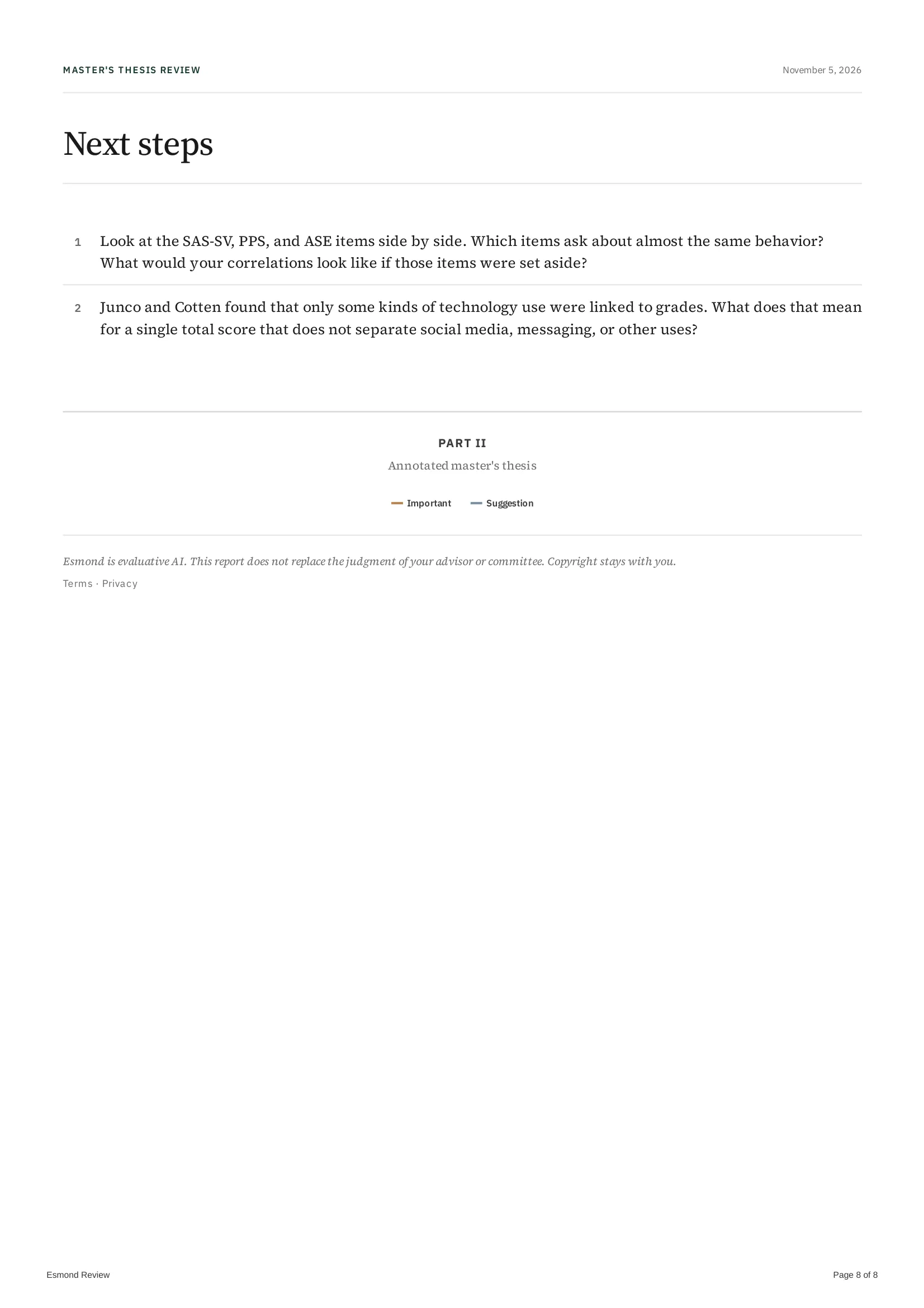
Esmond can flag, in the text you upload, the gaps a marketing reader may question: a construct defined one way in the review and measured another way in the method, a scale whose adaptations are not reported, a sample described as representative after a convenience recruitment, a hypothesis marked as supported without the test that supports it, or a managerial implication that no result in the draft carries. See the sample report for the format of the review, and how Esmond works for what happens after you upload.
Upload the whole draft if you can: Esmond then reads the chapters against each other, for example whether the conclusion answers the question the introduction asked. A single chapter gets a review of that chapter only.
Esmond doesn't rerun your statistics, check your data file, or judge whether a company's confidentiality terms are met. The comments are for you to weigh; what you change stays your decision.
Read on November 21, 2026.
Last revised
Get your paper evaluated before you submit