Abstract
An economics dissertation is read for the chain from theory to a testable hypothesis, an identification strategy, data, and coefficients interpreted in units. Assessors probe endogeneity from omitted variables, reverse causality, and measurement error, and the assumptions behind fixed effects, difference-in-differences, and instrumental variables. They also check data description before regressions, log interpretation, economic significance, and robustness checks aimed at weak points.
An empirical economics dissertation, from an undergraduate honors project to a master's thesis, is read closely for its identification strategy: why the estimate can be read the way the text reads it. This page sets out the usual structure, what an identification strategy has to show, what readers check in your data and estimates, and how coefficients should be read. Guidance from economics departments in Norway, Austria, Germany, and the US is quoted.
In short
An economics dissertation starts from a question that economic theory or methods can address and narrows it until evidence can settle it. The Department of Economics at Tufts University puts the test this way: “Your question must be specific and must contain a conjecture that can be supported or refuted by evidence that you are capable of producing.” From there, the reader expects a mechanism (a model, or at least a clear economic argument), a hypothesis with an expected sign, data that measure the concepts, an estimation strategy, and an interpretation.
Description alone is rarely enough. UC Irvine's guidelines for the economics honors thesis say that collecting data from secondary sources, without a theory-based application or interpretation of those data, will not normally qualify as an honors thesis. The University of Vienna's guidelines for the master's thesis in applied economics add a point that matters for students whose results turn out null: “The thesis is judged by execution and originality, not the results.”
Not every economics dissertation is empirical. The University of Oslo's Department of Economics names three kinds (empirical, theoretical, and surveys of a literature) and warns about the third: “If you choose a survey it should not be purely descriptive.” The rest of this page focuses on empirical work with regressions.
UC Irvine describes the order for empirical theses: after the introduction, a review of past studies, and the model and hypotheses, “If econometric work is undertaken, following sections would describe empirical implementation of the model, the data used, and the statistical results.” The table follows that order and adds what an economist reads for in each part.
| Section | What readers in economics look for in it |
|---|---|
| Introduction | The question, the answer in one or two sentences, the method that produced it, and the contribution compared with the closest papers |
| Literature | Papers grouped by question and method, with their estimates and identification, ending in what your work adds |
| Theory or model | A mechanism that yields a testable prediction with an expected sign, and the assumptions it rests on |
| Data | Source, unit of observation, sample period, variable definitions with units, how the sample was built, descriptive statistics |
| Empirical strategy | The estimating equation, the coefficient of interest, the identification argument, standard errors and clustering |
| Results | The main specification first, coefficients read in units, statistical and economic significance |
| Robustness | Alternative specifications, samples, and measures, chosen to test the weak points of the identification |
| Conclusion | The answer, its limits, what follows for policy if anything, and what further data or methods could add |
An ordinary least squares regression gives an unbiased estimate of a causal effect only if the error term is unrelated to the explanatory variable of interest (the zero conditional mean assumption). In observational data that assumption fails in three familiar ways. Omitted variables: ability affects both schooling and wages, so a wage regression on schooling picks up part of ability. Reverse causality: growth may raise trade as much as trade raises growth. Classical measurement error: random noise in an explanatory variable pulls its coefficient toward zero. Readers look for a paragraph that names the threat that matters most in your setting and says what you do about it.
The common strategies each rest on an assumption you have to argue for. Fixed effects in panel data remove differences that are constant over time within a unit, and leave time-varying confounders in place. Difference-in-differences needs the treated and control groups to have followed parallel trends without the treatment; show the pre-treatment years. Instrumental variables need an instrument that moves the explanatory variable (relevance, reported with the first-stage results) and affects the outcome only through it (the exclusion restriction, which you can't test with a single instrument and must defend with economic reasoning). A regression discontinuity needs units just above and below the cutoff to be comparable.
If none of these is available, the dissertation can still be good, as long as it calls its estimates associations and discusses the likely direction of bias. What assessors object to is causal language without an identification argument behind it.
Data shapes what an economics dissertation can do. Oslo's advice on choosing a topic is blunt: “Unless you have formulated the topic with a particular dataset in mind, the data you need is most likely not available in the form you need.” If you use a cross-country panel from the World Bank's World Development Indicators, readers check the number of countries and years, gaps in the series (often larger for low-income countries), whether values are in current or constant dollars or at purchasing power parity, and which download date or database version you used, since series are revised.
Describe the data before the regressions. The outline for the economics honors thesis in the University of Oregon's EC 418 notes: “It is important to understand and document the basic features of your data before discussing regression results.” The Chair of Econometrics at Johannes Gutenberg University Mainz adds a presentation rule: “Screenshots of STATA Output (or similar) will not be accepted.” Oslo also asks that the introduction name the software used for the calculations.
Then read each coefficient in the units of your variables. In a regression with both variables in levels, the coefficient is the change in the outcome for a one-unit change in the regressor. With a log outcome and a level regressor, 100 times the coefficient is approximately the percent change in the outcome (exactly 100 times e to the power of the coefficient, minus 1). With both in logs, the coefficient is an elasticity. A logit or probit coefficient is not a change in probability; report marginal effects. Say whether a result is large in economic terms, alongside whether it is statistically significant, and report standard errors that fit the data (allowing for heteroskedasticity, or clustered at the level where treatment varies).
Robustness checks are there to test the weak points of your identification, and a long list of minor variations doesn't replace that. Change the control set, the sample period, the measure of the key variable, or the clustering, and say in the text which conclusion holds and which doesn't. Novelty is judged in proportion too. William & Mary's honors guidelines in economics state that “replicating an existing analysis with only one or two additional years of data or one or two additional variables would not be sufficient unless that addition qualitatively changed the implications of the analysis.”
Across the guidance quoted on this page, assessors in economics check:
These fragments are made up. None of them comes from a real dissertation.
Your supervisor is the reader who matters most for the identification argument; bring the estimating equation and the threat you worry about. Econometrics teaching staff or graduate teaching assistants can help with a specification or standard errors, and the economics librarian can help you find datasets and track down the papers closest to yours. Presenting in a thesis seminar, where one exists, gives you the questions an audience of economists will ask.
Rules on outside help and AI differ by department, and some are specific. Oslo's Department of Economics asks for a declaration in the thesis: “Please include an AI-disclaimer where you document where and how you used AI.” Vienna's guidelines state: “The use of AI tools is, in general, allowed but it must be precisely documented.” The same guidelines let the supervisor set limits on AI use for a thesis. Where rules like these apply, ask your supervisor before you use an AI tool on your thesis, including for feedback, and declare its use the way your department asks. Feedback on your own draft leaves the work yours; analysis or text that someone else produces for you is not your own work. See is AI feedback on a thesis cheating and thesis advisor feedback.
For the methods section in general, see what goes in a methodology chapter; for the gap your question fills, see research gap in a thesis; and for the overall order of a master's thesis, see master thesis structure.
For empirical work: introduction, literature, theory or model, data, empirical strategy, results, robustness, and conclusion. UC Irvine's honors guidelines describe this order, with the empirical sections covering implementation of the model, the data, and the statistical results. A theoretical thesis replaces the data and estimation sections with the model's analysis.
A specific question with a conjecture evidence could refute, a clear mechanism, data that measure the concepts, an identification argument, coefficients read correctly in units, and a conclusion that matches the design. Vienna's guidelines note that the thesis is judged by execution and originality, not by its results.
Your department's own collection or the university repository is the best place, since those theses met your program's rules; some departments, such as Tufts, list recent honors theses on their pages. Read them for how the identification is argued, how data are described, and how coefficients are read. They show the standard; they are not text to reuse.
Yes. A well-identified estimate close to zero, with a narrow confidence interval, is a finding. What readers object to is treating an insignificant coefficient as proof of no effect when the interval is wide. Vienna's guidelines judge execution and originality rather than results, and William & Mary's put the focus on the student's effort, creativity, and diligence rather than on the findings.
From your supervisor first, then econometrics staff, the library, and a thesis seminar where your department runs one. Some departments set rules on AI use, so check them and ask your supervisor first. Esmond reads a draft you upload and comments on its argument, method, and sources.
Esmond evaluates every assignment before you submit. It never writes it.
Esmond is an AI tool that doesn't write for you. If your course doesn't allow any AI tools, don't use Esmond for that work. If you're unsure, ask your instructor or advisor.
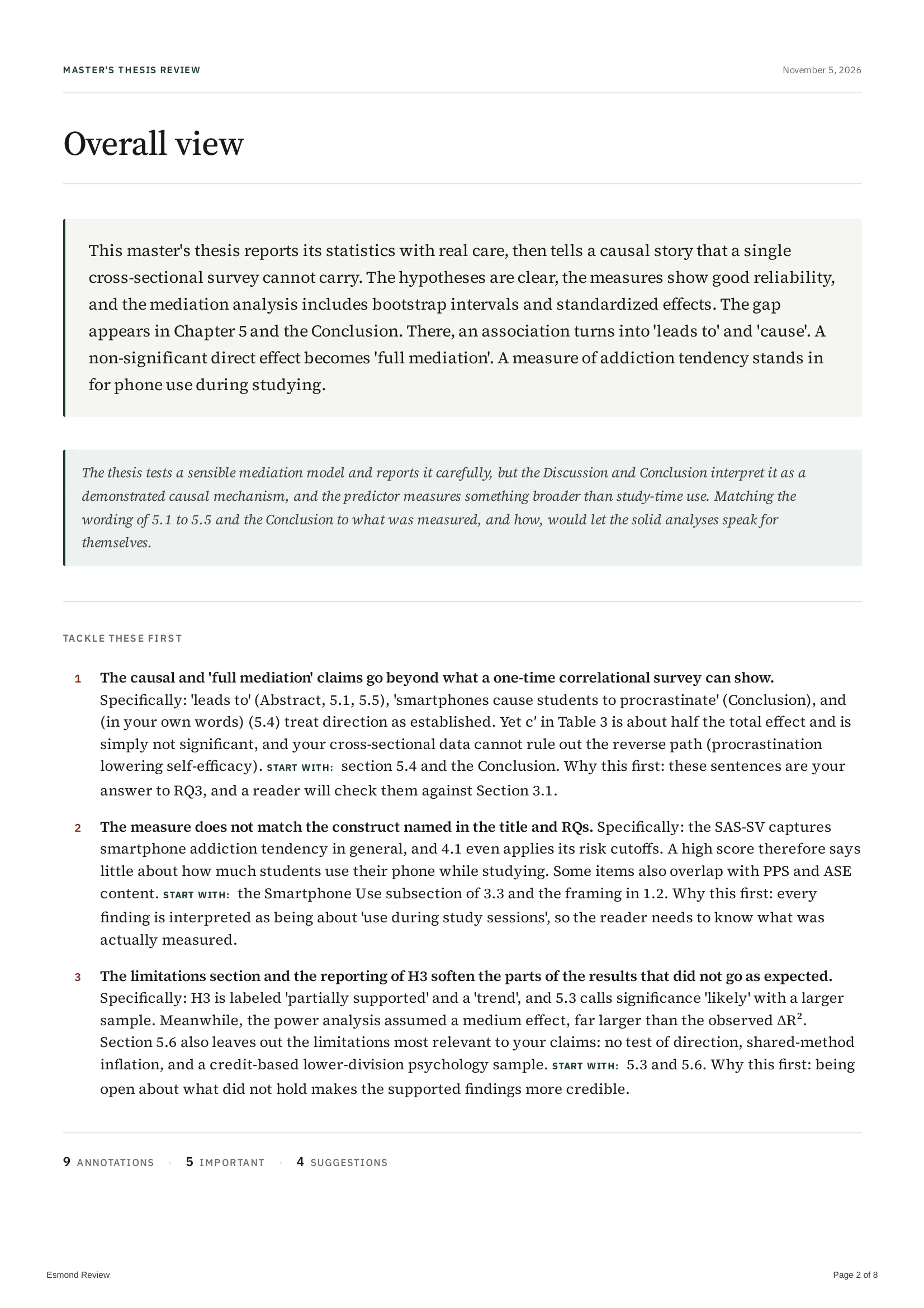
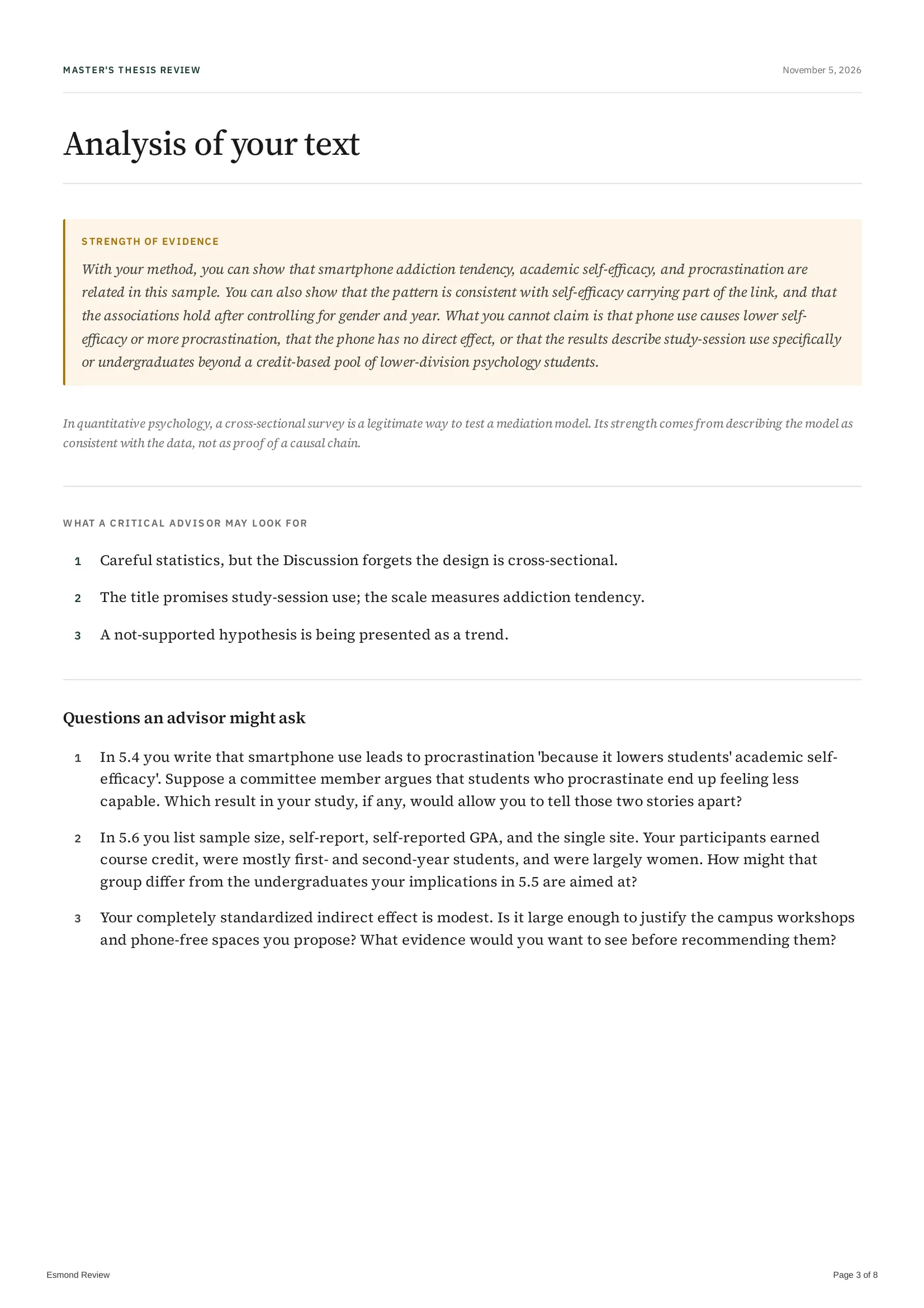
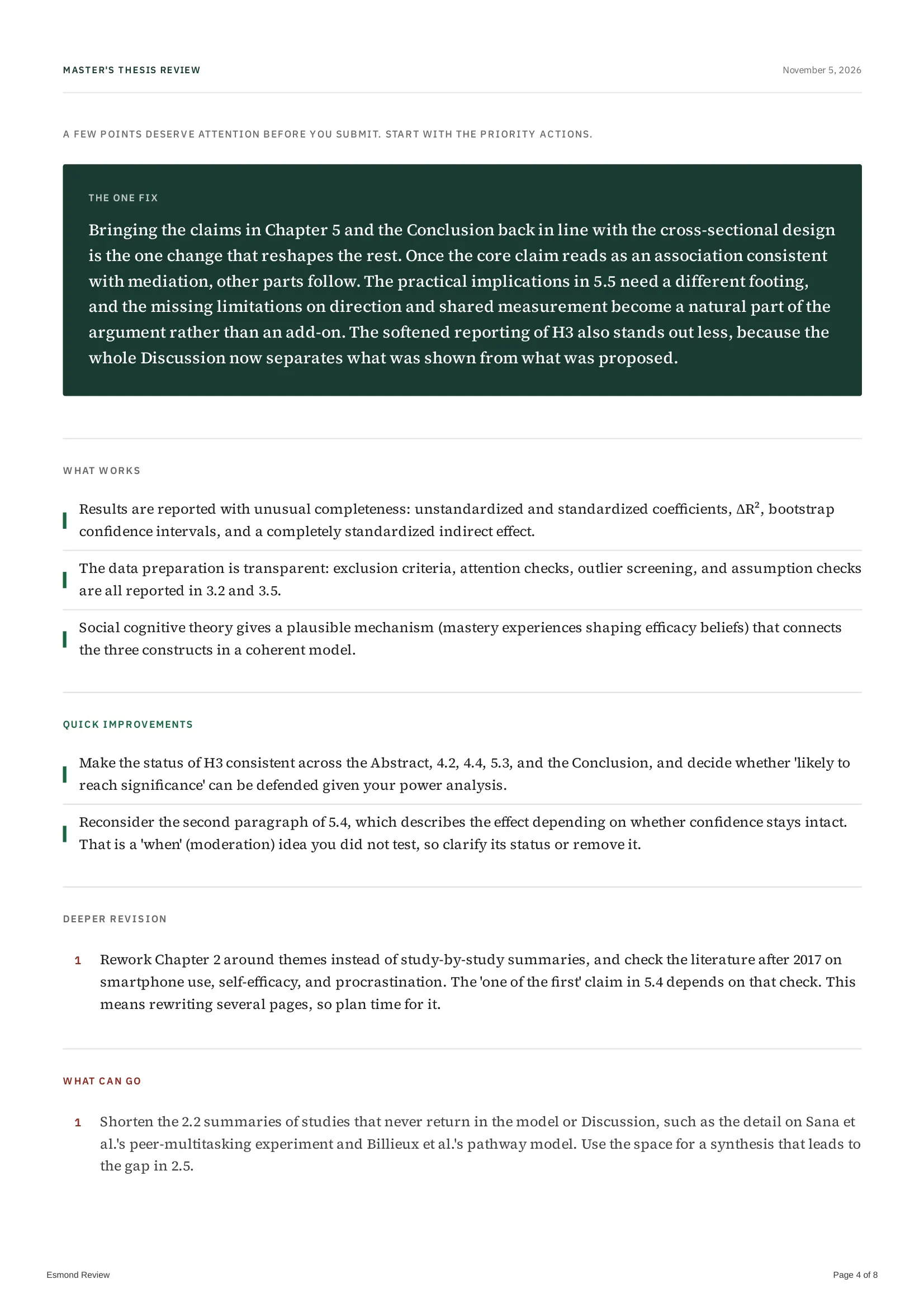
Esmond reads the draft you upload. It can flag, in the text, what an economics reader may question: causal claims without an identification argument behind them, a coefficient read as a percent where the table uses levels (or the other way round), observation counts that change between tables without explanation, an instrument whose exclusion restriction is never discussed, and a conclusion that goes further than the robustness section supports. The sample report shows the format, and how Esmond works describes the steps.
Upload the whole draft if you can: Esmond then reads the chapters against each other, for example whether the conclusion answers the question the introduction asked. A single chapter gets a review of that chapter only.
Esmond doesn't rerun your regressions, open your data or code, or check the dissertation against your department's template. Which changes to make is up to you.
Read on November 21, 2026.
Last revised
Get your paper evaluated before you submit