Abstract
An accounting dissertation names its reporting framework exactly, such as IFRS as adopted in the EU, US GAAP or a national framework, with the version in force for the period. Archival studies measure earnings management and audit quality through proxies with known weaknesses. Field studies with controllers or auditors are read for access, roles and confidentiality, and normative studies for use of the standard and its comment letters.
An accounting dissertation at bachelor's or master's level can be one of four kinds: an archival study of financial statements, a study of auditing or disclosure, a case study of management accounting inside a firm, or a normative analysis of a standard. This page explains how such dissertations are built, what accounting readers look for chapter by chapter, and where drafts in this field tend to slip. Guidance from accounting departments in Austria, Germany, Finland, and the United States is quoted.
In short
Accounting is a wide field. Elon University's Department of Accounting describes the range in its honors thesis guidelines: “This broad definition includes areas such as financial and/or managerial accounting, auditing, taxation, accounting information systems, accounting history, and forensic accounting.” Across that range, three kinds of dissertation are common: archival studies that test hypotheses on financial statement and market data, field studies that use interviews, observation, and internal documents inside organizations, and normative or doctrinal studies of what a standard requires and whether it should.
Each kind has to show something different. An archival study shows that its measures capture the construct and that its sample fits the question. A field study shows how access was gained and why the people interviewed can speak to the question. A normative study shows that it reads the standard itself and the debate around it. Elon describes the empirical form as follows: “Original Empirical Study: This involves applying accounting theory to appropriate data, structured as a publishable research paper, potentially presented at a regional or national accounting conference.”
Some departments rule certain forms out. Mannheim's Chair of Accounting & Capital Markets states: “Pure literature reviews or topics that are exclusively relevant for an individual company, will generally not be supported as suitable topics for a master thesis.” Check what your own program accepts before you commit to a form.
Chapter headings vary by program. The table sets the two empirical forms side by side, because accounting readers expect different things from each in the same chapter.
| Chapter | Archival study: what the reader looks for | Field study: what the reader looks for |
|---|---|---|
| Introduction | The question, the setting (country, framework, period), and the expected contribution | The practice studied (budgeting, controlling, audit planning) and why it is a puzzle |
| Literature and theory | Prior archival findings and a hypothesis with a predicted sign, often from agency or disclosure theory | A theoretical lens, such as institutional theory or a management control framework, that will guide the analysis |
| Institutional background | The standard or regulation, its effective date, and who applies it | The organization, its sector, and the accounting rules that shape the practice |
| Research design | Sample selection, data sources, proxy models, control variables, regression model | Case selection, access, interviewees by role, interview guide, documents, coding |
| Results or findings | Descriptive statistics, main tests, and what the coefficients mean in accounting terms | Themes supported by quotes and documents, with differences between roles shown |
| Discussion and conclusion | What the evidence says about the hypothesis, alternative explanations, and limits of the proxies | What the case adds to the lens, how far it travels to other organizations, and what stays specific |
Name the framework precisely. "International standards" is too vague for an accounting reader. IFRS has been required for the consolidated accounts of EU listed companies since 2005, while single-entity accounts in many EU countries still follow national law; IFRS as adopted in the EU can differ in timing from IFRS as issued by the IASB; US GAAP is organized in the FASB Codification. If your period crosses a change, such as IFRS 15 and IFRS 9 in 2018 or IFRS 16 in 2019, say how the change affects your variables.
Earnings management is not observed directly. Archival studies estimate it, for example as discretionary accruals from the modified Jones model of Dechow, Sloan, and Sweeney (1995), or as real activities manipulation following Roychowdhury (2006). These models have known weaknesses, especially for firms with extreme growth or performance, and readers expect the draft to say how it deals with them. Audit quality is measured through proxies as well: auditor size, audit fees, going concern opinions, restatements, or key audit matters under ISA 701. A result about "audit quality" is a result about the proxy you chose.
Hand-collected data from annual reports need a protocol: which report, which note, how ambiguous cases were coded, and whether a second person checked a subset. Interview data from controllers, CFOs, or auditors raise confidentiality questions. Agree with the firm what may be named, describe roles instead of names, and remove figures that would identify the company. The page about a master thesis in a company covers agreements and nondisclosure.
WU Vienna's Accounting and Reporting group sets out the expectation of an own contribution plainly: “The student’s contribution should be evident in the work”, for example through data collection or empirical investigation. Its concluding checklist for structure asks: “Is the initial objective consistently pursued? Is it achieved? If not, is this justified?”
For data, Mannheim's Chair of Accounting & Capital Markets welcomes a particular kind of proposal: “Self-proposed topics are particularly interesting and rewarding if you intend to work on specific research questions based on proprietary data, e.g. from industry contacts.” Proprietary data then come with the confidentiality questions above.
For normative work on standards, the guidelines of the Chair of Accounting and Management Control at European University Viadrina in Frankfurt (Oder) set out how to cite the consultation record: “In cases in which comment letters for a standard or an exposure draft of the IASB or the IFRIC are cited, the first reference source of a comment letter has to include the link under which all other comment letters for the standard/exposure draft are available.” The citation checker compares your reference list with your in-text citations.
| Point | Questions an assessor in accounting asks |
|---|---|
| Framework | Which standard, which version, and which entities apply it in the sample? |
| Sample | Which firms are excluded (financials, utilities, firms with missing data), and why? |
| Proxies | Is the earnings management or audit quality measure justified, and are its known weaknesses addressed? |
| Timing | Do the accounting figures and the market or audit data refer to the same period? |
| Alternative explanations | Could a result attributed to a standard change come from another event in the same year? |
| Field data | Who was interviewed, in which role, and are different roles' views kept apart? |
| Confidentiality | Can the company or a person be identified from the text, tables, or appendix? |
| Normative argument | Does the assessment rest on the standard's text and the consultation, or on textbooks? |
These fragments are made up. None of them comes from a real dissertation.
Your supervisor reads for the choices that only someone in the field can judge: the proxy, the framework, the case. Many accounting programs add a seminar. Aalto University's master's program in accounting describes active participation in its thesis seminar this way: “This includes presenting your own work, opposing fellow student's work and other types of participation depending on the supervisor.” At Mannheim's Chair of Accounting & Capital Markets: “During the Master colloquium students will present and discuss their research approach and preliminary research results.” The library helps with database access and with locating annual reports and comment letters.
Rules on AI differ sharply between departments, and accounting has some strict ones. WU Vienna's Accounting and Reporting group allows artificial intelligence only for language work: it “is exclusively allowed for text editing and must be explicitly declared and documented in the aid list.” Under a rule like that, AI feedback on content is not covered. Ask your supervisor first before using any AI review on your draft, and follow the declaration rules of your program. Hiring a service to produce the dissertation or parts of it is a separate matter: what you submit would not be your own work. For what universities say about AI feedback in general, see is AI feedback on a thesis cheating.
The research gap in a thesis page is useful for checking the contribution statement, and the thesis checklist before you submit covers formal points.
An archival accounting dissertation has an introduction, literature and hypotheses, an institutional background on the standard or regulation, a research design with sample and proxy models, results, and a discussion. A field study replaces the archival design with case selection, interviews, and documents. A normative study analyzes the standard and its consultation. Your department's template decides the headings.
Your department's thesis archive and your university library's repository show what your program accepts. When you read one, look at how the framework is named, how proxies are justified, and how interview data are kept confidential. Esmond doesn't supply example dissertations.
The one your sample firms actually apply, named exactly: IFRS as adopted in the EU, US GAAP, or a national framework, with the version in force during your period. If consolidated and single-entity accounts follow different rules in your country, say which accounts you use.
Having a service produce the dissertation or its analysis means submitting work that is not your own, and universities deal with that under their academic integrity rules. Feedback on your own draft is a different thing, where your institution allows it.
Ask your supervisor first, and use the seminar or colloquium if your program has one. Some departments restrict AI to language editing, so check your rules before using any AI tool. Where it is allowed, Esmond reads a draft you upload and comments on it.
Esmond evaluates every assignment before you submit. It never writes it.
Esmond is an AI tool that doesn't write for you. If your course doesn't allow any AI tools, don't use Esmond for that work. If you're unsure, ask your instructor or advisor.
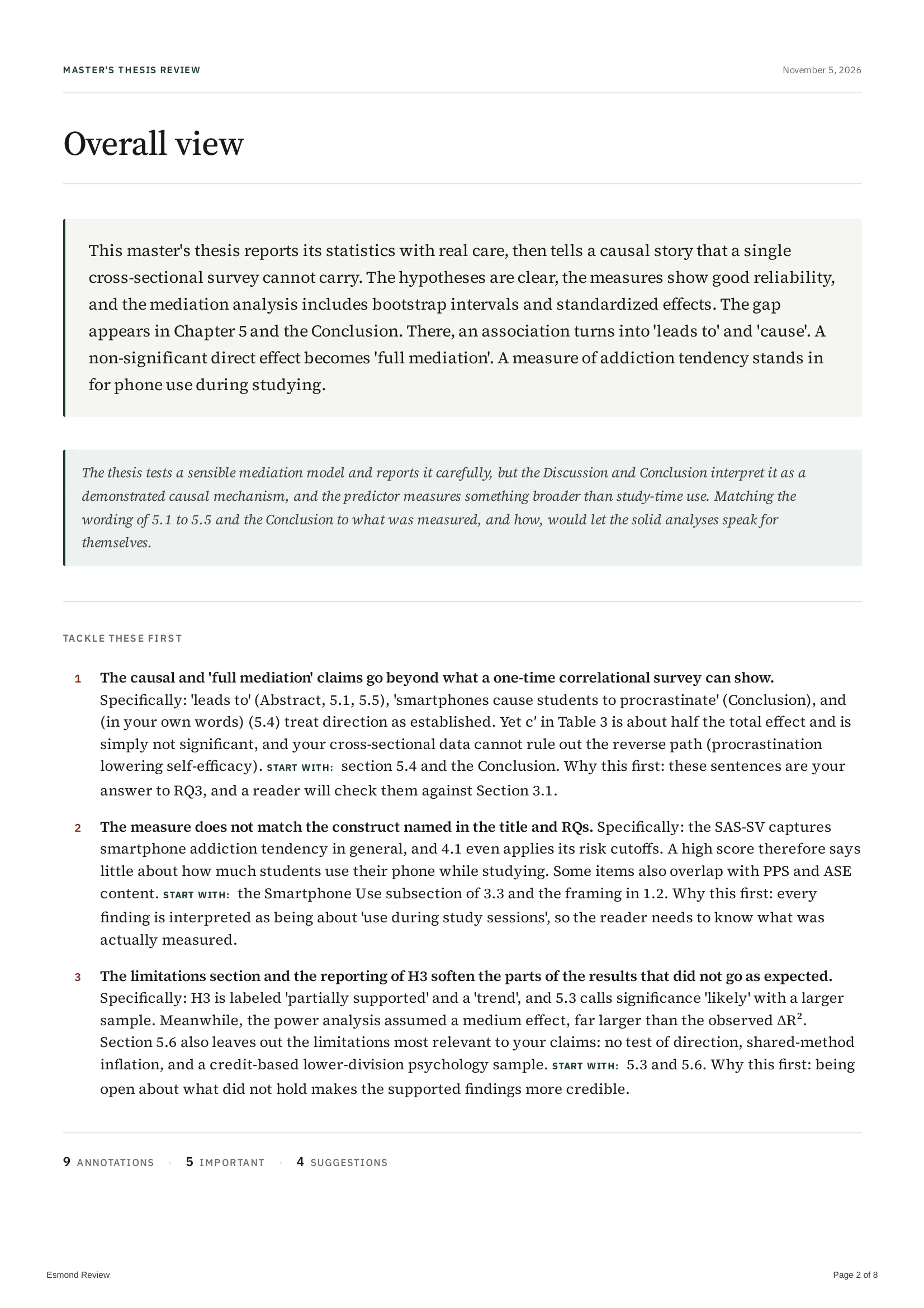
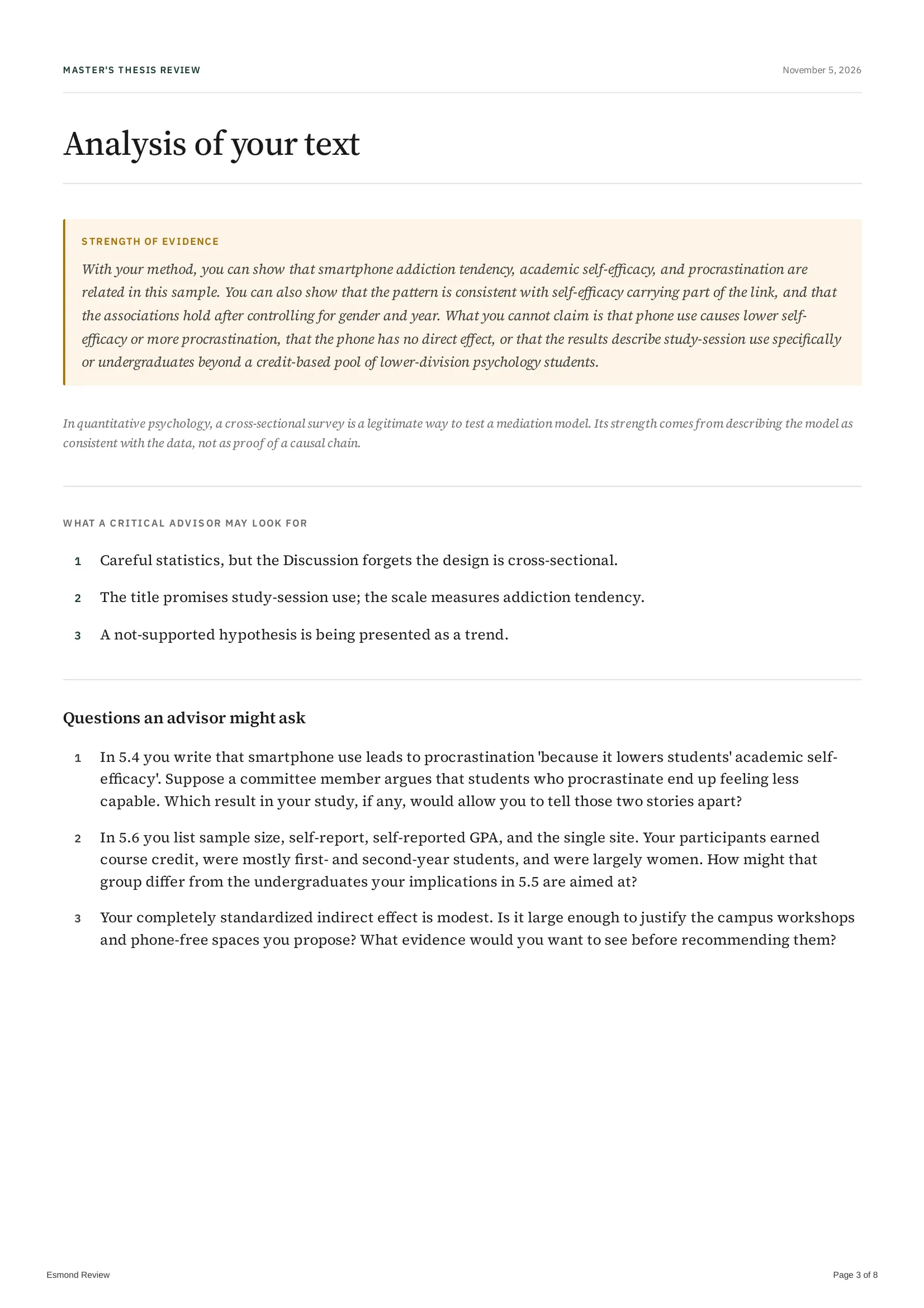
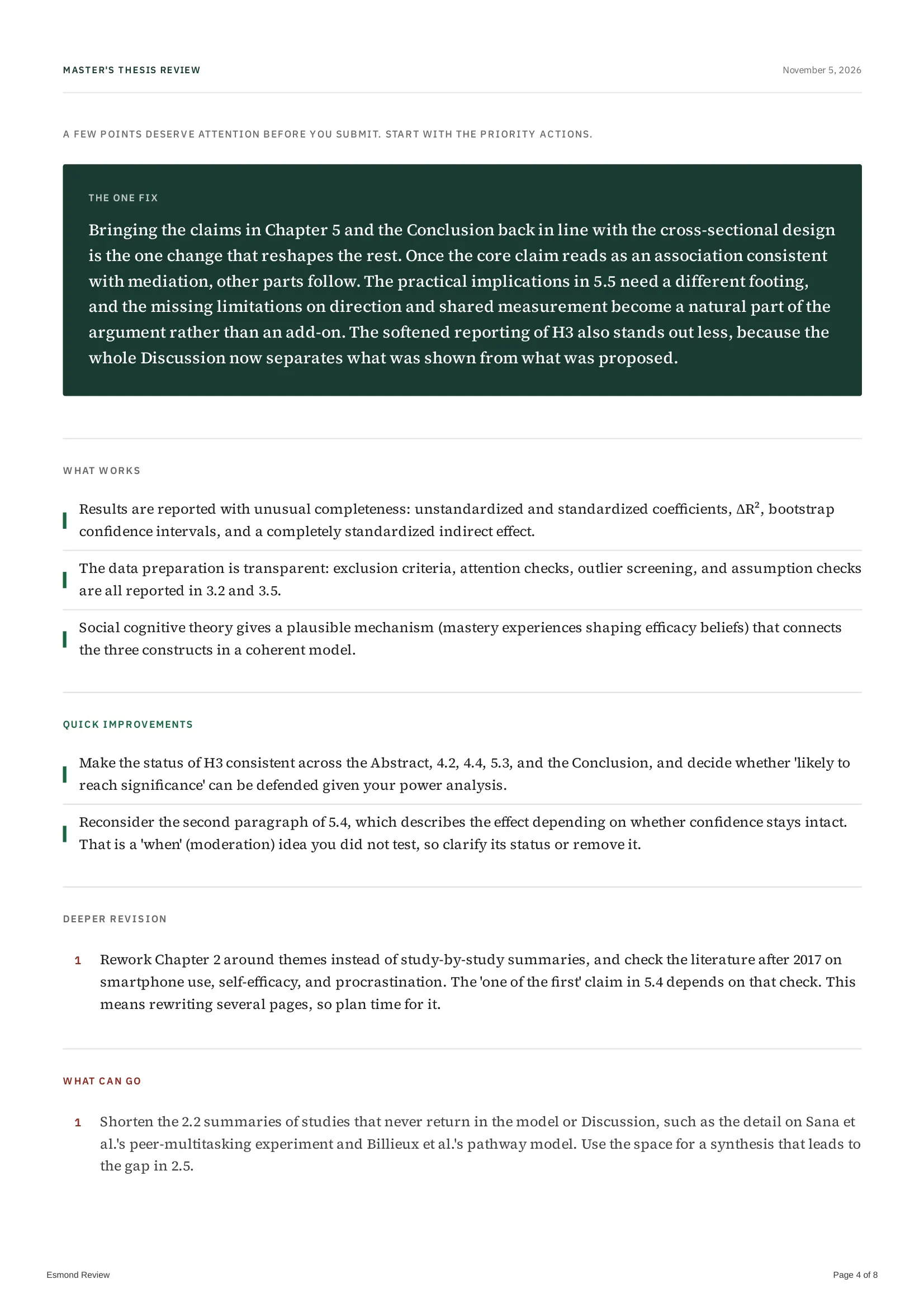
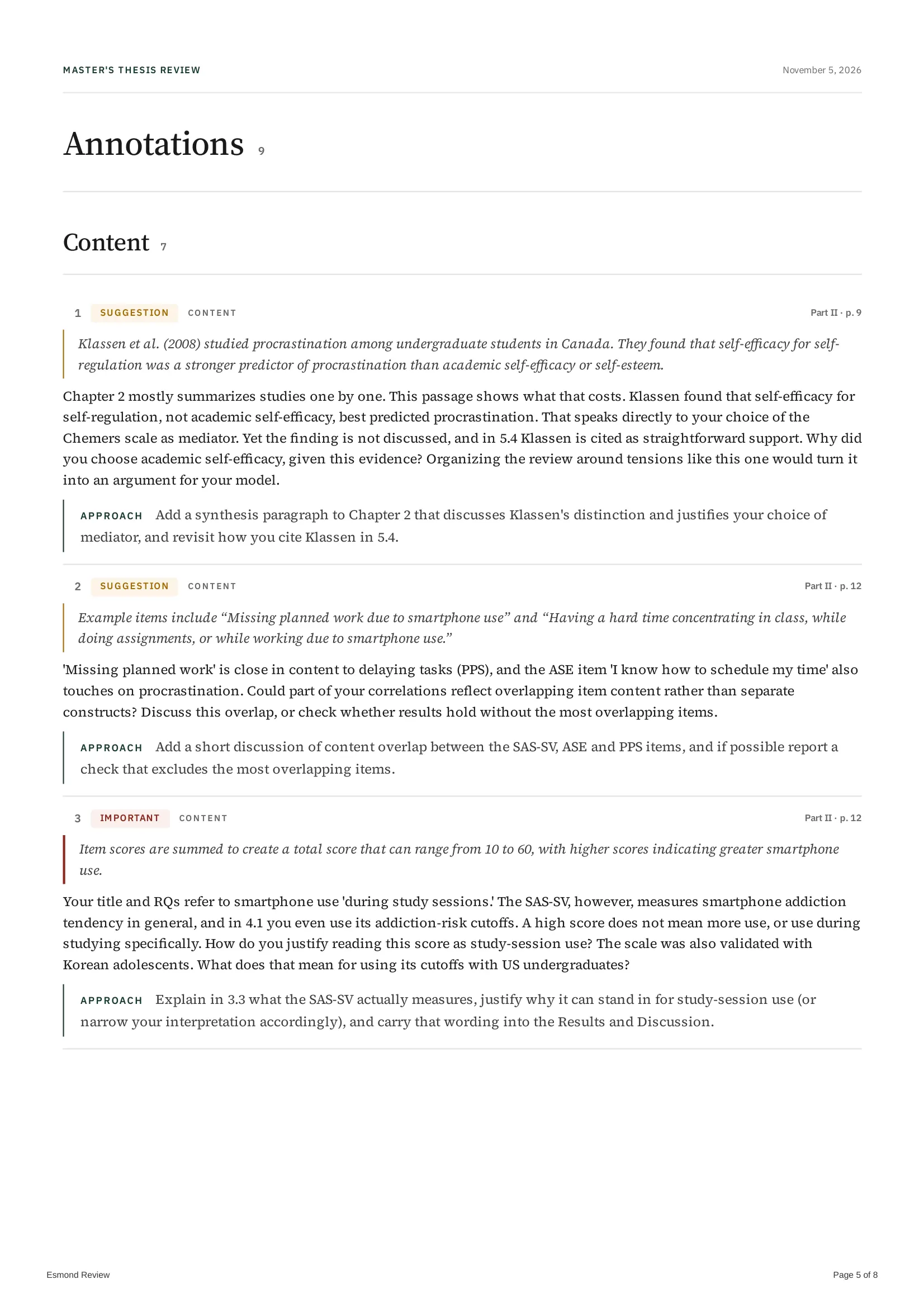
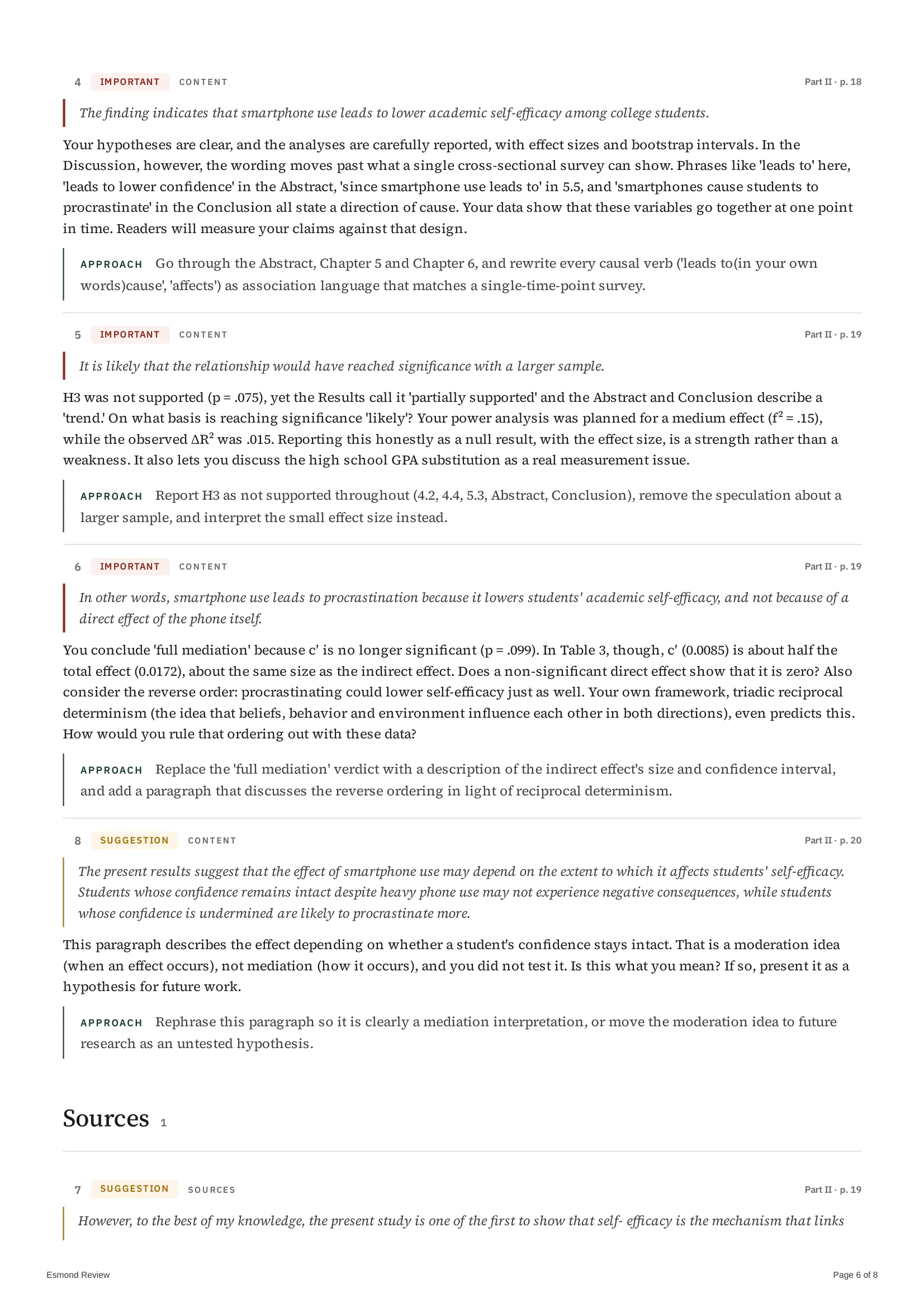
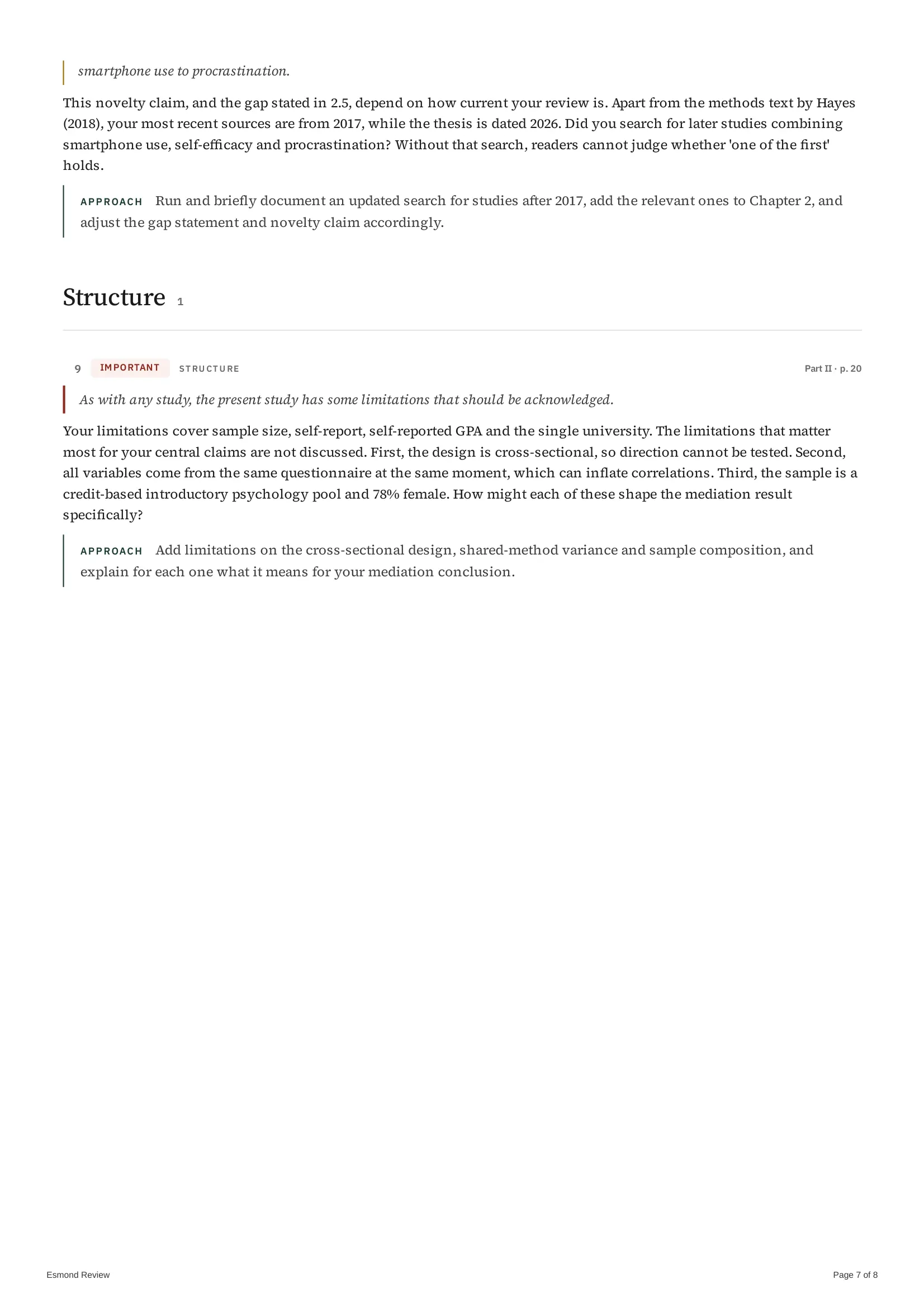
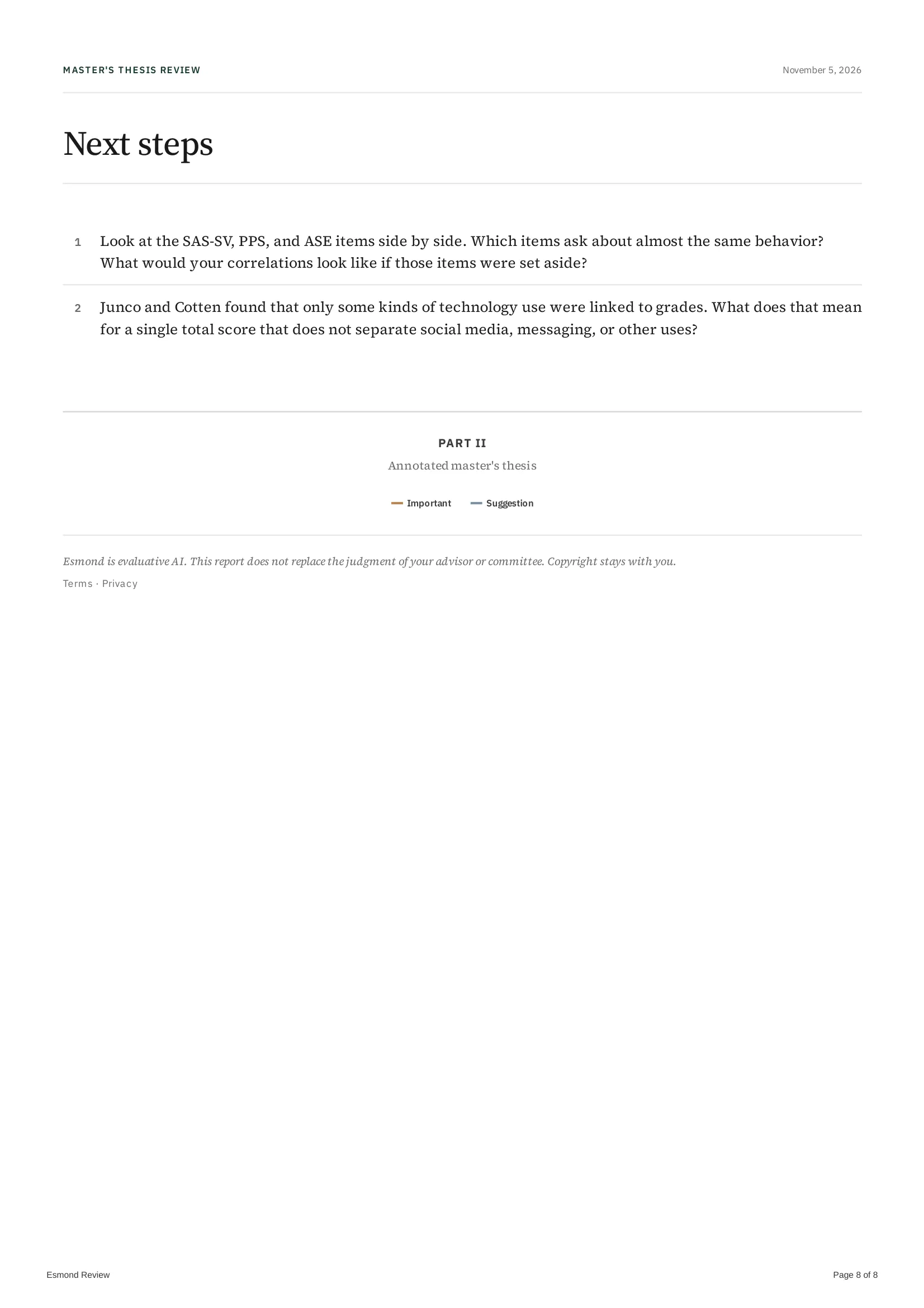
Esmond can flag, in the text you upload, what an accounting reader may question: a framework named loosely or inconsistently across chapters, a proxy treated as if it were the construct itself, a result attributed to a standard change while your own background chapter names another change in the same year, interview findings that blur the roles of the people quoted, or a case description detailed enough that a reader could ask whether the firm can be identified. Have a look at the sample report and at how Esmond works.
Upload the whole draft if you can: Esmond then reads the chapters against each other, for example whether the conclusion answers the question the introduction asked. A single chapter gets a review of that chapter only.
Esmond doesn't open your data, recompute accruals, or check the text of a standard against the source. What you do with the comments is up to you.
Read on November 21, 2026.
Last revised
Get your paper evaluated before you submit