Abstract
A sociology dissertation is read for a question tied to sociological theory and for concepts such as class or social capital turned into something observable. In interview studies readers look for coding that can be followed from transcript to theme and for reflexivity about the researcher's position; with survey data such as the ESS they check rounds, weights, and claims about change or generalization.
For students with a sociology dissertation underway, at bachelor's, honours, or master's level, whether it rests on interviews, survey data, or theory alone. You'll find the chapter structure with what sociology readers look for in each part, the weak spots that come up again and again in sociology drafts, and guidance from departments in Canada, Germany, and India, quoted word for word.
In short
Sociology studies how social life is patterned: inequality, institutions, groups, identities, and the ways people make sense of them. A sociology dissertation is expected to connect a concrete case or dataset to that larger conversation. Description alone rarely satisfies a sociology reader; the question is what your material says about a social process.
The University of Münster's sociology institute in Germany puts the goal plainly: the thesis is meant to show the competence “to develop a (defined) sociological research question on a given topic, to address it within a specified timeframe using scientific methods, and to present the results appropriately.” At the University of Regina in Canada, the honours handbook for sociology adds a demand about theory: “This evidence should be integrated with a guiding theory or concept”, or else the evidence should generate a theory or concept inductively.
Those two routes, theory first or theory built from the data, lead to different dissertations. Either is accepted. What draws questions is a draft that claims one and does the other. For how a framework chapter can be set up, see conceptual framework in research.
Mount Royal University's BA Honours in Sociology handbook says that the thesis “normally includes a research question(s), a literature review, methodology, results, and a discussion of the significance of your findings.” Regina's handbook also accepts a theoretical or critical paper and a literature review paper, besides empirical projects. The two empirical forms most sociology students choose are an interview study and an analysis of survey data. Readers look for different things in each.
| Part | Interview study: what sociology readers look for | Survey or secondary data: what sociology readers look for |
|---|---|---|
| Introduction and question | A question about meanings, experiences, or practices, framed so that interviews can answer it | A question about patterns or associations, with the population and period stated |
| Literature and theory | The theoretical lens and the debate it enters, with the concepts you will carry into the analysis | Hypotheses derived from theory, each tied to a concept you can measure |
| Concepts and operationalization | What each concept means in your study and how it shaped the interview guide | Which survey items or indices stand for each concept, and why they fit |
| Methods | Sampling route, number and profile of interviewees, consent, transcription, the coding procedure, and your position as researcher | Dataset, round or wave, sample size after exclusions, weights, missing data, and the model |
| Findings | Themes supported by quotes from several participants, with counterexamples noted | Tables a reader can check, effect sizes with uncertainty, and the reference category named |
| Discussion | What the findings add to the theory, and how far they reach beyond the people interviewed | Whether the hypotheses held, alternative explanations, and what a cross-sectional design cannot show |
| Conclusion | An answer to the question, with limits stated once and clearly | Same, without causal claims the design can't carry |
Sociological concepts are abstract on purpose. Class, social capital, stigma, or integration each have several definitions in the literature, and a reader wants to know which one you use. In survey work this becomes operationalization: class measured by occupation, education, or income gives different groups. In interview work it shapes the questions you asked and the codes you looked for.
Coding is where many sociology drafts go quiet. A reader wants to see the steps: how transcripts were read, what the first codes were, how they were grouped into themes, and whether you followed a named approach such as thematic analysis or grounded theory. One table of codes and themes in an appendix often answers most of these questions.
Reflexivity asks how you, as the person doing the research, may have shaped what you found: your relation to the group studied, what made access easy or hard, and how participants may have seen you. A positionality statement that lists your identity without saying what it changed reads as a formality.
Many sociology dissertations reuse existing data. The European Social Survey is a cross-national survey repeated every two years with new respondents each round; national panels such as the German Socio-Economic Panel (SOEP) or South Africa's National Income Dynamics Study follow the same people over time; India's National Family Health Survey is repeated with new samples. The chair for inequality research at the University of Potsdam tells master's students that “The chair can assist you if you are interested in conducting a secondary analysis of already existing survey data (e.g. micro-census, European Value Study, SOEP).”
With reuse comes the duty to show your steps. The social stratification group at the University of Oldenburg asks students to hand in their R or Stata code and states: “Your work should be completely replicable after changing the path information.” A reader of a survey-based dissertation checks which round or wave you used, whether weights were applied, how missing answers were handled, and whether the design fits the claim: one cross-sectional round can describe differences between groups at one moment, but not change within people.
Mount Royal's handbook lists what the thesis should demonstrate: “that the student is familiar with published literature on the topic, that appropriate research methods have been selected and correctly applied, that critical interpretation or analysis has been undertaken, that the findings have been contextualized, and that any original contributions to the field of study have been clearly identified.” Regina's criteria include that “Empirical papers should follow a recognized qualitative or quantitative methodological design, and all methods of data collection and analysis should be described using the literature.” At the Central University of Punjab in India, one learning outcome of the MA dissertation is to “Justify the findings of the study in line of the research aim and objectives.” In practice, sociology readers check:
These fragments are made up. None of them comes from a real dissertation.
Your supervisor reads your chapters and knows what your department expects. Ask about specific points: whether your operationalization convinces, whether the coding is shown in enough detail, whether the discussion goes back to your theory. Fellow students in a thesis seminar or colloquium can test whether your argument is clear to someone outside your project, and many universities offer academic skills support and subject librarians who know the survey archives.
For AI tools, check your department's rules before anything else. Regina's sociology handbook forbids generative AI as a substitute for the student's own content and adds: “In certain cases, generative AI may be used as a part of the research process. Any such exceptions should be discussed with your supervisor before beginning the work.” The same handbook requires a statement on the use or non-use of AI in every honours paper, and Oldenburg's stratification group asks students to declare the tools they used, AI software included. Where your department has a rule like these, ask your supervisor before you use Esmond on your thesis, and declare it if you do.
Having your own draft read and questioned is feedback; having someone else produce the analysis or the text means the work is no longer your own. More on the line between the two: is AI feedback on a thesis cheating.
If your gap statement feels thin, read research gap in a thesis; for the order of chapters at master's level, master thesis structure. The citation checker compares your reference list with your in-text citations.
Most empirical sociology dissertations have an introduction with the research question, a literature and theory chapter, methods, findings, discussion, and a conclusion. Mount Royal's sociology honours handbook lists the same core parts. Some departments also accept a theoretical paper or a literature review as the whole dissertation.
Your department or university library is the best place, because those examples were accepted under the rules that apply to you. In a sample dissertation, look at how concepts are defined and measured, how the coding or the model is reported, and how the discussion links back to theory. Use examples to understand structure; your own text stays your own.
Often yes; the University of Potsdam's inequality chair, for instance, offers support for secondary analysis of survey data. Readers will check that you name the round or wave, apply weights, report missing data, and keep your claims within what the design can show.
In qualitative sociology, readers usually expect some reflection on your position as researcher, especially when you share or don't share characteristics with participants. What matters is that it explains effects on access, interviews, or interpretation. Ask your supervisor how your department handles it.
Your supervisor comes first, then peers and university support. Outside feedback, including AI tools, depends on your department's rules, and some departments require you to ask your supervisor first or declare it. Esmond reads a draft you upload and comments on it; it adds no text.
Esmond evaluates every assignment before you submit. It never writes it.
Esmond is an AI tool that doesn't write for you. If your course doesn't allow any AI tools, don't use Esmond for that work. If you're unsure, ask your instructor or advisor.
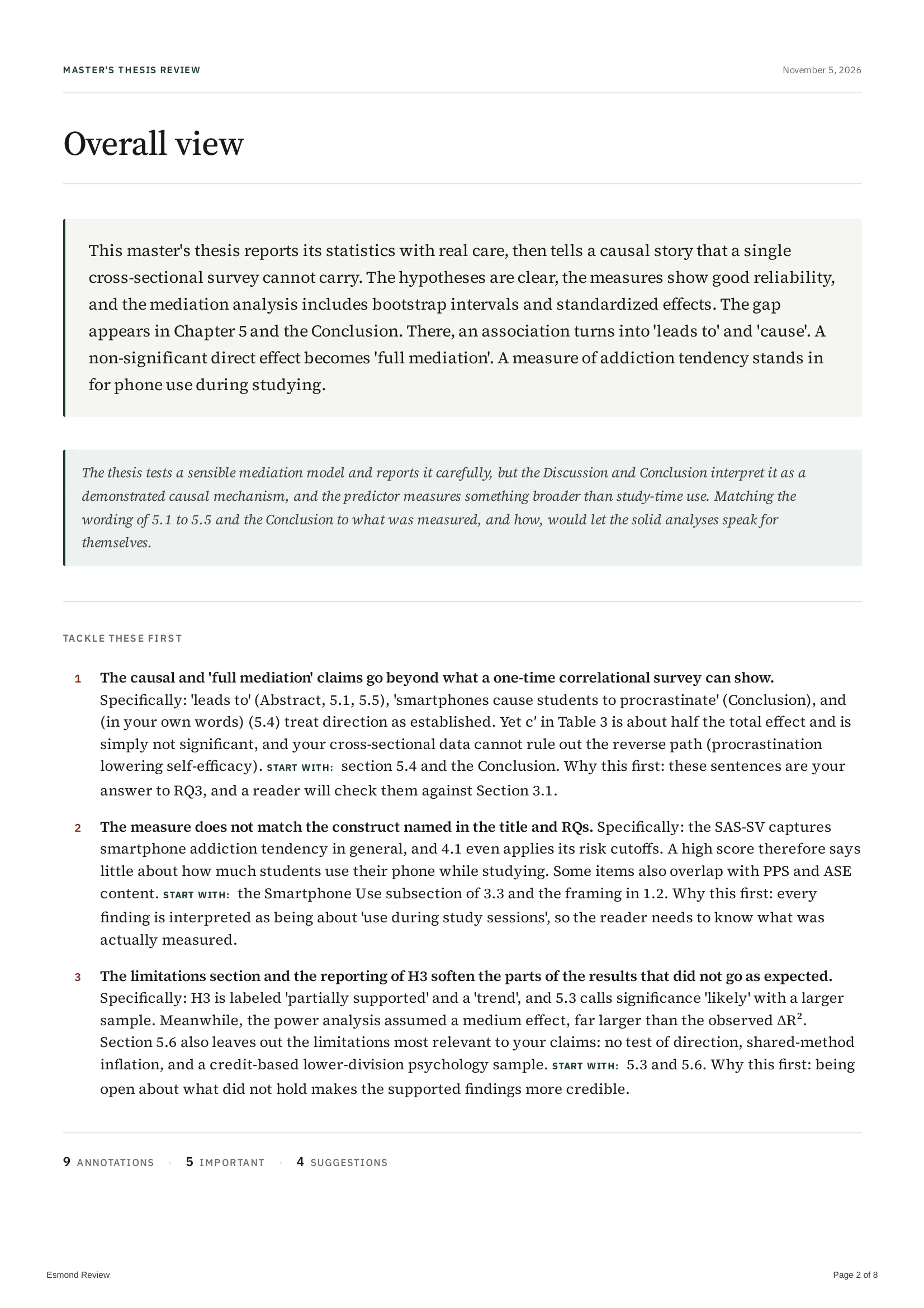
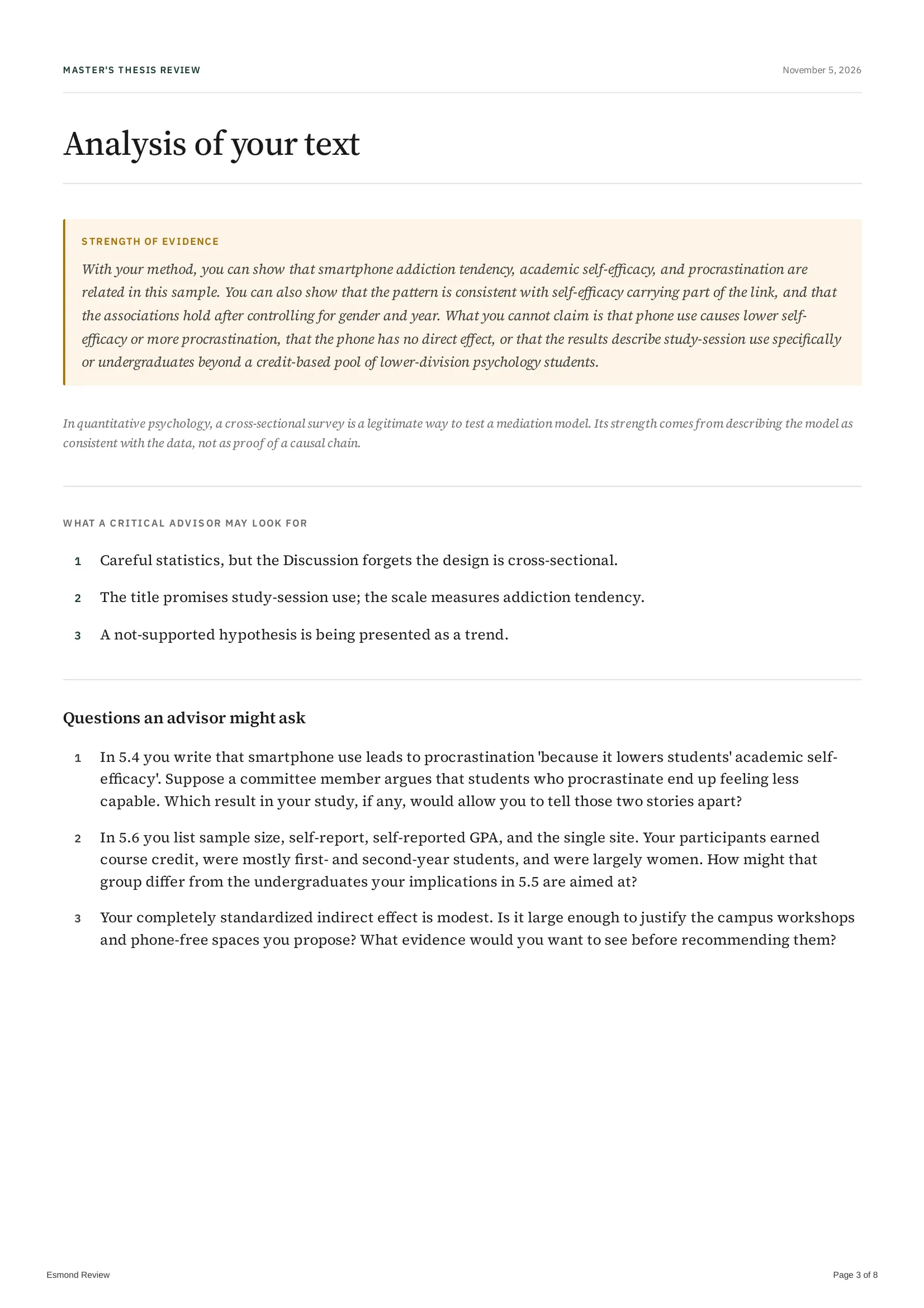
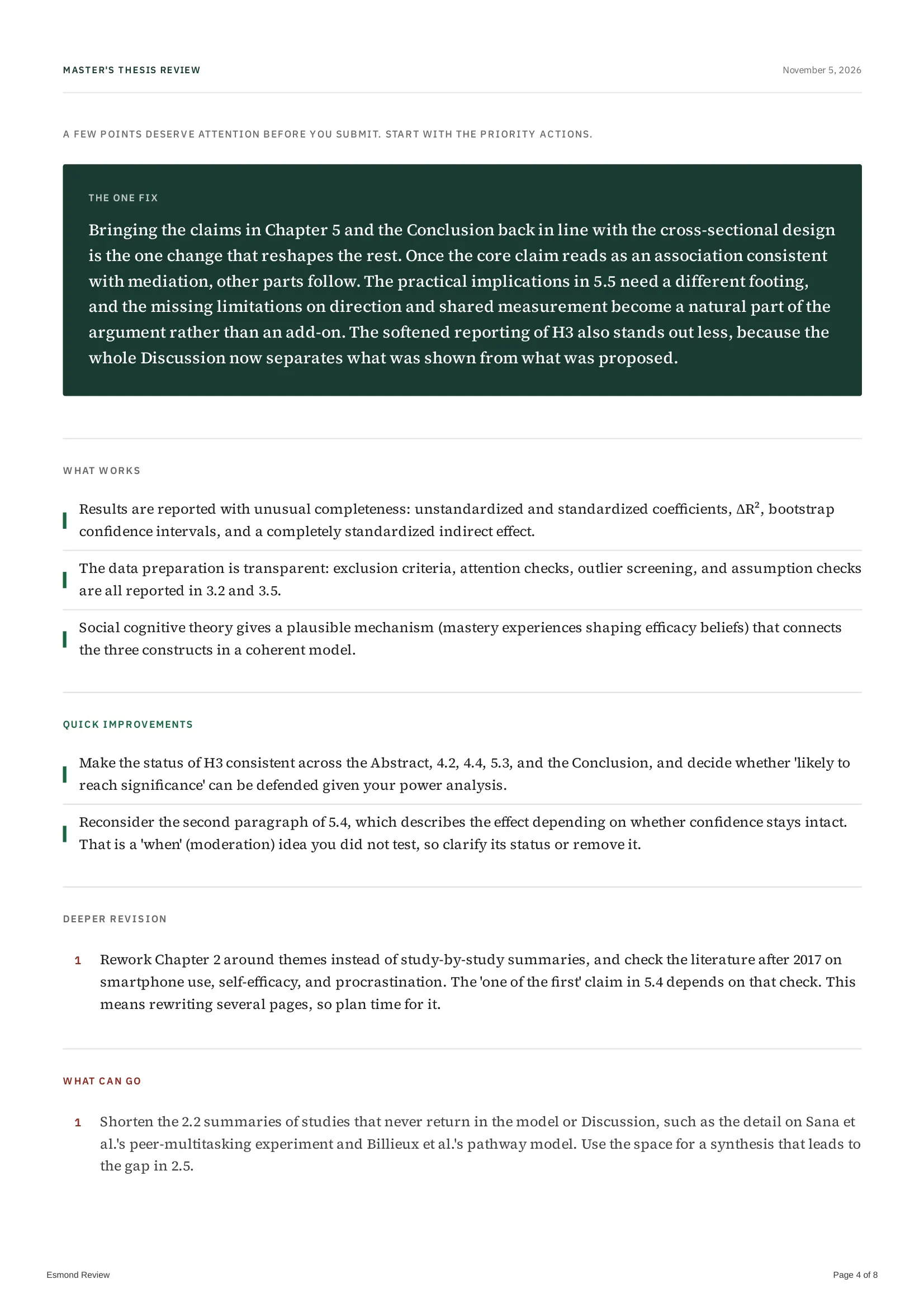
Esmond can flag, in the text you upload, what a sociology reader may question: a concept that is defined one way in the theory chapter and measured another way later, themes presented without the coding behind them, a positionality statement that does no work, a trend claimed from a single survey round, and conclusions about a whole society drawn from a small sample. See the sample report for the format and how Esmond works for the steps.
Upload the whole draft if you can: Esmond then reads the chapters against each other, for example whether the conclusion answers the question the introduction asked. A single chapter gets a review of that chapter only.
Esmond doesn't rerun your models, recode your transcripts, or check your work against your department's template or ethics approval. You decide what to change.
Read on November 21, 2026.
Last revised

Get your paper evaluated before you submit