Abstract
Acadia has no overarching AI policy, according to its History and Classics department, so the thesis rule depends on your department. The Psychology department does not permit generative AI in undergraduate or master's thesis work unless the thesis supervisor explicitly allows it, with any use declared in the acknowledgments, naming the tools and context and taking responsibility for accuracy.
AI use in an Acadia thesis depends on your department, and you ask your supervisor first. When we checked on November 12, 2026, we found no Acadia-wide thesis rule on AI; the History and Classics department says there is currently no overarching AI policy at Acadia. Psychology has a thesis rule: generative AI only if the thesis supervisor explicitly allows it, declared in the acknowledgments.
In short
The History and Classics department's AI policy page, which cites material accessed in August 2025, says: “Currently there is no explicit or overarching policy regarding the use of AI tools at Acadia University.” It adds that students will meet different approaches across courses and departments. On November 12, 2026, we found no Acadia graduate studies text on AI in theses either.
The one thesis rule we found sits on the Psychology department's page on academic integrity penalties, in a part titled Generative AI in Thesis Work (Undergraduate or Master's). It covers Psychology theses at the undergraduate and master's level. It is that department's rule, and other departments may handle the question differently or not at all. The page carries no date.
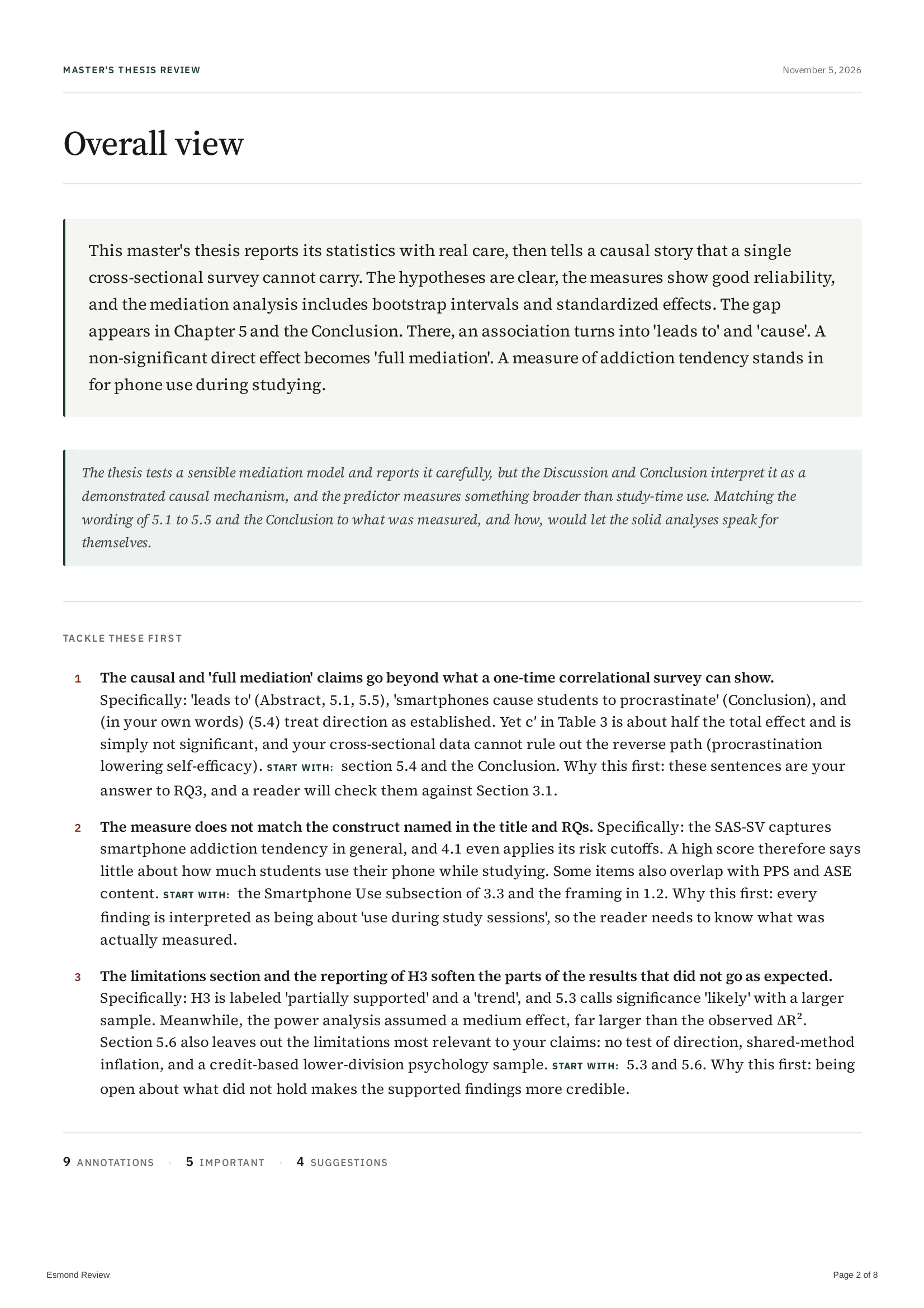
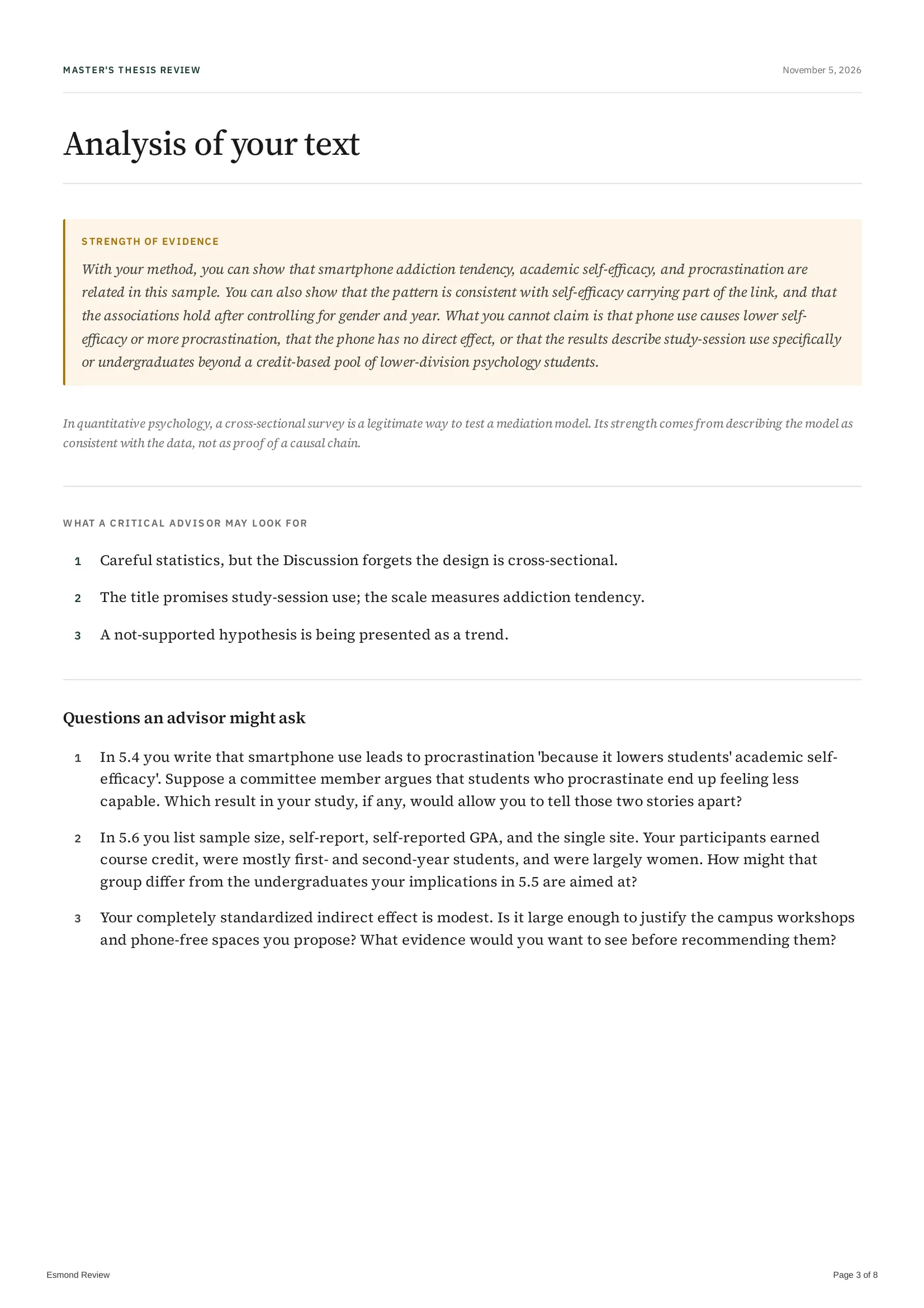
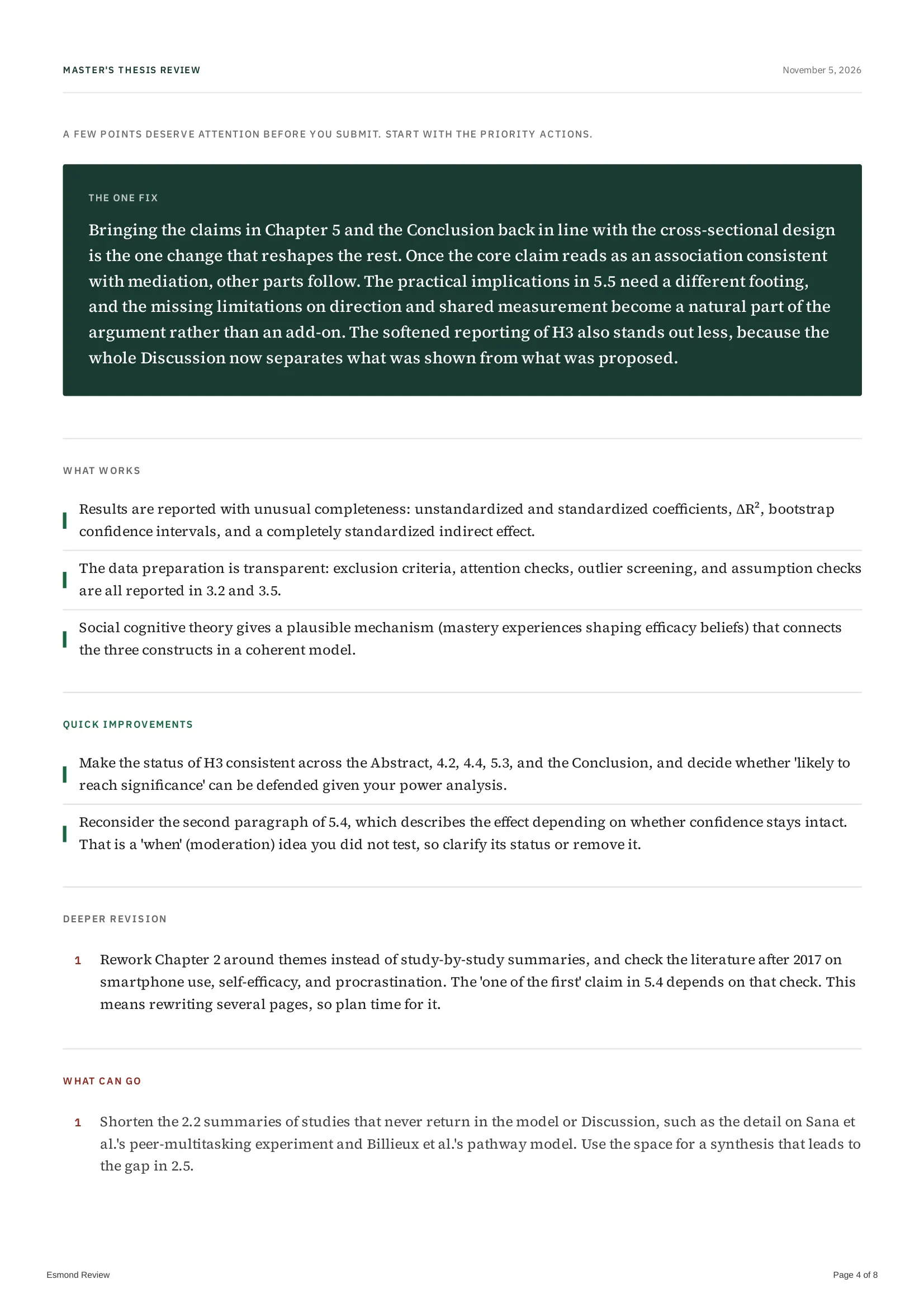
Ask your supervisor how the rule above applies to your thesis. If AI feedback on a draft is allowed, an online thesis review by Esmond comments on its content and adds no text to it.
The department applies the wider academic integrity policy to theses, and says the use of generative AI tools “is not permitted in thesis work unless explicitly allowed by the thesis supervisor”. Acceptable uses, if any, are to be discussed with the supervisor before use, in consultation with the Research Ethics Board and the wider department.
For a Psychology thesis at Acadia, that means permission comes first. Ask your thesis supervisor before you use Esmond or any other AI tool on thesis work, and keep the answer.
Even with permission, use stays limited: the department says an allowed tool is used in a limited capacity that supports learning. It adds: “Generative AI should never be used to create or replace any substantive portion of the thesis project (e.g., idea generation, research, writing, data generation, interpretation).”
| Use | What the department says | What to have ready |
|---|---|---|
| Guidance on sentence clarity | Named as a possible acceptable use, if your supervisor allows it | The supervisor's yes, with the tool named |
| Spelling and grammar checks | Named as a possible acceptable use | A note of which chapters you checked |
| Formatting reference lists | Named as a possible acceptable use | Each entry compared with the source itself |
| Ideas, research, text, data, interpretation | Never to create or replace a substantive portion | Your own record of how each part was produced |
| Any other use | Discuss with the supervisor first, with the REB and department in mind | A written answer before you start |
The department's disclosure rule: “Students must declare if Generative AI was used in the acknowledgements section of their thesis.” The declaration names the tools and the context in which you used them, and adds a statement of personal responsibility for the accuracy of the information.
The page gives two sample sentences: one for a thesis that used a tool on grammar and sentence structure, and one for a thesis that used none. The rule asks for a declaration when generative AI was used; whether to add the second line is a question for your supervisor.
Thesis projects are high-value works meant to show the abilities of strong students. Research with human participants is held to the standards of Acadia's Research Ethics Board and the Canadian Psychological Association's Code of Ethics. The finished theses are shared publicly through the thesis repository, so they reflect on the student, the supervisor and the university.
On that basis, any academic integrity violation in a thesis, misuse of generative AI included, is treated as a serious offense.
Start with your own department's pages and your supervisor. The other unit rules we found are for course work: Law and Society requires the course instructor's explicit permission, the Jodrey School of Computer Science treats AI-generated work as plagiarism unless the syllabus or assignment allows it, and History and Classics leaves the choice to each instructor. A course rule does not settle a thesis question unless it says so. If your department says nothing about theses, ask your supervisor before you use any AI tool on the thesis and agree on how you will declare it.
Hypothetical example, psychology. An undergraduate's thesis supervisor allows a grammar check on the discussion chapter. The student also runs the methods chapter through the tool and accepts its reordering of two paragraphs. The acknowledgments mention grammar only. The supervisor asks: was the methods chapter part of what I allowed?
Hypothetical example, biology. A master's student who finds no department text on AI in theses uses an AI tool to suggest search terms for a review of invasive plant studies. Nobody asked about it, and the thesis is silent. Her supervisor asks at the draft stage: how did you build the search, and should the tool be mentioned?
Hypothetical example, education. A master's student in education asks a tool to format sixty references in APA style. Three entries end up with wrong page ranges. His committee asks: did you compare each formatted entry with the source?
We found no university-wide rule on November 12, 2026. The History and Classics department says there is currently no explicit or overarching policy on AI tools at Acadia. The Psychology department has a rule for undergraduate and master's theses.
Only if your thesis supervisor explicitly allows it. Allowed uses stay limited, a tool may never create or replace a substantive part of the thesis, and you declare the use in the acknowledgments.
In the acknowledgments section, naming the tools and the context of use, with a statement that you take responsibility for the accuracy of the content.
Yes. Its thesis section is headed Undergraduate or Master's.
Esmond evaluates every assignment before you submit. It never writes it.
Esmond is an AI tool that doesn't write for you. If your course doesn't allow any AI tools, don't use Esmond for that work. If you're unsure, ask your instructor or advisor.
Esmond is a review of your own draft before you submit it: it evaluates the text and points out factual errors, inconsistencies, and blind spots, and you keep the pen. See how Esmond works and a sample report. In Psychology, generative AI is not permitted in thesis work unless your thesis supervisor explicitly allows it, so ask first, and if you go ahead, declare the use in the acknowledgments with the context. In other departments, ask your supervisor as well. Acadia University has not reviewed or approved Esmond.
Read on November 12, 2026.
We last checked the passages quoted on this page against their sources on . Acadia University is one of the universities in the AI policy tracker.
Last revised
Get your paper evaluated before you submit