Abstract
A psychology honours thesis in the Canadian guides quoted here is one empirical study over fall and winter, reported in APA style. Ethics clearance comes before the first participant. A second reader or reviewer assesses the final thesis at Waterloo, Western, and uOttawa. Honours readers expect the student's own contribution to a lab study to be visible and claims sized to a small sample.
For psychology students in a Canadian honours program who are planning the thesis year or have a draft in progress. This page follows the year as departments run it: finding a supervisor, the proposal, ethics approval, data collection, the poster, and the final APA report, with what the supervisor and second reader check at each point. Guides from Waterloo, uOttawa, Carleton, Western, Mount Royal, and Windsor are quoted. For section-by-section detail, it links to the chapter pages.
In short
The psychology thesis page covers the APA research report in general. The honours version has the same sections and adds conditions of its own: one academic year, a supervisor who often runs the lab where the study happens, a participant pool or an existing dataset, and a second reader who meets the work late. Carleton's Department of Psychology describes the thesis option this way: “With the mentorship of a faculty supervisor, students conduct a project of research.” The department adds that students review the literature, contribute to the design of a study or experiment, run the data analysis, and produce an APA-style report.
The word "contribute" matters. In an honours thesis the study is often part of a larger project, and the reader wants to see where your part starts. Mount Royal University's handbook sets the type of project: “The thesis project is to be empirical in nature and involves the collection of psychological data.” The same handbook rules out a purely theoretical paper or a literature review as the thesis, and lists experimental, correlational, and archival data collection and meta-analysis as possible designs.
The dates differ, the sequence is similar. The table combines what the guides quoted here set out; your department's calendar decides the actual deadlines.
| When | What happens | What the reader checks at that point |
|---|---|---|
| Winter to spring before the thesis year | Application and supervisor search: Carleton matches students and supervisors by late April; uOttawa sets September 15 as the last day to name a supervisor | Whether your interests fit an active lab |
| September to October | Literature, question, design; ethics training and application; a progress report or progress talk (uOttawa in October) | A testable hypothesis and a design that can be run in the time left |
| October to December | Proposal with planned participants, design, and statistical tests; at Waterloo, presented orally to supervisor and reviewer in the PSYCH 499B term | Whether the planned test answers the hypothesis, and whether the sample is realistic |
| January to February | Data collection; draft introduction and method (uOttawa asks for both in January) | Whether the method draft matches what was approved |
| March | Poster or conference talk: Western's poster session on March 19, 2027; uOttawa's honours thesis conference in mid-March | Whether you can state the finding and its limits in a few sentences |
| April | Final thesis: Western's deadline is April 7, 2027; uOttawa's final report is due in April | The whole report, read by the supervisor and the second reader |
Three roles recur. The supervisor guides the work and, in most programs quoted here, also assesses it. A second reader or reviewer reads it from outside the project. At Western, the supervisor and a second reader each assess the written thesis and the poster, and their results are averaged: “The second reader (selected by the honours thesis coordinator) is usually familiar with the general topic domain of the thesis.” At Waterloo, the student picks a thesis reviewer with the supervisor's advice; the reviewer reads the proposal, runs the oral presentation, reads the final thesis, and sets the final result after the supervisor's recommendation. The supervisor cannot be the reviewer.
At uOttawa, according to the department's information session, the supervisor and a second professor each propose an assessment and the coordinators decide. At Carleton, the advisor sends the course instructor a suggested result with a short justification, and the instructor reads the thesis and decides. In each case, someone who did not see the study grow reads the final text, so the report has to stand on its own.
Research ethics boards (REBs) review studies with human participants under the Tri-Council Policy Statement (TCPS 2), so the application has to fit into the first term. Waterloo's handbook is direct about the order: “Research involving human or animal participants must not begin until notification of full ethics clearance has been provided by the ORE.” Waterloo also requires the TCPS 2 CORE tutorial before an application naming the student goes in, and asks for a copy of the clearance notification with the final thesis. Western asks for a signed Research Ethics Status Form in October of the thesis year.
Not every honours study collects new data. Western's outline: “Some honours thesis projects may involve the collection of original data whereas other projects may draw from existing data sets that may be available from the student’s supervisor.” With an existing dataset, the method section should say who collected it, under which approval, and what you did: new hypotheses, recoding, the analysis. Mount Royal adds a rule for later use: “Typically, presentations or publications outside of MRU include the supervisor as a co-author unless the supervisor gives explicit written permission otherwise.”
An honours study runs on one term of data collection, often from a departmental participant pool. That limits the sample, and the sample limits what the study can detect. Power is the chance that a study finds an effect of a given size if it exists. With 40 participants per group, a two-group comparison at alpha .05 has 80% power only for effects of about d = 0.63 or larger. A smaller true effect will often come out non-significant.
A small sample is part of the honours format. What helps a reader is a clear account of what yours can and cannot show. Check what your guide and supervisor ask for; common advice is to report an effect size with a confidence interval for each hypothesis, say what effect size the design could detect, avoid reading a non-significant result as proof of no effect, and leave out subgroup comparisons the sample cannot carry. The psychology results section page goes through the reporting in detail, and the psychology methods section page covers how to justify the sample.
The sections follow APA. Waterloo's handbook notes that the thesis may be more abbreviated than a regular journal article; Western sets a minimum of 5,000 words. What changes at honours level is what the reader expects in each section:
| Section | What an honours reader looks for | More detail |
|---|---|---|
| Introduction | A short line of studies that leads to one or two hypotheses, without a full review of the field | Psychology introduction |
| Literature | Recent studies on your exact question, including those that found nothing | Psychology literature review |
| Method | Your own part in the study, the ethics approval, the planned test for each hypothesis, the sample size and why | Psychology methods section |
| Results | Each hypothesis tested in the order stated, reported as your guide asks (effect sizes where required); exploratory tests labeled | Psychology results section |
| Discussion | Claims sized to an honours sample; limitations specific to your design, not a generic list | Psychology discussion section |
| Poster | The same numbers and the same conclusion as the thesis | Your department's poster guidelines |
These fragments are made up. None of them comes from a real dissertation.
Your supervisor reads drafts; Waterloo's handbook says students normally get feedback on at least one or two drafts before the final submission. If you work in a lab, ask your supervisor whether lab members can answer analysis questions. The proposal presentation and the poster session are feedback points too: at Western, the poster session is also the moment to meet the second reader before the final thesis is assessed. Windsor advises students to start earlier: “Some faculty members expect to work with students prior to committing to supervising an honours thesis.” Thesis courses such as Carleton's PSYC 4907/4908 add classes on ethics, the participant pool, data screening in SPSS, and each section of the report.
Feedback on your own draft keeps the thesis yours; text or statistical work produced by someone else is not your own work. Rules on AI tools differ between departments and courses. Western's thesis outline allows some support uses and rules out others, and Carleton's Department of Psychology requires students in MA theses and dissertations to discuss any AI use with their thesis supervisor. Ask your supervisor before you use an AI tool on your thesis, and do not upload raw or identifiable participant data to any outside tool. See using AI for your thesis in Canada for more schools.
For the whole document, the thesis checklist before you submit adds the general checks.
In the Canadian departments quoted here, it is an empirical study carried out over the fall and winter terms under a faculty supervisor, reported as an APA-style research paper and assessed by the supervisor and a second reader or course instructor. Carleton's department advises students aiming at graduate programs in clinical or experimental psychology to assume they need one.
Several departments split the thesis into consecutive courses. At uOttawa, students are enrolled in two course codes (PSY 42761 and PSY 42762) for PSY 4276; at Waterloo, PSYCH 499A, B, and C cover the progress report, the proposal presentation, and the completed thesis. The first part covers the supervisor, the literature, the proposal, and ethics.
Ask your department or thesis course: Waterloo's handbook notes that sample honours theses are available in the course's online space. In an example, look at how the hypotheses are worded, how the method separates the student's part from the lab's, and how non-significant results are discussed.
All three run the thesis with a faculty supervisor and an APA-style report. Who decides differs: at uOttawa and Waterloo a second professor or reviewer reads the thesis, while at Carleton the course instructor reads it and decides after the advisor's suggestion. Application routes differ too: Carleton matches students and supervisors through an online application, uOttawa requires a supervisor by September 15, and Waterloo enrolls students in PSYCH 499A, B, and C. For other departments, such as Guelph, check their own pages.
At Carleton, generally not: the department says you should expect to complete the thesis during the fall and winter terms. Other departments set their own terms.
Your supervisor and often lab members read drafts, and the proposal presentation and poster session give feedback from the second reader. For outside or AI feedback, ask your supervisor first. Esmond reads a draft you upload and comments on it without adding text or running statistics.
Esmond evaluates every assignment before you submit. It never writes it.
Esmond is an AI tool that doesn't write for you. If your course doesn't allow any AI tools, don't use Esmond for that work. If you're unsure, ask your instructor or advisor.
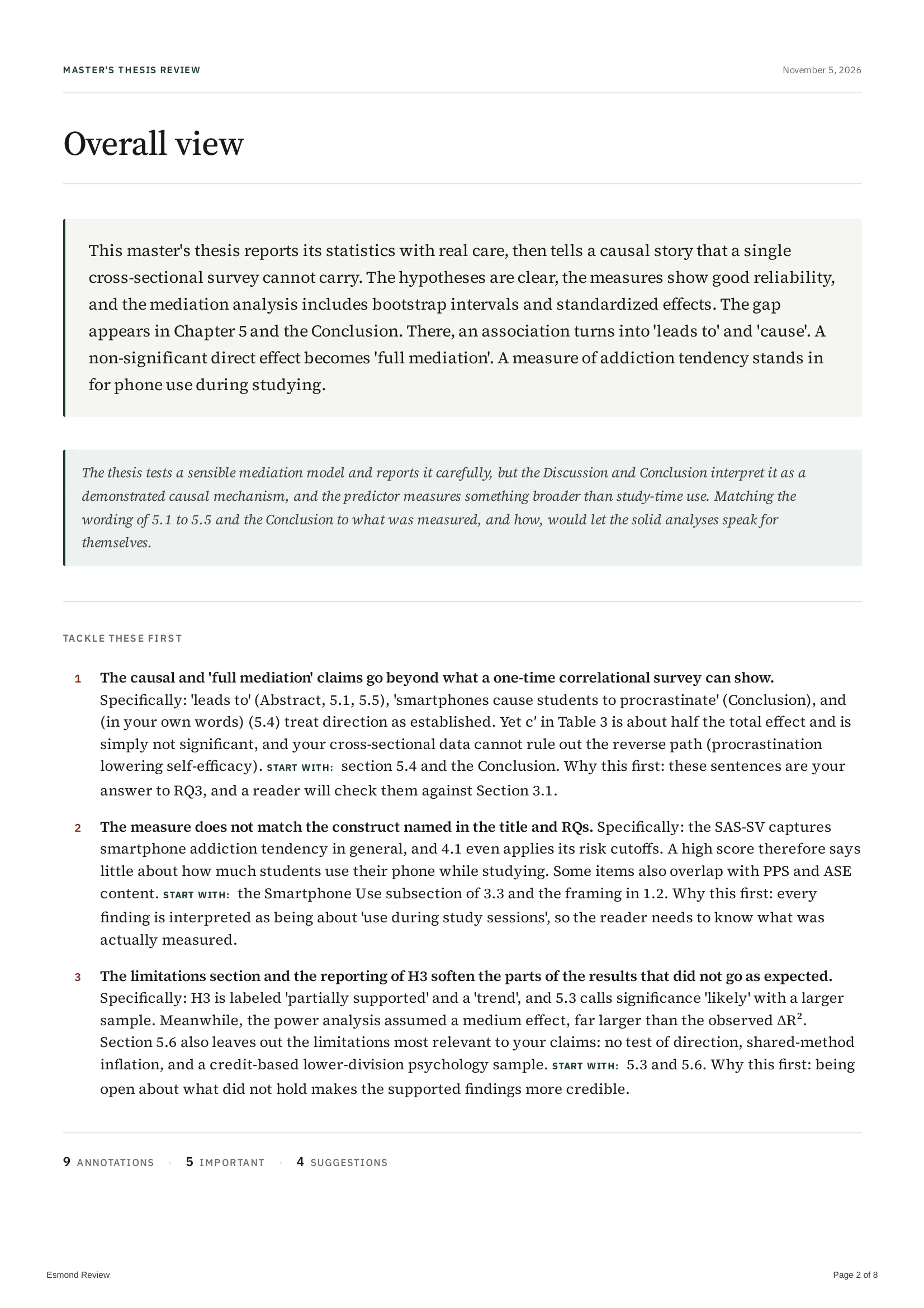
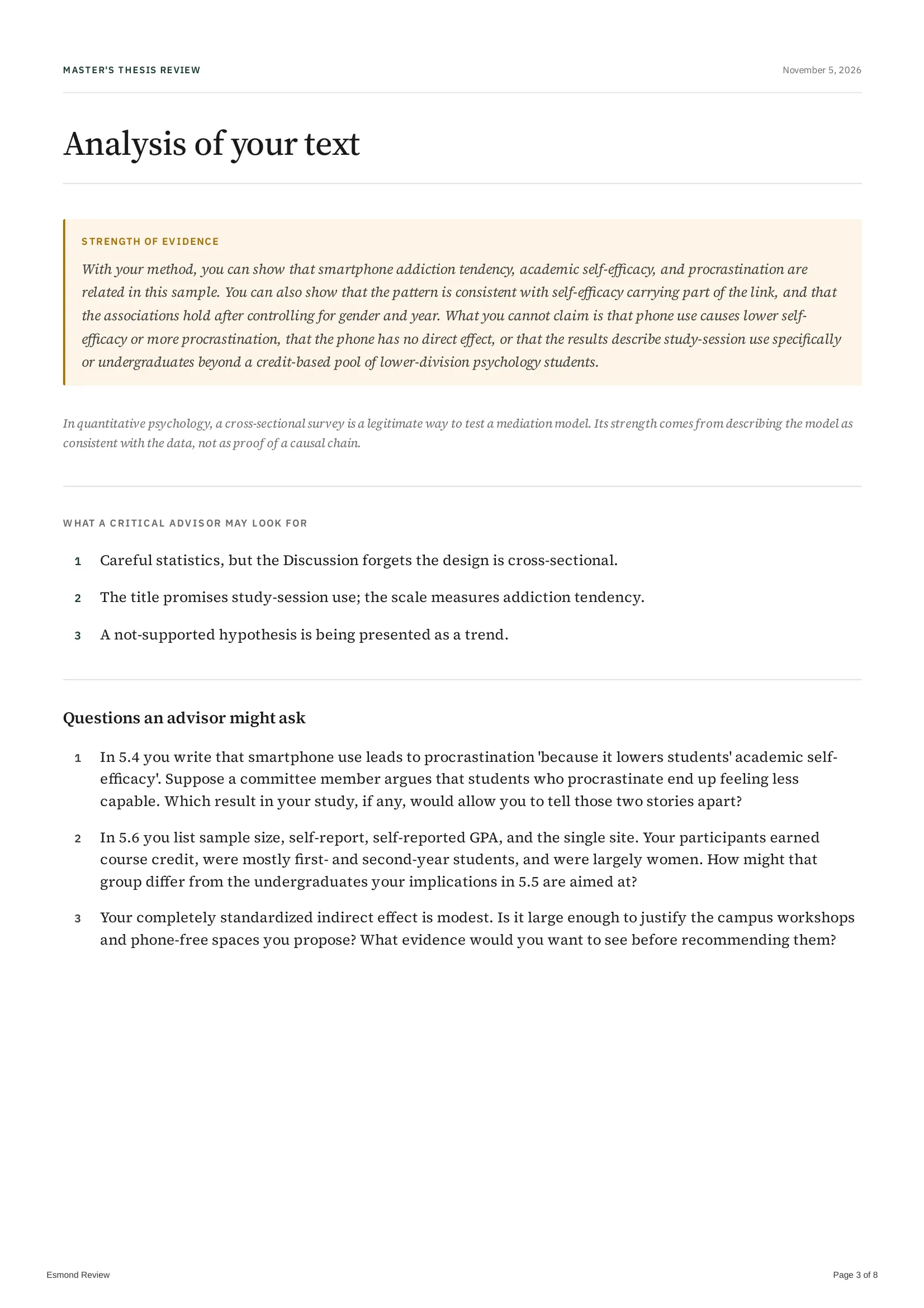
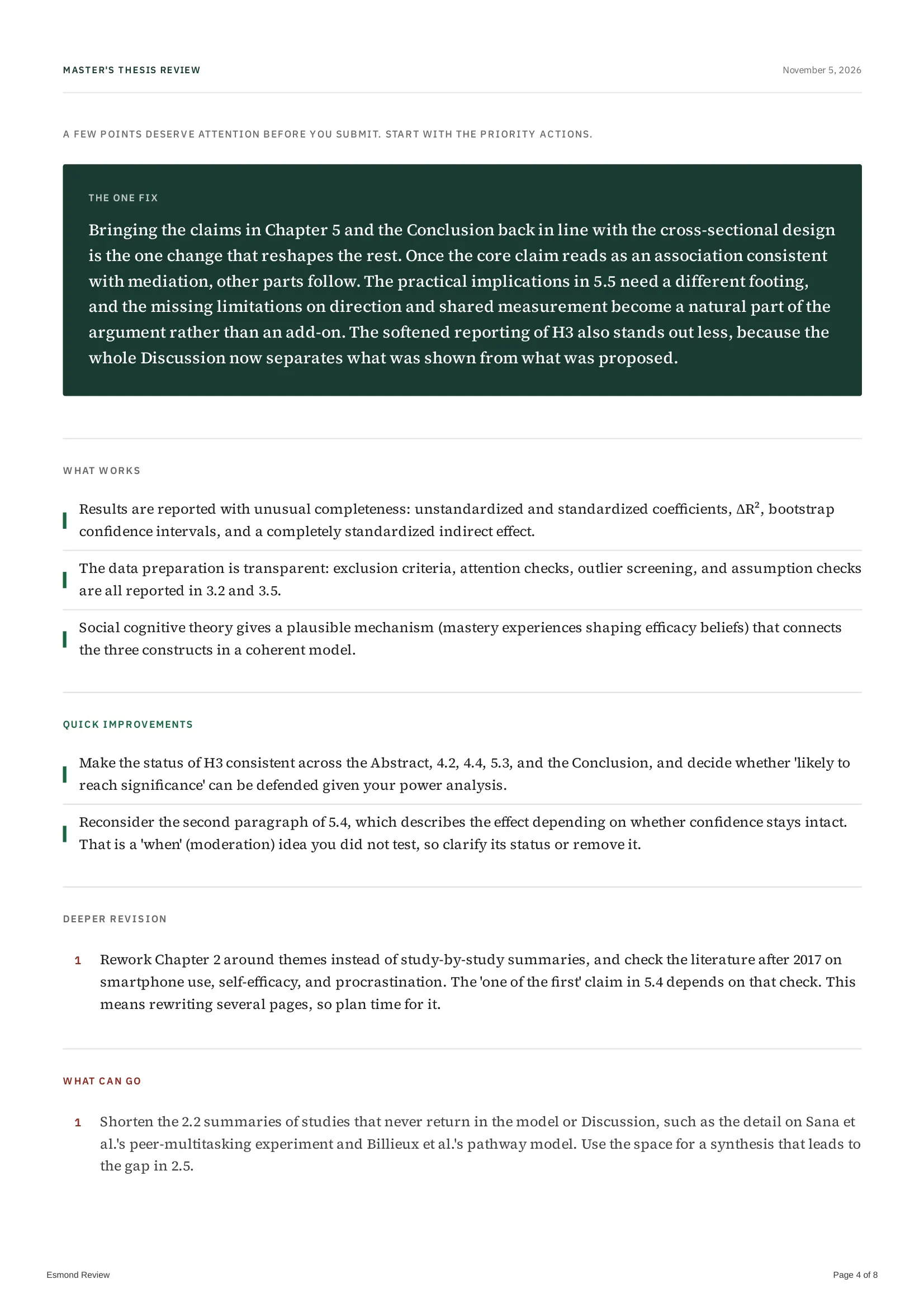
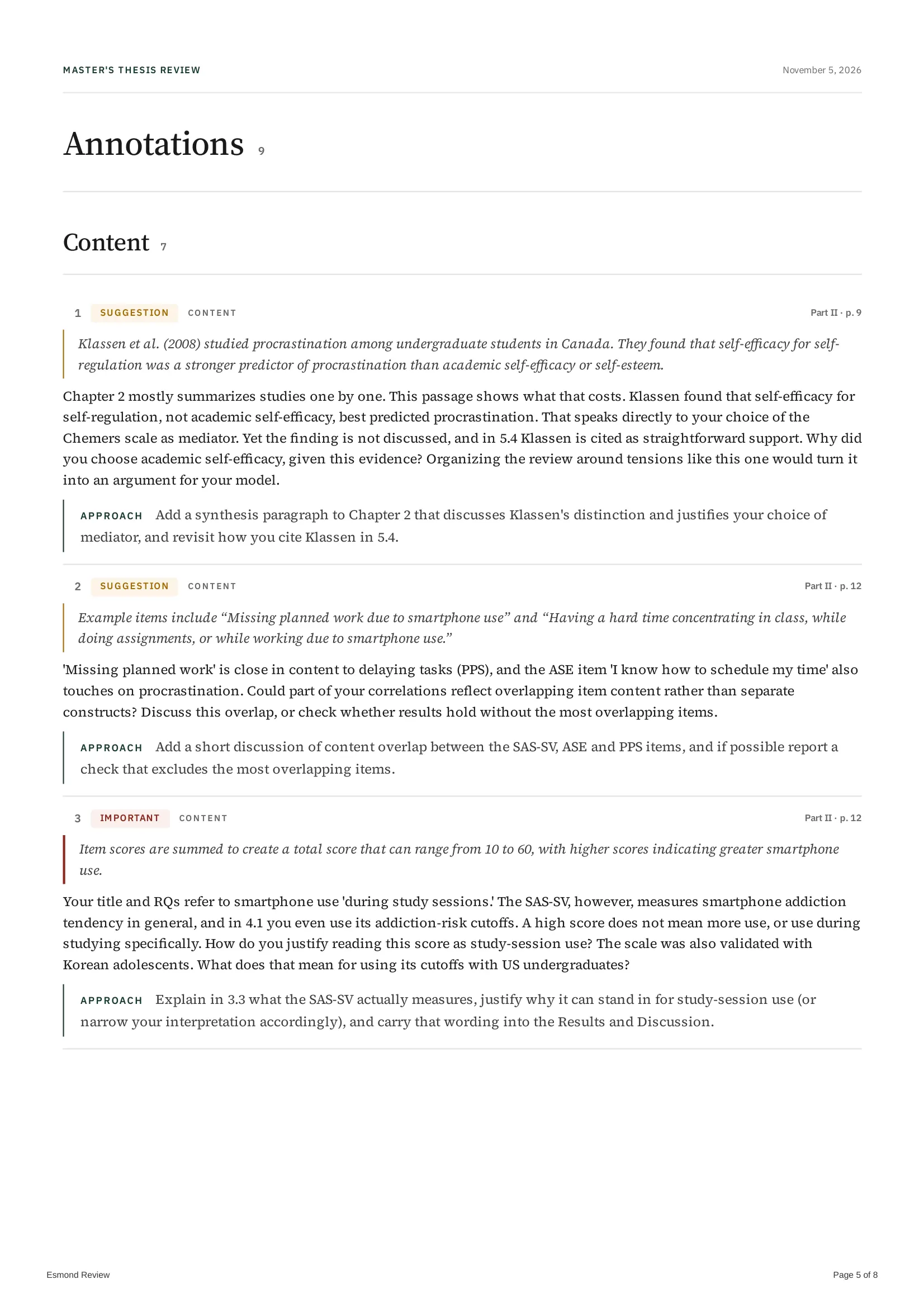
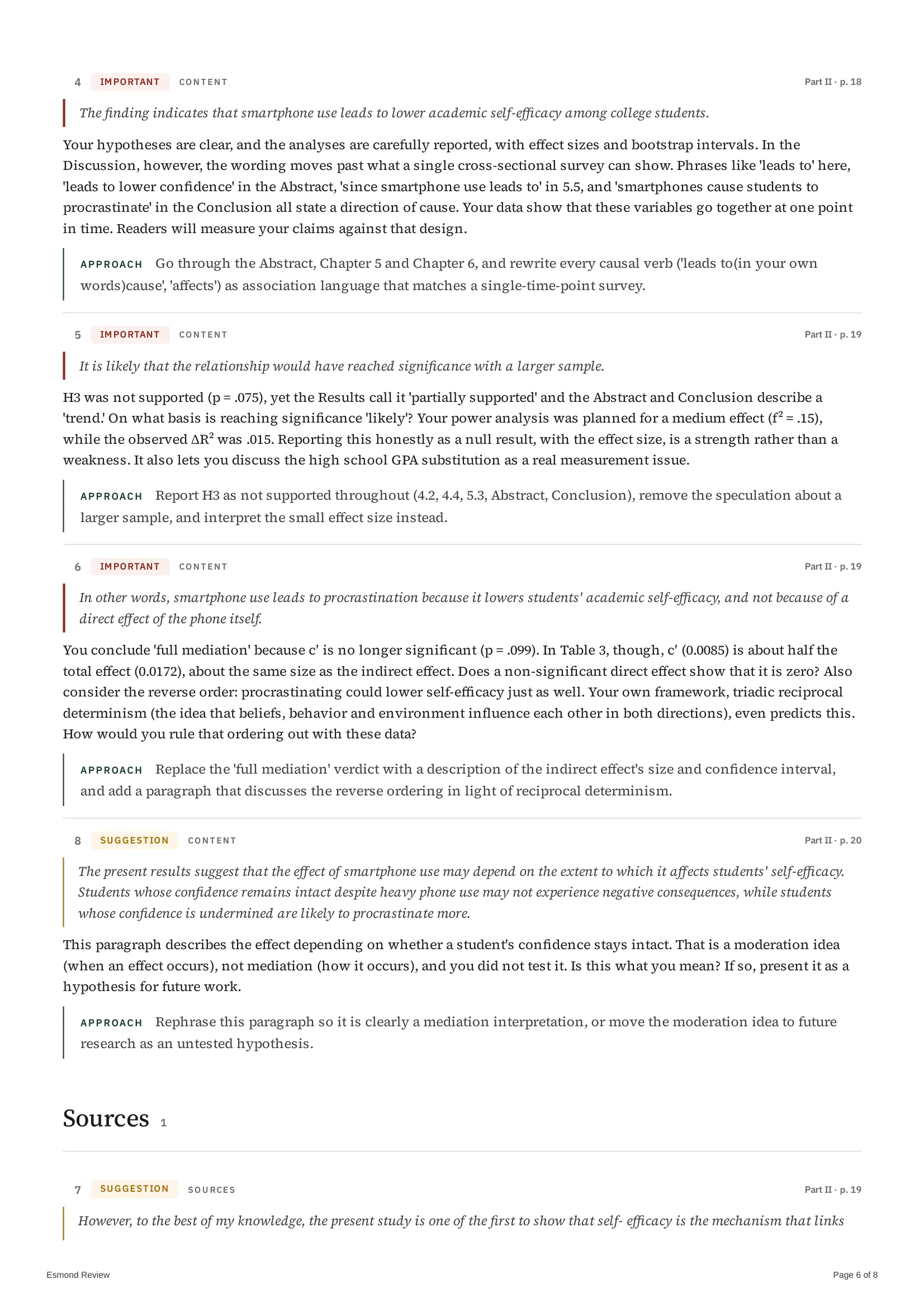
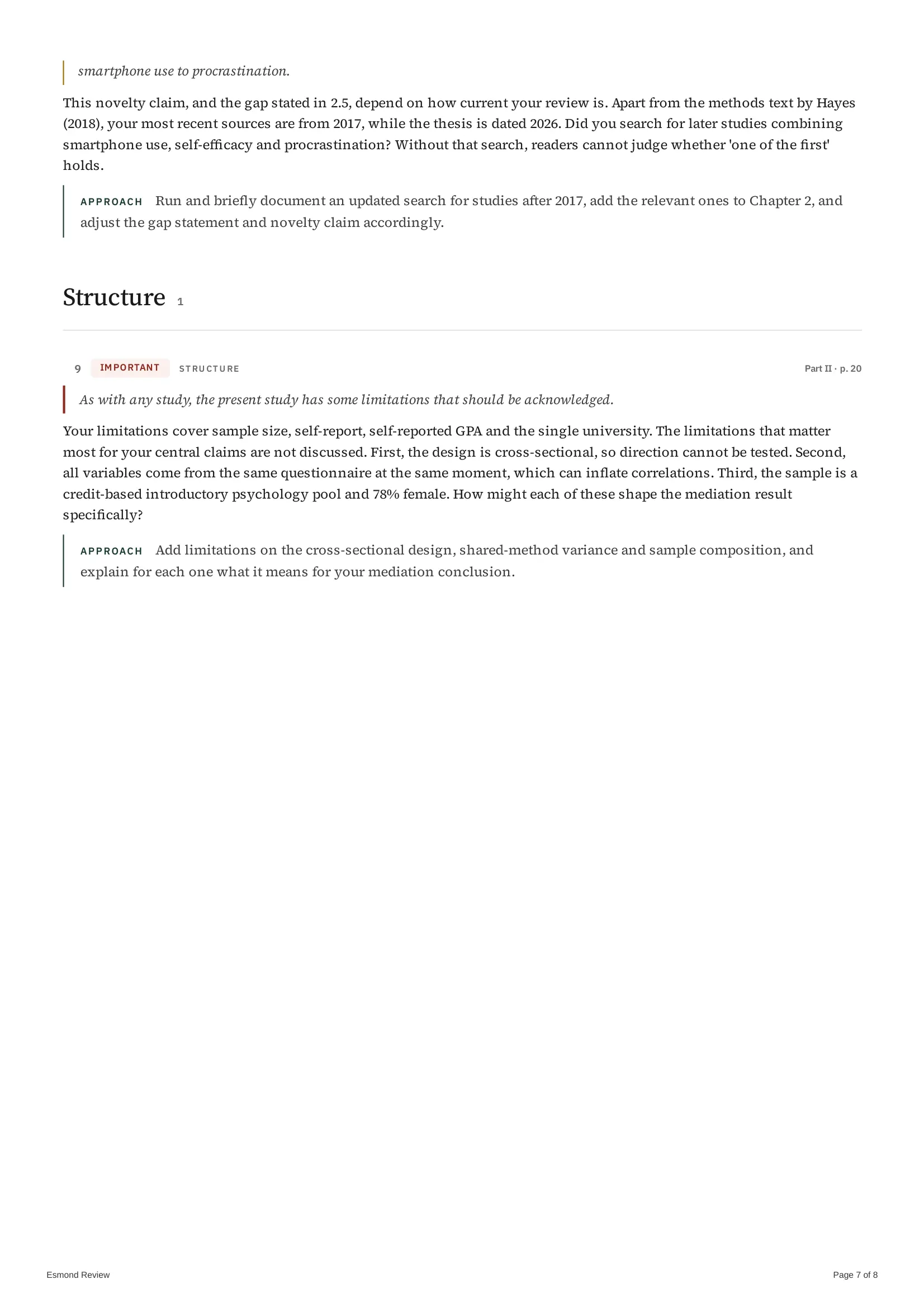
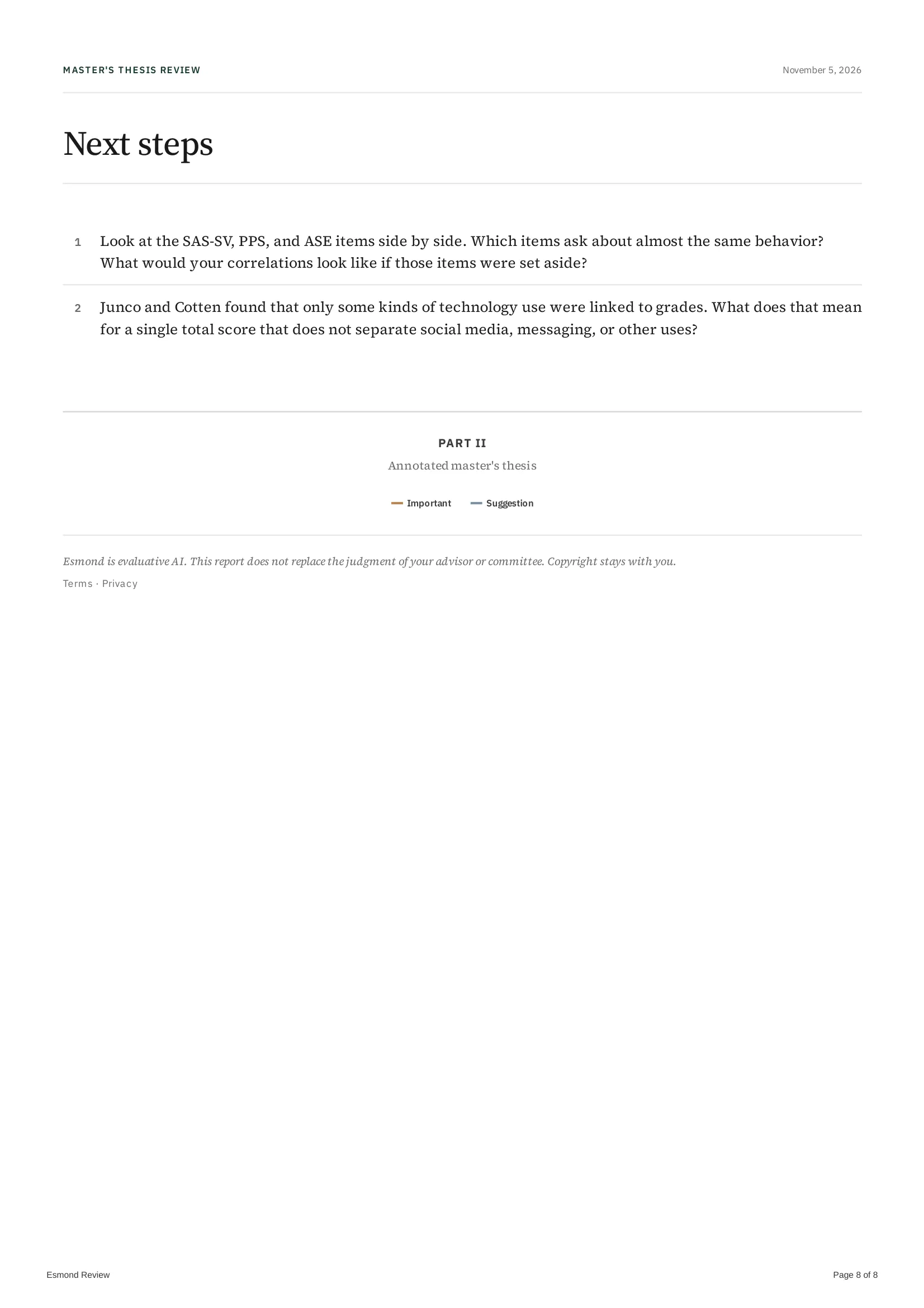
Esmond reads your psychology honours thesis draft. It can flag, in the text you upload, a hypothesis without a matching test, sample sizes that change between sections, a non-significant result described as proof of no effect, a discussion that generalizes beyond the sample, or a method section that leaves your own contribution unclear. See the sample report for the format and how Esmond works for the steps.
Upload the whole draft if you can: Esmond then reads the chapters against each other, for example whether the conclusion answers the question the introduction asked. A single chapter gets a review of that chapter only.
Esmond does not rerun your statistics, open your data, or check your ethics approval or your department's template. Upload the thesis text, not participant data. You decide what to change.
Read on November 21, 2026.
Last revised
Get your paper evaluated before you submit