Abstract
A computer science honours project at Carleton is a one-term project ending in a report and, for software, a demonstration; the honours thesis runs two terms with a proposal and oral presentation. UCT's 2016 assessment document required a paper of at most ten pages in ACM format. Readers check that every performance claim rests on a described, repeatable test against a baseline.
For computer science students in the final year of an honours bachelor's in Canada, or in the one-year postgraduate honours degree in South Africa, who are scoping a project or finishing the report. This page covers the choice between an honours project and an honours thesis, the proposal, how the report is built for development, experimental, and theoretical projects, and what a supervisor, a second reader, or a presentation panel looks for. Guides from Carleton, uOttawa, and the University of Cape Town are quoted.
In short
An honours project in computer science is a supervised piece of independent work in the final year of an honours bachelor's in Canada, or in the one-year postgraduate honours degree in South Africa: a system, a prototype, an experiment, or an algorithm, plus a report that explains it to someone who was not there. Carleton's School of Computer Science lists the usual forms as a software system or framework, an implementation or prototype of an application, an experimental comparison of similar algorithms, or the design and analysis of a new algorithm, and adds: “The project may not solely be a survey-based investigation of previous work done in an area of computer science”.
At the University of Ottawa, the honours project course CSI4900 is a team format: “Projects must be done in teams of 1-3 people.” In the University of Cape Town's 2016 assessment document, the honours project ended in a short research paper. This page is about that honours year. For a master's or bachelor's dissertation in computer science, see computer science dissertation; for the project report in Indian, Pakistani, and Nigerian engineering and computing degrees, see the FYP report page.
Some departments offer two formats. At Carleton, COMP 4905 (Honours Project, half a credit) fits in one term, while COMP 4906 (Honours Thesis, a full credit) runs from fall to winter. The School describes the thesis this way: “An Honours Thesis allows you to prepare for graduate school in that it is structured like a Masters Thesis (i.e., proposal, thesis and oral presentation).” The first term goes to research and planning, and a supervisor can stop the thesis if the proposal does not pass. Since Fall 2022, both are optional in Carleton's BCS Honours programs, replaceable by 4000-level courses.
The report changes with the format. A project report documents what was built, how it was tested, and what works. A research thesis or research paper starts from a question, positions it against related work, and reports an experiment or analysis that answers it. UCT's 2016 document set a strict form for the paper: “The project paper must conform to the Association for Computing Machinery (ACM) proceedings format.” and “Papers are to be a maximum of ten pages in the ACM proceedings format, excluding references.” Supporting material that does not fit in ten pages, such as software design artifacts, went on a project website.
Carleton's guidance on the proposal: “The proposal is usually a two-page document that defines the scope and schedule of the project.” It covers the motivation, the main objectives, equipment needs, what will be implemented, what will be tested, and what analysis will be done on the results, with a bi-weekly schedule of milestones. Two points from the same page shape the final assessment. If you start from existing software or a framework, the proposal must say which part is yours. And features you list as planned are the ones you will be assessed on, so separate firm features from ones you may add if time allows.
A reader of the final report compares it with the proposal. Features that were dropped need a reason; a schedule that slipped needs an account of what took longer and why. The master's thesis proposal page shows the longer version of the same logic.
Carleton's report outline runs from title page, abstract (problem, approach, results, and conclusion in at most 200 words), and table of contents through the main text to references and appendices, with a suggested length of 30 to 40 pages plus an appendix for code and extra data. The main text has to cover motivation, methodology, and results, and the last chapter is direct about its job: “Finally, the report should conclude with a frank appraisal of the achievements, relating these to the project/thesis goals, and suggestions for further work.” What the middle chapters contain depends on the type of project. UCT's 2016 scheme weighted the same categories differently for development, experimental, and theoretical projects; the table follows that split.
| Part | Development project | Experimental project | What readers look for in it |
|---|---|---|---|
| Introduction | Problem, users, objectives | Question or hypothesis, objectives | Objectives that can be checked at the end |
| Background and related work | Existing tools and why they fall short | Prior experiments and their results | Your contribution placed against the closest alternatives |
| Design or method | Requirements, architecture, design decisions with reasons | Experimental setup, data sets, metrics, baselines | Choices justified, including approaches you tried and dropped |
| Implementation | What was built, with which tools, and what was reused | The test setup and the code used for the experiment | A clear line between your code and libraries or prior code |
| Evaluation or results | Testing against requirements, user testing if any | Results per hypothesis, variance across runs | Evidence for each claim, described well enough to repeat |
| Conclusion | What works, what does not, what is missing | What the results show and do not show | An honest appraisal tied to the objectives from the introduction |
Evaluation carries the claims of the report. UCT's 2016 assessment questions for quantitative work included whether there is a well-formulated hypothesis, whether the experiments were designed to confirm or refute it, and “Is the work reported in such a way that the results can be replicated?” The same document expected ethical issues to be discussed and clearance obtained where needed, for example in user studies. A performance claim needs a baseline, the number of runs, the hardware, and the variation between runs; a usability claim needs participants, tasks, and the measure used.
The report is read by people who did not follow the work. Carleton's FAQ says the supervisor knows the effort that went in, but others may meet the project only through the report, so the report should be aimed at those readers. It names the usual failure: “A common pitfall, when a project involves coding, is for the project report to become little more than code documentation.” For software, Carleton expects a demonstration to the supervisor; in UCT's 2016 document, the supervisor and second reader also viewed a demonstration. At uOttawa, each team gives a 15-minute presentation assessed by an assigned professor, and the report contents are agreed with the project supervisor.
These fragments are made up. None of them comes from a real dissertation.
Your supervisor is the main source: Carleton asks students to keep the supervisor informed through the term with test results, screenshots, video clips, or demonstrations, and to send a draft of the report at least a week before the deadline. At UCT in 2016, a full draft went to the supervisor ten days before the paper deadline. Lab mates or teammates can test your system, the writing center can read the report for clarity, and the library can help with related-work searches.
Feedback on your own report and code keeps the project yours; code or text produced by someone else, a person or a tool, is not your own work unless your course allows it and you declare it. Rules on AI tools, including coding assistants, are set by your department and course. Ask your supervisor before you use any AI tool on the report or code, and do not upload code or data you have no right to share. Can I get AI feedback on my thesis? covers the general question.
The citation checker compares your reference list with your in-text citations.
A supervised project in the honours year (the last bachelor's year in Canada, a one-year postgraduate degree in South Africa): a system, prototype, experiment, or algorithm, with a report and often a demonstration. At Carleton it is a one-term course (COMP 4905), with a two-term honours thesis (COMP 4906) as the alternative; at uOttawa (CSI4900) it can be done in teams of up to three.
A project report documents what you built and how it was tested. A research project or thesis starts from a question, compares with related work, and reports an experiment or analysis that answers it, as in the ten-page ACM paper of UCT's 2016 assessment document or Carleton's two-term honours thesis.
Carleton suggests 30 to 40 pages plus an appendix with code and extra data; UCT's 2016 document set a maximum of ten pages in ACM proceedings format, excluding references. uOttawa's CSI4900 leaves the content to be agreed with the supervisor.
Your department's own archive is the best guide: Carleton's School of Computer Science FAQ describes an online repository of past honours projects and theses that shows their titles and abstracts publicly. Look at how narrow the objectives are and how the evaluation is set up.
Yes, from your supervisor first, who often expects a draft before the deadline. For outside or AI feedback, ask your supervisor. Esmond reads a report you upload and comments on it without adding text or code.
Esmond evaluates every assignment before you submit. It never writes it.
Esmond is an AI tool that doesn't write for you. If your course doesn't allow any AI tools, don't use Esmond for that work. If you're unsure, ask your instructor or advisor.
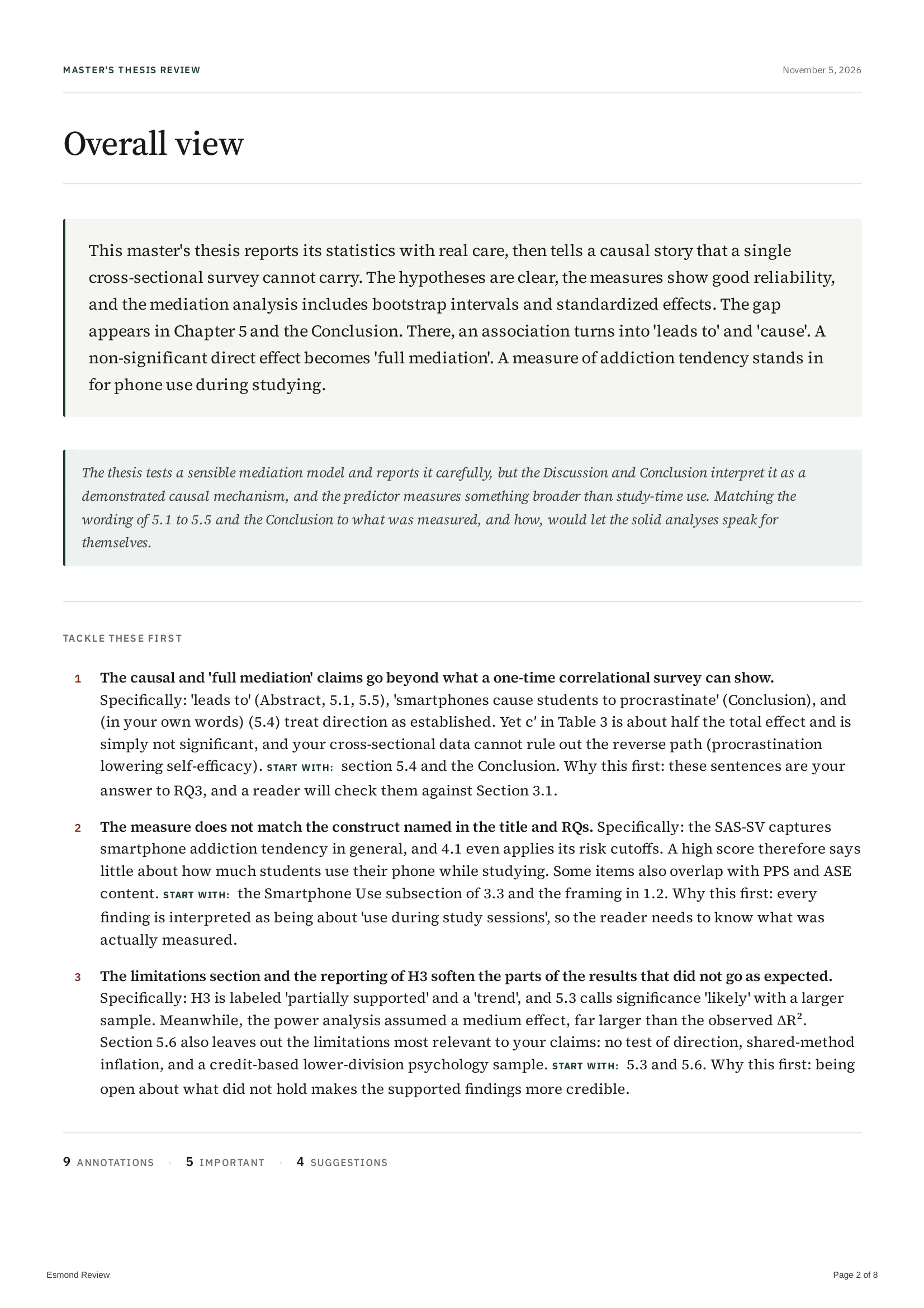
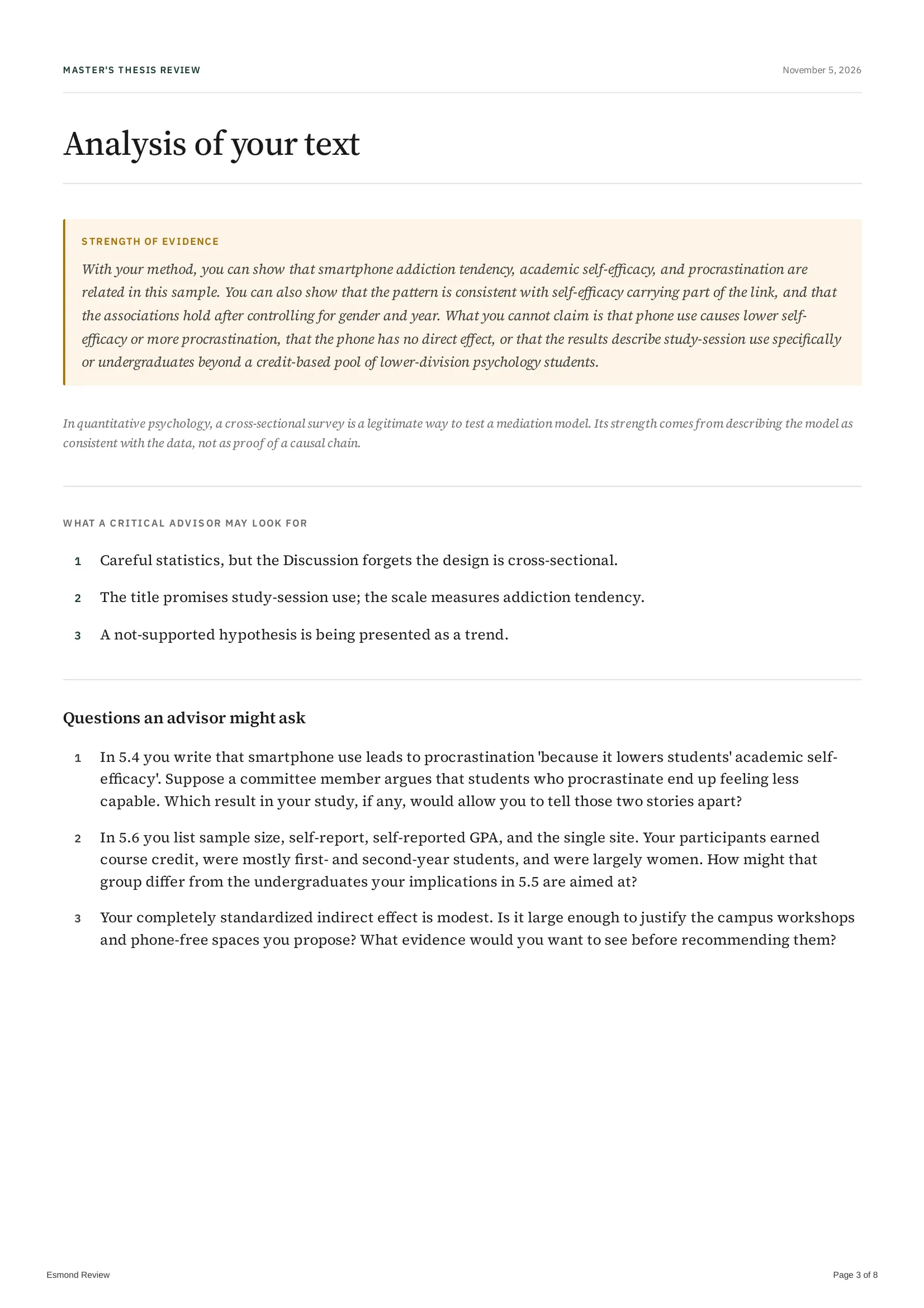
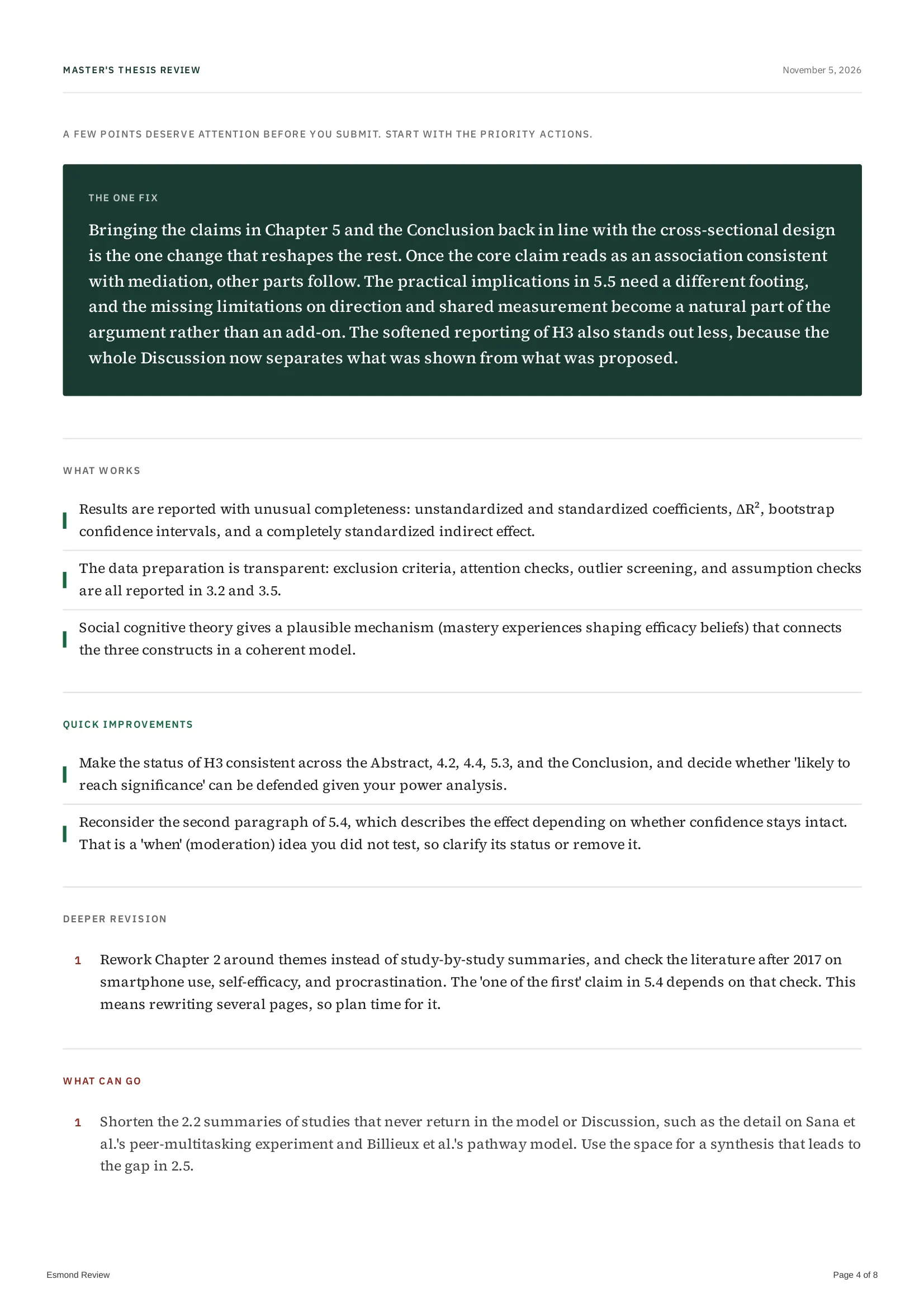
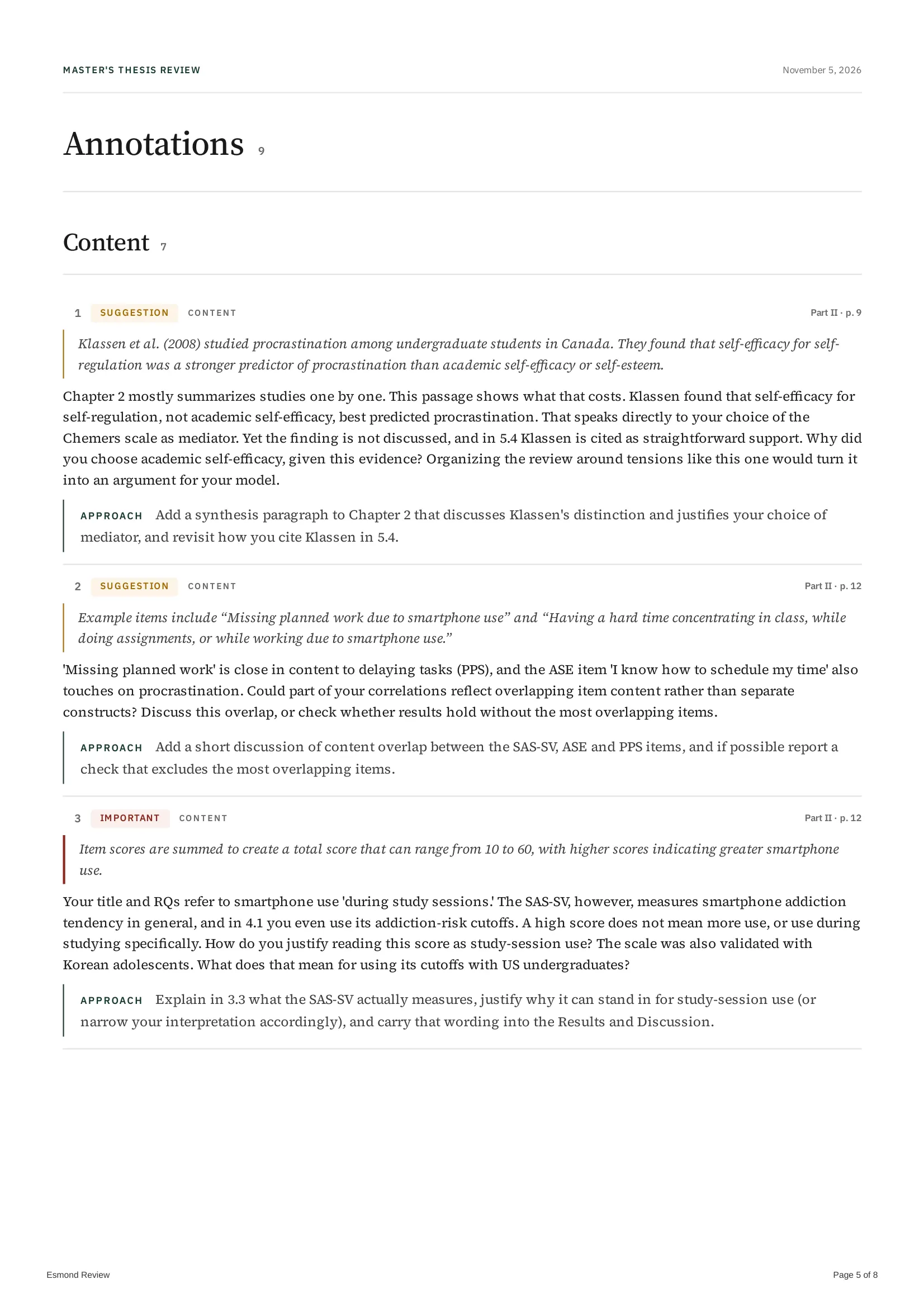
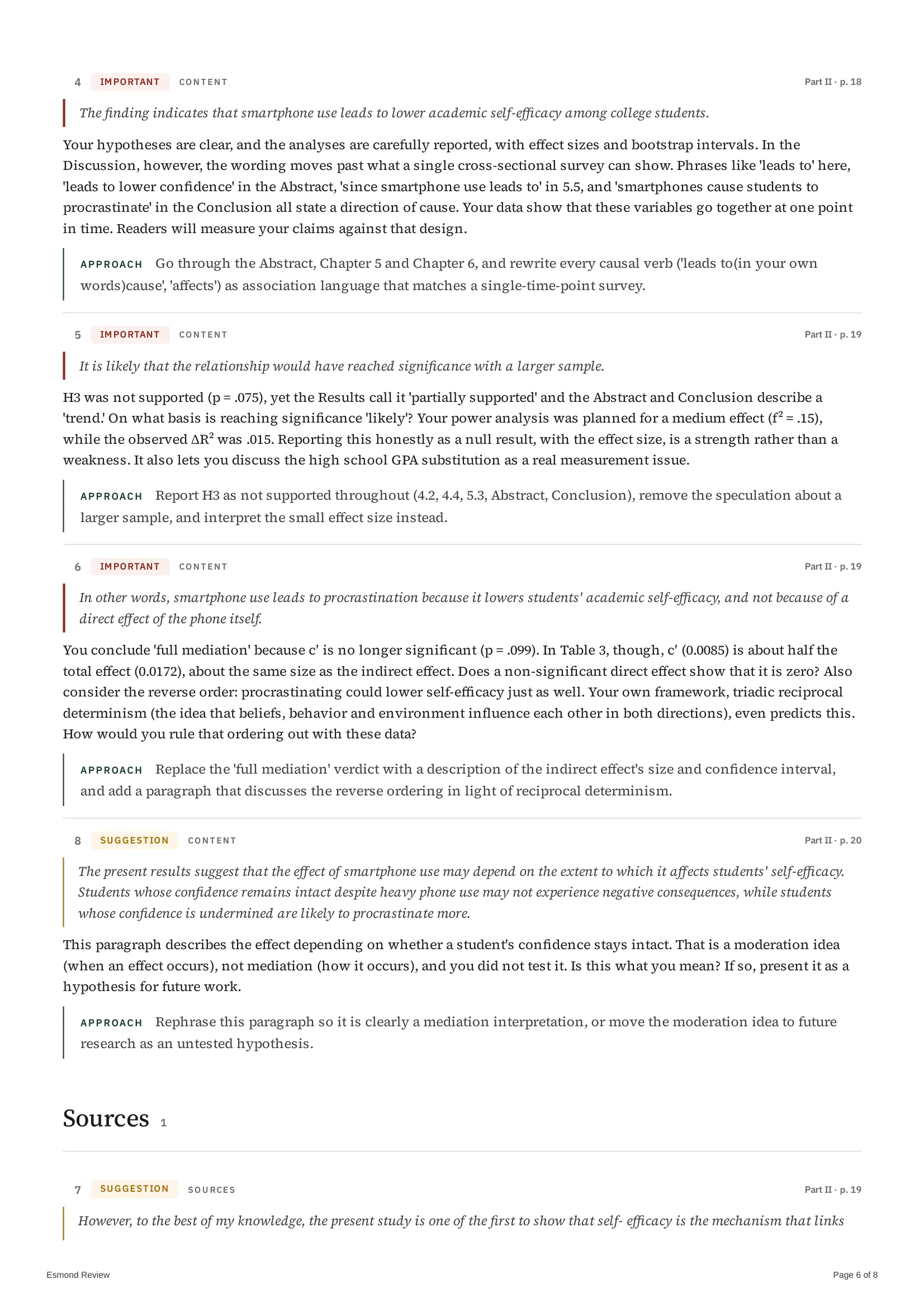
Esmond reads the report of your honours project. It can flag, in the text you upload, objectives that the evaluation never tests, performance claims without a baseline or setup, results that differ between abstract and results chapter, related work that is listed but not compared, and a conclusion that claims more than the tests show. The sample report shows the format, and how Esmond works describes the steps.
Upload the whole draft if you can: Esmond then reads the chapters against each other, for example whether the conclusion answers the question the introduction asked. A single chapter gets a review of that chapter only.
Esmond does not run, test, or review your code, does not check the ACM or department template, and does not open your repository. You decide what to change.
Read on November 21, 2026.
Last revised
Get your paper evaluated before you submit